

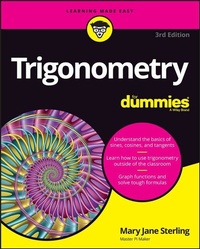
Trigonometry For Dummies
Description

Believe it or not, trigonometry is easier than it looks! With the right help, you can breeze through your next trig class, test, or exam and be ready for your next math challenge. In Trigonometry For Dummies, you'll learn to understand the basics of sines, cosines, and tangents, graph functions, solve tough formulas, and even discover how to use trig outside the classroom in some cool and interesting ways.
Ditch the confusing jargon and take a plain-English tour of one of the most useful disciplines in math. In this lifesaving guide, you'll learn how to:
* Graph trig functions, including sine, cosine, tangent, and cotangent functions
* Understand inverse trig functions and solve trig equations
* Relate triangles to circular functions and get a handle on basic identities
So, whether you're looking for an easy-to-use study guide, to boost your math grade, or get a refresher on some basic trig concepts after a long absence from studying, Trigonometry For Dummies is your ticket to understanding the mathematical mysteries of the triangle.
More details
Other editions
Additional editions
Person
Mary Jane Sterling is the author of Algebra I For Dummies, Pre-Calculus Workbook For Dummies, Algebra II For Dummies, and oodles of other Dummies titles. She was a Professor of Mathematics at Bradley University in Peoria, Illinois, for more than 35 years, teaching algebra, business calculus, geometry, and finite mathematics.
Content
Part 1: Getting Started with Trigonometry 5
Chapter 1: Taking On Trig Technicalities 7
Chapter 2: Cooperating with Cartesian Coordinates 31
Chapter 3: Finding Degrees in Triangles and Planes 51
Chapter 4: Dishing Out the Pi: Radians 63
Chapter 5: Tackling Right Triangles 77
Part 2: Trigonometric Functions 89
Chapter 6: Describing Trig Functions 91
Chapter 7: Relating Triangles to Circular Functions 107
Chapter 8: Taking Trig Functions Global 123
Chapter 9: Applying Yourself to Trig Functions 139
Part 3: Identities 159
Chapter 10: Introducing Basic Identities 161
Chapter 11: Operating on Identities 177
Chapter 12: Proving Identities: The Basics 197
Chapter 13: Sleuthing Out Identity Solutions 213
Part 4: Equations and Applications 231
Chapter 14: Investigating Inverse Trig Functions 233
Chapter 15: Making Inverse Trig Work for You 241
Chapter 16: Solving Trig Equations 253
Chapter 17: Obeying the Laws and Applying Them 277
Part 5: The Graphs of Trig Functions 301
Chapter 18: Graphing Sine and Cosine 303
Chapter 19: Graphing Tangent and Cotangent 319
Chapter 20: Graphing Two More Trig Functions 327
Chapter 21: Topping Off Trig Graphs 339
Part 6: The Part of Tens 353
Chapter 22: Ten Basic Identities Plus Some Bonuses 355
Chapter 23: Ten Not-So-Basic Identities 361
Appendix: Graphs and Function Values 367
Index 373
Chapter 1
Taking On Trig Technicalities
IN THIS CHAPTER
Identifying angles and their names
Understanding trig speak
Finding trig applications in the basics
How did Columbus find his way across the Atlantic Ocean? How did the Egyptians build the pyramids? How did early astronomers measure the distance to the moon? No, Columbus didn't follow a yellow brick road. No, the Egyptians didn't have LEGO instructions. And, no, there isn't a tape measure long enough to get to the moon. The common answer to all these questions is trigonometry.
Trigonometry is the study of angles and triangles and the wonderful things about them and that you can do with them. For centuries, humans have been able to measure distances that they can't reach because of the power of this mathematical subject.
Taking Trig for a Ride: What Trig Is
"What's your angle?" That question isn't a come-on such as, "What's your astrological sign?" In trigonometry, you can measure angles in both degrees and radians. You can position the angles into triangles and circles and make them do special things. Actually, angles drive trigonometry. Sure, you have to consider algebra and other math to make it all work. But you can't have trigonometry without angles. Put an angle measure into a trig function, and out pops a special, unique number. What do you do with that number? Read on, because that's what trig is all about.
Sizing up the basic figures
Segments, rays, and lines are some of the basic forms found in geometry, and they're just as important in trigonometry. As I explain in the following sections, you use those segments, rays, and lines to form angles and triangles and other geometric and trig forms.
Drawing segments, rays, and lines
A segment is a straight figure drawn between two endpoints. You usually name it by its endpoints, which you indicate by capital letters. Sometimes, a single letter names a segment; this single letter is positioned at about the middle of the segment. For example, in a triangle, a lowercase letter may refer to a segment opposite the angle labeled with the corresponding uppercase letter.
A ray is another straight figure that has an endpoint on one end, and then it just keeps going forever in some specified direction. You name rays by their endpoint first and then by any other point that lies on the ray. You indicate that the other end goes on forever by using an arrow point.
A line is a straight figure that goes forever and ever in either direction. You only need two points to determine a particular line - and only one line can go through both of those points. You can name a line by any two points that lie on it.
Figure 1-1 shows a segment, ray, and line and the different ways you can name them using points.
FIGURE 1-1: Segment AB, ray CD, and line EF.
Intersecting lines
When two lines intersect - if they do intersect - they can only do so at one point. They can't double back and cross one another again. And some curious things happen when two lines intersect. The angles that form between those two lines are related to one another. Any two angles that are next to one another and share a side are called adjacent angles. In Figure 1-2, you see several sets of intersecting lines and marked angles. The top two figures indicate two pairs of adjacent angles. Can you spot the other two pairs? The angles that are opposite one another when two lines intersect also have a special name. Mathematicians call these angles vertical angles. They don't have a side in common. The two middle pairs in Figure 1-2 are vertical angles. Vertical angles are always equal in measure.
FIGURE 1-2: Intersecting lines form adjacent, vertical, and supplementary angles.
Why are these different angles so special? They're different because of how they interact with one another. The adjacent angles here are called supplementary angles. The sides that they don't share form a straight line, which has a measure of 180 degrees. The bottom two figures show supplementary angles. Note that these are also adjacent.
Identifying angles and their names
When two lines, segments, or rays touch or cross one another, they form an angle or angles. In the case of two intersecting lines, the result is four different angles. When two segments intersect, they can form one, two, or four angles; the same goes for two rays.
These examples are just some of the ways that you can form angles. Geometry, for example, describes an angle as being created when two rays have a common endpoint. In practical terms, you can form an angle in many ways, from many figures. The business with the two rays means that you can extend the two sides of an angle out farther to help with measurements, calculations, and practical problems.
Describing the parts of an angle is pretty standard. The place where the lines, segments, or rays cross is called the vertex of the angle. From the vertex, two sides extend.
Naming angles by size
You can name or categorize angles based on their size or measurement in degrees and radians. For more on radian measures, go to Chapter 4. Figure 1-3 shows examples of each of the following angles.
- Acute: An angle with a positive measure less than 90 degrees (less than radians).
- Obtuse: An angle measuring more than 90 degrees but less than 180 degrees (between and radians).
- Right: An angle measuring exactly 90 degrees (or radians).
- Straight: An angle measuring exactly 180 degrees (a straight line or radians).
- Oblique: An angle measuring more than 180 degrees (more than radians).
Naming angles by letters
How do you name an angle? Why does it even need a name? In most cases, you want to be able to distinguish a particular angle from all the others in a picture. When you look at a photo in a newspaper, you want to know the names of the different people and be able to point them out. With angles, you should feel the same way.
FIGURE 1-3: Types of angles - acute, obtuse, right, straight, and oblique.
You can name an angle in one of three different ways.
- By its vertex alone: Often, you name an angle by its vertex alone because such a label is efficient, neat, and easy to read. In Figure 1-4, you can call the angle A. You only use this type of name if there aren't any angles adjacent at the vertex A. It has to stand alone.
- By a point on one side, followed by the vertex, and then a point on the other side: For example, you can call the angle in Figure 1-4 angle BAC or angle CAB. This naming method is helpful if someone may be confused as to which angle you're referring to in a picture. Remember: Make sure you always name the vertex in the middle.
- By a letter or number written inside the angle: Usually, that letter is Greek; in Figure 1-4, however, the angle has the letter w. Often, you use a number for simplicity if you're not into Greek letters or if you're going to compare different angles later.
FIGURE 1-4: Naming an angle.
Taking on triangles and their angles
All on their own, angles are certainly very exciting. But put them into a triangle, and you've got icing on the cake. Triangles are one of the most frequently studied geometric figures. When angles are part of a triangle, they have many characteristics.
Angles in triangles
A triangle always has three angles. The angles in a triangle have measures that always add up to 180 degrees - no more, no less. A triangle named ABC (often written ) has angles A, B, and C, and you can name the sides , , and , depending on which two angles the side is between. The angles themselves can be acute, obtuse, or right. If the triangle has either an obtuse or right angle, then the other two angles have to be acute.
Naming triangles by their shape
Triangles can have special names based on their angles and sides. They can also have more than one name - a triangle can be both acute and isosceles, for example. Here are their descriptions, and check out Figure 1-5 for the pictures.
- Acute triangle: A triangle where all three angles are acute.
- Right triangle: A triangle with a right angle (the other two angles must be acute).
FIGURE 1-5: Triangles can have more than one name, based on their characteristics.
- Obtuse triangle: A triangle with an obtuse angle (the other two angles must be acute).
- Isosceles triangle: A triangle with two equal sides; the angles opposite those sides are equal, too. The equal angles have to be acute.
- Equilateral triangle: A triangle where all three side lengths are equal, and all the angles measure 60 degrees.
- Scalene triangle: A triangle with no angles or sides of the same measure.
