

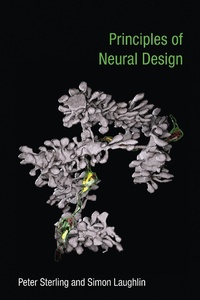
Principles of Neural Design
Description

Neuroscience research has exploded, with more than fifty thousand neuroscientists applying increasingly advanced methods. A mountain of new facts and mechanisms has emerged. And yet a principled framework to organize this knowledge has been missing. In this book, Peter Sterling and Simon Laughlin, two leading neuroscientists, strive to fill this gap, outlining a set of organizing principles to explain the whys of neural design that allow the brain to compute so efficiently.
Setting out to "reverse engineer” the brain—disassembling it to understand it—Sterling and Laughlin first consider why an animal should need a brain, tracing computational abilities from bacterium to protozoan to worm. They examine bigger brains and the advantages of "anticipatory regulation”; identify constraints on neural design and the need to "nanofy”; and demonstrate the routes to efficiency in an integrated molecular system, phototransduction. They show that the principles of neural design at finer scales and lower levels apply at larger scales and higher levels; describe neural wiring efficiency; and discuss learning as a principle of biological design that includes "save only what is needed.”
Sterling and Laughlin avoid speculation about how the brain might work and endeavor to make sense of what is already known. Their distinctive contribution is to gather a coherent set of basic rules and exemplify them across spatial and functional scales.
More details
Other editions
Additional editions
Persons
Simon Laughlin is Emeritus Professor of Neurobiology in the Department of Zoology at the University of Cambridge and a Fellow of the Royal Society.
