

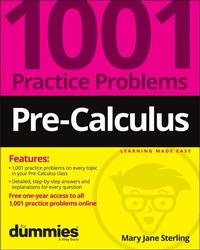
Pre-Calculus
Description

Pre-Calculus: 1001 Practice Problems For Dummies gives you 1,001 opportunities to practice solving problems from all the major topics in Pre-Calculus--in the book and online! Get extra help with tricky subjects, solidify what you've already learned, and get in-depth walk-throughs for every problem with this useful book. These practice problems and detailed answer explanations will turn you into a pre-calc problem-solving machine, no matter what your skill level. Thanks to Dummies, you have a resource to help you put key concepts into practice.
* Work through practice problems on all Pre-Calculus topics covered in school classes
* Read through detailed explanations of the answers to build your understanding
* Access practice questions online to study anywhere, any time
* Improve your grade and up your study game with practice, practice, practice
The material presented in Pre-Calculus: 1001 Practice Problems For Dummies is an excellent resource for students, as well as for parents and tutors looking to help supplement Pre-Calculus instruction.
Pre-Calculus: 1001 Practice Problems For Dummies (9781119883623) was previously published as 1,001 Pre-Calculus Practice Problems For Dummies (9781118853320). While this version features a new Dummies cover and design, the content is the same as the prior release and should not be considered a new or updated product.
More details
Other editions
Additional editions
Person
Content
Part 1: The Questions 5
Chapter 1: Getting Started with Algebra Basics 7
Chapter 2: Solving Some Equations and Inequalities 13
Chapter 3: Function Basics 19
Chapter 4: Graphing and Transforming Functions 27
Chapter 5: Polynomials 35
Chapter 6: Exponential and Logarithmic Functions 43
Chapter 7: Trigonometry Basics 51
Chapter 8: Graphing Trig Functions 59
Chapter 9: Getting Started with Trig Identities 65
Chapter 10: Continuing with Trig Identities 71
Chapter 11: Working with Triangles and Trigonometry 77
Chapter 12: Complex Numbers and Polar Coordinates 87
Chapter 13: Conic Sections 95
Chapter 14: Systems of Equations and Inequalities 101
Chapter 15: Sequences and Series 109
Chapter 16: Introducing Limits and Continuity 115
Part 2: The Answers 123
Chapter 17: Answers 125
Index 539
Introduction
Pre-calculus is a rather difficult topic to define or describe. There's a little bit of this, a lot of that, and a smattering of something else. But you need the mathematics considered to be pre-calculus to proceed to what changed me into a math major: calculus! Yes, believe it or not, I started out as a biology major - inspired by my high school biology teacher. Then I got to the semester where I was taking invertebrate zoology, chemistry, and calculus. (Yes, all at the same time.) All of a sudden, there was a bright light! An awakening! "So this is what mathematics can be!" Haven't turned back since. Calculus did it for me, and my great preparation for calculus made the adventure wonderful.
Pre-calculus contains a lot of algebra, some trigonometry, some geometry, and some analytic geometry. These topics all get tied together, mixed up, and realigned until out pops the mathematics you'll use when working with calculus. I keep telling my calculus students that "calculus is 60 percent algebra." Maybe my figures are off a bit, but believe me, you can't succeed in calculus without a good background in algebra (and trigonometry). The geometry is very helpful, too.
Why would you do 1,001 pre-calculus problems? Because practice makes perfect. Unlike other subjects where you can just read or listen and absorb the information sufficiently, mathematics takes practice. The only way to figure out how the different algebraic and trigonometric rules work and interact with one another, or how measurements in degrees and radians fit into the big picture, is to get into the problems - get your hands dirty, so to speak. Many problems given here may appear to be the same on the surface, but different aspects and challenges have been inserted to make them unique. The concepts become more set in your mind when you work with the problems and have your solutions confirm the properties.
What You'll Find
This book contains 1,001 pre-calculus problems, their answers, and complete solutions to each. There are 16 problem chapters, and each chapter has many different sets of questions. The sets of questions are sometimes in a logical, sequential order, going from one part of a topic to the next and then to the next. Or sometimes the sets of questions represent the different ways a topic can be presented. In any case, you'll get instructions on doing the problems. And sometimes you'll get a particular formula or format to use. Feel free to refer to other mathematics books, such as Yang Kuang and Elleyne Kase's Pre-Calculus For Dummies, my Algebra II For Dummies, or my Trigonometry For Dummies (all published by Wiley) for even more ideas on how to solve some of the problems.
Instead of just having answers to the problems, you'll find a worked-out solution for each and every one. Flip to the last chapter of this book for the step-by-step processes needed to solve the problems. The solutions include verbal explanations inserted in the work where necessary. Sometimes, the explanation may offer an alternative procedure. Not everyone does algebra and trigonometry problems exactly the same way, but this book tries to provide the most understandable and success-promoting process to use when solving the problems presented.
How This Workbook Is Organized
This workbook is divided into two main parts: questions and answers. But you probably figured that out already.
Part 1: The Questions
The chapters containing the questions cover many different topics:
- Review of basic algebraic processes:Chapters 1 and 2 contain problems on basic algebraic rules and formulas, solving many types of equations and inequalities, and interpreting and using very specific mathematical notation correctly. They thoroughly cover functions and function properties, with a segue into trigonometric functions.
- Graphing functions and transformations of functions: Functions and properties of functions are a big part of pre-calculus and calculus. You work with operations on functions, including compositions. These operations translate into transformations. And all this comes together when you look at the graphs of the functions. Transformations of functions help you see the similarities and differences in basic mathematical models - and the practice problems help you see how all this can save you a lot of time in the end.
- Polynomial functions: Some of the more familiar algebraic functions are the polynomials. The graphs of polynomials are smooth, rolling curves. Their characteristics include where they cross the axes and where they make their turns from moving upward to moving downward or vice versa. You get to practice your equation-solving techniques when determining the x-intercepts and y-intercept of polynomial functions.
- Exponential and logarithmic functions: You're not in Kansas anymore, so it's time to leave the world of algebraic functions and open your eyes to other types: exponential and logarithmic, to name two. You practice the operations specific to these types of functions and see how one is the inverse of the other. The applications of these functions are closer to real-world than most others in earlier chapters.
- Trigonometric functions: Trigonometric functions take being different one step further. You'll see how the input values for these functions have to be angle measures, not just any old numbers. The trig functions have their own rules, too, and lots of ways to interact, called identities. Solving trig identities helps you prepare for that most exciting process in calculus, where you get to find the area under a trigonometric curve. So, keep your eye on that goal! And the trig applications are some of my favorite - all so easy to picture (and draw) and to solve.
- Complex numbers and polar coordinates: Complex numbers were created; no, they aren't real or natural. Mathematicians needed to solve problems whose solutions were the square roots of negative numbers, so they adopted the imaginary number i to accomplish this task. Performing operations on complex numbers and finding complex solutions are a part of this general arena. Polar coordinates are a way of graphing curves by using angle measures and radii. You open up a whole new world of curves when you practice with these problems dealing with polar graphs.
- Conic sections: A big family of curves belongs in the classification of conics. You find the similarities and differences between circles, ellipses, hyperbolas, and parabolas. Exercises have you write the standard forms of the equations so you can better deter-mine individual characteristics and create reasonable sketches of the graphs of the curves.
Part 2: The Answers
This part provides not only the answers to all the questions but also explanations of the answers. So, you get the solution, and you see how to arrive at that solution.
Beyond the Book
In addition to what you're reading right now, this book comes with a free, access-anywhere Cheat Sheet that includes tips and other goodies you may want to have at your fingertips. To get this Cheat Sheet, simply go to www.dummies.com and type Pre-Calculus: 1001 Practice Problems For Dummies into the Search box.
The online practice that comes free with this book offers you the same 1,001 questions and answers that are available here, presented in a multiple-choice format. The beauty of the online problems is that you can customize your online practice to focus on the topic areas that give you trouble. If you're short on time and want to maximize your study, you can specify the quantity of problems you want to practice, pick your topics, and go. You can practice a few hundred problems in one sitting or just a couple dozen, and whether you can focus on a few types of problems or a mix of several types. Regardless of the combination you create, the online program keeps track of the questions you get right and wrong so you can monitor your progress and spend time studying exactly what you need.
To gain access to the online practice, you simply have to register. Just follow these steps:
- Register your book or ebook at Dummies.com to get your PIN. Go to
www.dummies.com/go/getaccess. - Select your product from the dropdown list on that page.
- Follow the prompts to validate your product, and then check your email for a confirmation message that includes your PIN and instructions for logging in.
If you don't receive this email within two hours, please check your spam folder before contacting us through our Technical Support website at http://support.wiley.com or by phone at 877-762-2974.
Now you're ready to go! You can come back to the practice material as often as you want - simply log in with the username and password you created during your initial login. No need to enter the access code a second time.
Your registration is good for one year from the day you activate your PIN.
Where to Go for Additional Help
The written directions given with the individual problems are designed to tell you what you need to do to get the correct answer. Sometimes the directions may seem vague if you aren't familiar with the words or the context of the words. Go...
