

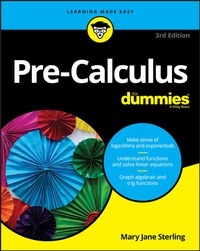
Pre-Calculus For Dummies
3rd Edition
Published on 25. October 2018
416 pages
978-1-119-50879-3 (ISBN)
Description

Get ahead in pre-calculus
Pre-calculus courses have become increasingly popular with 35 percent of students in the U.S. taking the course in middle or high school. Often, completion of such a course is a prerequisite for calculus and other upper level mathematics courses.
Pre-Calculus For Dummies is an invaluable resource for students enrolled in pre-calculus courses. By presenting the essential topics in a clear and concise manner, the book helps students improve their understanding of pre-calculus and become prepared for upper level math courses.
* Provides fundamental information in an approachable manner
* Includes fresh example problems
* Practical explanations mirror today's teaching methods
* Offers relevant cultural references
Whether used as a classroom aid or as a refresher in preparation for an introductory calculus course, this book is one you'll want to have on hand to perform your very best.
Pre-calculus courses have become increasingly popular with 35 percent of students in the U.S. taking the course in middle or high school. Often, completion of such a course is a prerequisite for calculus and other upper level mathematics courses.
Pre-Calculus For Dummies is an invaluable resource for students enrolled in pre-calculus courses. By presenting the essential topics in a clear and concise manner, the book helps students improve their understanding of pre-calculus and become prepared for upper level math courses.
* Provides fundamental information in an approachable manner
* Includes fresh example problems
* Practical explanations mirror today's teaching methods
* Offers relevant cultural references
Whether used as a classroom aid or as a refresher in preparation for an introductory calculus course, this book is one you'll want to have on hand to perform your very best.
More details
Other editions
Additional editions
Mary Jane Sterling
Pre-Calculus For Dummies
Book
12/2018
3rd Edition
Wiley
€24.00
Shipment within 15-20 days
Content
- Intro
- Title Page
- Copyright Page
- Table of Contents
- Introduction
- About This Book
- Foolish Assumptions
- Icons Used in This Book
- Beyond the Book
- Where to Go from Here
- Part 1 Getting Started with Pre-Calculus
- Chapter 1 Pre-Pre-Calculus
- Pre-Calculus: An Overview
- All the Number Basics (No, Not How to Count Them!)
- The multitude of number types: Terms to know
- The fundamental operations you can perform on numbers
- The properties of numbers: Truths to remember
- Visual Statements: When Math Follows Form with Function
- Basic terms and concepts
- Graphing linear equalities and inequalities
- Gathering information from graphs
- Get Yourself a Graphing Calculator
- Chapter 2 Playing with Real Numbers
- Solving Inequalities
- Recapping inequality how-tos
- Solving equations and inequalities when absolute value is involved
- Expressing solutions for inequalities with interval notation
- Variations on Dividing and Multiplying: Working with Radicals and Exponents
- Defining and relating radicals and exponents
- Rewriting radicals as exponents (or, creating rational exponents)
- Getting a radical out of a denominator: Rationalizing
- Chapter 3 The Building Blocks of Pre-Calculus Functions
- Qualities of Special Function Types and Their Graphs
- Even and odd functions
- One-to-one functions
- Dealing with Parent Functions and Their Graphs
- Linear functions
- Quadratic functions
- Square-root functions
- Absolute-value functions
- Cubic functions
- Cube-root functions
- Graphing Functions That Have More Than One Rule: Piece-Wise Functions
- Setting the Stage for Rational Functions
- Step 1: Search for vertical asymptotes
- Step 2: Look for horizontal asymptotes
- Step 3: Seek out oblique asymptotes
- Step 4: Locate the x- and y-intercepts
- Putting the Results to Work: Graphing Rational Functions
- Graphing f(x)=3x-1/x2+4x-21
- Graphing g(x)=6x+12/4-3x
- Graphing h(x)=x2-9/x+2
- Chapter 4 Operating on Functions
- Transforming the Parent Graphs
- Stretching and flattening
- Translations
- Reflections
- Combining various transformations (a transformation in itself!)
- Transforming functions point by point
- Sharpen Your Scalpel: Operating on Functions
- Adding and subtracting
- Multiplying and dividing
- Breaking down a composition of functions
- Adjusting the domain and range of combined functions (if applicable)
- Turning Inside Out with Inverse Functions
- Graphing an inverse
- Inverting a function to find its inverse
- Verifying an inverse
- Chapter 5 Digging Out and Using Roots to Graph Polynomial Functions
- Understanding Degrees and Roots
- Factoring a Polynomial Expression
- Always the first step: Looking for a GCF
- Unwrapping the box containing a trinomial
- Recognizing and factoring special polynomials
- Grouping to factor four or more terms
- Finding the Roots of a Factored Equation
- Cracking a Quadratic Equation When It Won't Factor
- Using the quadratic formula
- Completing the square
- Solving Unfactorable Polynomials with a Degree Higher Than Two
- Counting a polynomial's total roots
- Tallying the real roots: Descartes's rule of signs
- Accounting for imaginary roots: The fundamental theorem of algebra
- Guessing and checking the real roots
- Listing the possibilities with the rational root theorem
- Testing roots by dividing polynomials
- Put It in Reverse: Using Solutions to Find Factors
- Graphing Polynomials
- When all the roots are real numbers
- When roots are imaginary numbers: Combining all techniques
- Chapter 6 Exponential and Logarithmic Functions
- Exploring Exponential Functions
- Searching the ins and outs of exponential functions
- Graphing and transforming exponential functions
- Logarithms: The Inverse of Exponential Functions
- Getting a better handle on logarithms
- Managing the properties and identities of logs
- Changing a log's base
- Calculating a number when you know its log: Inverse logs
- Graphing logs
- Base Jumping to Simplify and Solve Equations
- Stepping through the process of exponential equation solving
- Solving logarithmic equations
- Growing Exponentially: Word Problems in the Kitchen
- Part 2 The Essentials of Trigonometry
- Chapter 7 Circling in on Angles
- Introducing Radians: Circles Weren't Always Measured in Degrees
- Trig Ratios: Taking Right Triangles a Step Further
- Making a sine
- Looking for a cosine
- Going on a tangent
- Discovering the flip side: Reciprocal trig functions
- Working in reverse: Inverse trig functions
- Understanding How Trig Ratios Work on the Coordinate Plane
- Building the Unit Circle by Dissecting the Right Way
- Familiarizing yourself with the most common angles
- Drawing uncommon angles
- Digesting Special Triangle Ratios
- The 45er:45deg-45deg-90deg triangle
- The old 30-60:30deg-60deg-90deg triangle
- Triangles and the Unit Circle: Working Together for the Common Good
- Placing the major angles correctly, sans protractor
- Retrieving trig-function values on the unit circle
- Finding the reference angle to solve for angles on the unit circle
- Measuring Arcs: When the Circle Is Put in Motion
- Chapter 8 Simplifying the Graphing and Transformation of Trig Functions
- Drafting the Sine and Cosine Parent Graphs
- Sketching sine
- Looking at cosine
- Graphing Tangent and Cotangent
- Tackling tangent
- Clarifying cotangent
- Putting Secant and Cosecant in Pictures
- Graphing secant
- Checking out cosecant
- Transforming Trig Graphs
- Messing with sine and cosine graphs
- Tweaking tangent and cotangent graphs
- Transforming the graphs of secant and cosecant
- Chapter 9 Identifying with Trig Identities: The Basics
- Keeping the End in Mind: A Quick Primer on Identities
- Lining Up the Means to the End: Basic Trig Identities
- Reciprocal and ratio identities
- Pythagorean identities
- Even/odd identities
- Co-function identities
- Periodicity identities
- Tackling Difficult Trig Proofs: Some Techniques to Know
- Dealing with demanding denominators
- Going solo on each side
- Chapter 10 Advanced Identities: Your Keys to Success
- Finding Trig Functions of Sums and Differences
- Searching out the sine of (a+-b)
- Calculating the cosine of (a+-b)
- Taming the tangent of (a+-b)
- Doubling an Angle and Finding Its Trig Value
- Finding the sine of a doubled angle
- Calculating cosines for two
- Squaring your cares away
- Having twice the fun with tangents
- Taking Trig Functions of Common Angles Divided in Two
- A Glimpse of Calculus: Traveling from Products to Sums and Back
- Expressing products as sums (or differences)
- Transporting from sums (or differences) to products
- Eliminating Exponents with Power-Reducing Formulas
- Chapter 11 Taking Charge of Oblique Triangles with the Laws of Sines and Cosines
- Solving a Triangle with the Law of Sines
- When you know two angle measures
- When you know two consecutive side lengths
- Conquering a Triangle with the Law of Cosines
- SSS: Finding angles using only sides
- SAS: Tagging the angle in the middle (and the two sides)
- Filling in the Triangle by Calculating Area
- Finding area with two sides and an included angle (for SAS scenarios)
- Using Heron's Formula (for SSS scenarios)
- Part 3 Analytic Geometry and System Solving
- Chapter 12 Plane Thinking: Complex Numbers and Polar Coordinates
- Understanding Real versus Imaginary
- Combining Real and Imaginary: The Complex Number System
- Grasping the usefulness of complex numbers
- Performing operations with complex numbers
- Graphing Complex Numbers
- Plotting Around a Pole: Polar Coordinates
- Wrapping your brain around the polar coordinate plane
- Graphing polar coordinates with negative values
- Changing to and from polar coordinates
- Picturing polar equations
- Chapter 13 Creating Conics by Slicing Cones
- Cone to Cone: Identifying the Four Conic Sections
- In picture (graph form)
- In print (equation form)
- Going Round and Round: Graphing Circles
- Graphing circles at the origin
- Graphing circles away from the origin
- Writing in center-radius form
- Riding the Ups and Downs with Parabolas
- Labeling the parts
- Understanding the characteristics of a standard parabola
- Plotting the variations: Parabolas all over the plane
- The vertex, axis of symmetry, focus, and directrix
- Identifying the min and max of vertical parabolas
- The Fat and the Skinny on the Ellipse
- Labeling ellipses and expressing them with algebra
- Identifying the parts from the equation
- Pair Two Curves and What Do You Get? Hyperbolas
- Visualizing the two types of hyperbolas and their bits and pieces
- Graphing a hyperbola from an equation
- Finding the equations of asymptotes
- Expressing Conics Outside the Realm of Cartesian Coordinates
- Graphing conic sections in parametric form
- The equations of conic sections on the polar coordinate plane
- Chapter 14 Streamlining Systems, Managing Variables
- A Primer on Your System-Solving Options
- Algebraic Solutions of Two-Equation Systems
- Solving linear systems
- Working nonlinear systems
- Solving Systems with More than Two Equations
- Decomposing Partial Fractions
- Surveying Systems of Inequalities
- Introducing Matrices: The Basics
- Applying basic operations to matrices
- Multiplying matrices by each other
- Simplifying Matrices to Ease the Solving Process
- Writing a system in matrix form
- Reduced row-echelon form
- Augmented form
- Making Matrices Work for You
- Using Gaussian elimination to solve systems
- Multiplying a matrix by its inverse
- Using determinants: Cramer's Rule
- Chapter 15 Sequences, Series, and Expanding Binomials for the Real World
- Speaking Sequentially: Grasping the General Method
- Determining a sequence's terms
- Working in reverse: Forming an expression from terms
- Recursive sequences: One type of general sequence
- Difference between Terms: Arithmetic Sequences
- Using consecutive terms to find another
- Using any two terms
- Ratios and Consecutive Paired Terms: Geometric Sequences
- Identifying a particular term when given consecutive terms
- Going out of order: Dealing with nonconsecutive terms
- Creating a Series: Summing Terms of a Sequence
- Reviewing general summation notation
- Summing an arithmetic sequence
- Seeing how a geometric sequence adds up
- Expanding with the Binomial Theorem
- Breaking down the binomial theorem
- Expanding by using the binomial theorem
- Chapter 16 Onward to Calculus
- Scoping Out the Differences between Pre-Calculus and Calculus
- Understanding Your Limits
- Finding the Limit of a Function
- Graphically
- Analytically
- Algebraically
- Operating on Limits: The Limit Laws
- Calculating the Average Rate of Change
- Exploring Continuity in Functions
- Determining whether a function is continuous
- Discontinuity in rational functions
- Part 4 The Part of Tens
- Chapter 17 Ten Polar Graphs
- Spiraling Outward
- Falling in Love with a Cardioid
- Cardioids and Lima Beans
- Leaning Lemniscates
- Lacing through Lemniscates
- Roses with Even Petals
- A Rose Is a Rose Is a Rose
- Limaçon or Escargot?
- Limaçon on the Side
- Bifolium or Rabbit Ears?
- Chapter 18 Ten Habits to Adjust before Calculus
- Figure Out What the Problem Is Asking
- Draw Pictures (the More the Better)
- Plan Your Attack - Identify Your Targets
- Write Down Any Formulas
- Show Each Step of Your Work
- Know When to Quit
- Check Your Answers
- Practice Plenty of Problems
- Keep Track of the Order of Operations
- Use Caution When Dealing with Fractions
- Index
- EULA
