

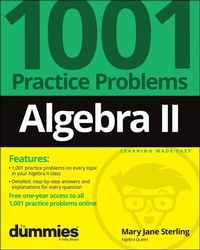
Algebra II
Description

Algebra II: 1001 Practice Problems For Dummies gives you 1,001 opportunities to practice solving problems on all the major topics in Algebra II--in the book and online! Get extra help with tricky subjects, solidify what you've already learned, and get in-depth walk-throughs for every problem with this useful book. These practice problems and detailed answer explanations will get your advanced algebra juices flowing, no matter what your skill level. Thanks to Dummies, you have a resource to help you put key concepts into practice.
* Work through practice problems on all Algebra II topics covered in class
* Step through detailed solutions for every problem to build your understanding
* Access practice questions online to study anywhere, any time
* Improve your grade and up your study game with practice, practice, practice
The material presented in Algebra II: 1001 Practice Problems For Dummies is an excellent resource for students, as well as parents and tutors looking to help supplement classroom instruction.
Algebra II: 1001 Practice Problems For Dummies (9781119883562) was previously published as 1,001 Algebra II Practice Problems For Dummies (9781118446621). While this version features a new Dummies cover and design, the content is the same as the prior release and should not be considered a new or updated product.
More details
Other editions
Additional editions
Person
Content
Part 1: The Questions 5
Chapter 1: Reviewing Algebra Basics 7
Chapter 2: Solving Quadratic Equations and Nonlinear Inequalities 13
Chapter 3: Solving Radical and Rational Equations 21
Chapter 4: Graphs and Equations of Lines 27
Chapter 5: Functions 33
Chapter 6: Quadratic Functions and Relations 39
Chapter 7: Polynomial Functions and Equations 45
Chapter 8: Rational Functions 51
Chapter 9: Exponential and Logarithmic Functions 57
Chapter 10: Conic Sections 65
Chapter 11: Systems of Linear Equations 73
Chapter 12: Systems of Nonlinear Equations and Inequalities 79
Chapter 13: Working with Complex Numbers 85
Chapter 14: Matrices 91
Chapter 15: Sequences and Series 97
Chapter 16: Sets 103
Chapter 17: Counting Techniques and Probability 109
Part 2: The Answers 117
Chapter 18: The Answers 119
Index 499
Introduction
One-thousand-one algebra problems: You must wonder what inspired such an endeavor.
One possibility for the inspiration is 1,001 Arabian Nights. (Okay, I'm really stretching here, but why not?) 1,001 Arabian Nights is a collection of stories and folk tales, compiled over several centuries. Likewise, 1,001 Algebra II Practice Problems For Dummies is a collection of math problems and explanations, and some of them involve interesting stories. This book wasn't compiled over centuries (though my editors say it seemed to take that long), but the concepts and ideas involved took mathematicians centuries to develop.
Practice makes perfect. Unlike other subjects in which you can just read or listen and absorb the information sufficiently, mathematics takes practice. The only way to figure out how the different algebraic rules work and interact with one another is to get into the problems - get your hands dirty, so to speak. Many problems appear to be the same, on the surface, but different aspects and challenges have been inserted to make the different problems unique. The concepts become more set in your mind when you work with the problems and have the properties confirmed with your solutions.
Yes, whether it's 1,001 algebra problems or 1,001 mathematical adventures, you'll find them here. Enjoy!
What You'll Find
This book contains 1,001 algebra problems, their answers, and complete solutions to each. There are 17 problem chapters, and each chapter has many different sets of questions. The sets of questions are sometimes in a logical, sequential order, going from one part of a topic to the next and then to the next. Other times the sets of questions represent the different ways a topic can be presented. In any case, you're given brief instructions on doing the problems. And sometimes you're given a particular formula or format to use. Feel free to refer to other algebra books, such as Algebra II For Dummies, to give you ideas on how to solve some of the problems.
Instead of just having answers to the problems, you find a worked-out solution for each and every one. Flip to the last chapter of the book for the step-by-step processes needed to solve the problems. The solutions include verbal explanations inserted in the work where necessary. Sometimes an alternate procedure may be offered. Not everyone does algebra exactly the same way, but this book tries to provide the most understandable and success-promoting process to use when solving the algebra problems presented.
How This Workbook Is Organized
This workbook is divided into two main parts: questions and answers. But you probably figured that out already.
Part 1: Questions
The questions chapters cover many different topics:
- Review of basic operations: The chapter takes you through some of the main concepts from Algebra I that are essential to working in Algebra II. You'll find problems on powers of binomials and patterns in those powers. Solving linear equations and linear inequalities are fairly straightforward tasks, but it doesn't hurt to review these types of problems to bring your skill level up to speed. Two other topics covered here are radicals and complex numbers. Each topic is special in its own way, but similarities crop up - such as the use of conjugates when simplifying the expressions.
-
Solving nonlinear equations and inequalities: Quadratic equations are by far one of the most used and referred-to equation types in secondary mathematics. That's why you'll find techniques such as factoring (with the multiplication property of zero), the square root rule, the quadratic formula, and completing the square to be the main methods covered here.
Throw in some radical equations (square roots, cube roots) and rational equations (fractional expressions), and you have more tricks and techniques to practice so you can increase your repertoire.
- Graphing lines: A line is a very basic structure and is easy to graph when you have two points. You'll also find lines to graph when you're given their equations, and then equations to write when you're given information about the line. You get to consider lines that are parallel to one another and others that are perpendicular. The graphing part is simplified when you recognize the basics: a point on the line and the line's slope.
- Functions: A function in mathematics has a very specific definition. You can have a function when you have a relationship between sets of numbers and the relationship is described with mathematical operations. The operations take input values and produce output values based on the rules created with the operations. What's particularly special about functions is that there's only one output for every input. The functions you'll find include linear, quadratic, polynomial, rational, exponential, and logarithmic. There are more functions out there, but you get a really good start right here.
- Systems of equations and inequalities: When you have two or more statements or equations and want to know whether there are any solutions common to both or all of them at the same time, you're talking about solving systems. The equations can be linear, quadratic, exponential, and so on. You'll use algebraic techniques as well as matrices to solve some of the linear systems.
- Sequences, sets, and counting techniques: When you're getting ready for future studies in probability and statistics, you'll want to practice problems involving lists, counting, sets, and set notation. You'll use Venn diagrams and make lists of elements in sets. You'll also write the terms in sequences and add up the terms in series.
Part 2: Answers
This part provides not only the answers to all the questions but explanations of the answers as well. So, you get the solution, and you see how to arrive at that solution.
Beyond the Book
In addition to what you're reading right now, this book comes with a free, access-anywhere Cheat Sheet that includes tips and other goodies you may want to have at your fingertips. To get this Cheat Sheet, simply go to www.dummies.com and type Algebra II: 1001 Practice Problems For Dummies into the Search box.
The online practice that comes free with this book offers you the same 1,001 questions and answers that are available here, presented in a multiple-choice format. The beauty of the online problems is that you can customize your online practice to focus on the topic areas that give you trouble. If you're short on time and want to maximize your study, you can specify the quantity of problems you want to practice, pick your topics, and go. You can practice a few hundred problems in one sitting or just a couple dozen, depending on whether you can focus on a few types of problems or prefer a mix of several types. Regardless of the combination you create, the online program keeps track of the questions you get right and wrong so you can monitor your progress and spend time studying exactly what you need.
To gain access to the online practice, you simply have to register. Just follow these steps:
- Register your book or ebook at Dummies.com to get your PIN. Go to
www.dummies.com/go/getaccess. - Select your product from the drop-down list on that page.
- Follow the prompts to validate your product and then check your email for a confirmation message that includes your PIN and instructions for logging in.
If you don't receive this email within two hours, please check your spam folder before contacting us through our technical support website at http://support.wiley.com or by phone at 877-762-2974.
Now you're ready to go! You can come back to the practice material as often as you want - simply log in with the username and password you created during your initial login. No need to enter the access code a second time.
Your registration is good for one year from the day you activate your PIN.
Where to Go for Additional Help
The written directions given with the individual problems are designed to tell you what you need to do to get the correct answer. Sometimes the directions may seem vague if you aren't familiar with the words or the context of the words. Go ahead and look at the solution to see whether that helps you with the meaning. But if the vocabulary is still unrecognizable, you may want to refer to the glossaries in algebra books, such as Algebra I For Dummies or Algebra II For Dummies, written by yours truly and published by John Wiley & Sons, Inc.
This book is designed to provide you with enough practice to become very efficient in algebra, but it isn't intended to give the step-by-step explanation on how and why each step is necessary. You may need to refer to Algebra II For Dummies or Algebra II Essentials For Dummies (also written by me) to get more background on a problem or to understand why a particular step is taken in the solution of the problem.
Algebra is sometimes seen as being a bunch of rules without a particular purpose. Why do you have to solve for the solutions of a quadratic equation? Where will you use that again? The answers to all these questions are more apparent when...
