

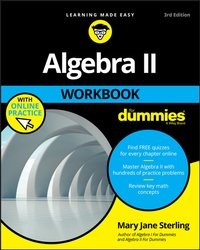
Algebra II Workbook For Dummies
Description

Algebra II introduces students to complex algebra concepts in preparation for trigonometry and calculus. In this new edition of Algebra II Workbook For Dummies, high school and college students will work through the types of Algebra II problems they'll see in class, including systems of equations, matrices, graphs, and conic sections. Plus, the book now comes with free 1-year access to chapter quizzes online!
A recent report by ACT shows that over a quarter of ACT-tested 2012 high school graduates did not meet any of the four college readiness benchmarks in mathematics, English, reading, and science. Algebra II Workbook For Dummies presents tricky topics in plain English and short lessons, with examples and practice at every step to help students master the essentials, setting them up for success with each new lesson.
* Tracks to a typical Algebra II class
* Can be used as a supplement to classroom learning or for test prep
* Includes plenty of practice and examples throughout
* Comes with free access to chapter quizzes online
Get ready to take the intimidation out of Algebra II!
More details
Other editions
Additional editions
Content
Chapter 1
Going Beyond Beginning Algebra
IN THIS CHAPTER
Applying order of operations and algebraic properties
Using FOIL and other products
Solving linear and absolute value equations
Dealing with inequalities
The nice thing about the rules in algebra is that they apply no matter what level of mathematics or what area of math you're studying. Everyone follows the same rules, so you find a nice consistency and orderliness. In this chapter, I discuss and use the basic rules to prepare you for the topics that show up in Algebra II.
Good Citizenship: Following the Order of Operations and Other Properties
The order of operations in mathematics deals with what comes first (much like the chicken and the egg). When faced with multiple operations, this order tells you the proper course of action.
The order of operations states that you use the following sequence when simplifying algebraic expressions:
- Raise to powers or find roots.
- Multiply or divide.
- Add or subtract.
Special groupings can override the normal order of operations. For instance, asks you to add before raising a to the power, which is a sum. If groupings are a part of the expression, first perform whatever's in the grouping symbol. The most common grouping symbols are parentheses, ( ); brackets, [ ]; braces, { }; fraction bars, -; absolute value bars, | |; and radical signs, .
If you find more than one operation from the same level, move from left to right performing those operations.
The commutative, associative, and distributive properties allow you to rewrite expressions and not change their value. So, what do these properties say? Great question! And here are the answers:
-
Commutative property of addition and multiplication: , and ; the order doesn't matter.
Rewrite subtraction problems as addition problems so you can use the commutative (and associative) property. In other words, think of as .
- Associative property of addition and multiplication: , and ; the order is the same, but the grouping changes.
- Distributive property of multiplication over addition (or subtraction): , and .
The multiplication property of zero states that if the product of , then either a or b (or both) must be equal to 0.
Q. Use the order of operations and other properties to simplify the expression .
A. . The big fraction bar is a grouping symbol, so you deal with the numerator and denominator separately. Use the commutative and associative properties to rearrange the fractions in the numerator; square the 3 under the radical in the denominator. Next, in the numerator, combine the fractions that have a common denominator; below the fraction bar, multiply the two numbers under the radical. Reduce the first fraction in the numerator; add the numbers under the radical. Distribute the 12 over the two fractions; take the square root in the denominator. Simplify the numerator and denominator.
Here's what the process looks like:
1 Simplify:
2 Simplify:
3 Simplify:
4 Simplify:
5 Simplify:
6 Simplify:
(For info on absolute value, see the upcoming section, "Dealing with Linear Absolute Value Equations.")
Specializing in Products and FOIL
Multiplying algebraic expressions together can be dandy and nice or downright gruesome. Taking advantage of patterns and processes makes the multiplication quicker, easier, and more accurate.
When multiplying two binomials together, you have to multiply the two terms in the first binomial times the two terms in the second binomial - you're actually distributing the first terms over the second. The FOIL acronym describes a way of multiplying those terms in an organized fashion, saving space and time. FOIL refers to multiplying the two First terms together, then the two Outer terms, then the two Inner terms, and finally the two Last terms. The Outer and Inner terms usually combine. Then you add the products together by combining like terms. So, if you have , you can do the multiplication of the terms, or FOIL, like so:
Terms
Product
First
ax(cx)
Outer
ax(d)
Inner
b(cx)
Last
b(d)
The following examples show some multiplication patterns to use when multiplying binomials (expressions with two terms).
Q. Find the square of the binomial:
A. . When squaring a binomial, you square both terms and put twice the product of the two original terms between the squares: . So, .
Q. Multiply the two binomials together using FOIL:
A. . Find the products: First, , plus Outer, , plus Inner, , plus Last, . So, the product of is .
Q. Find the product of the binomial and the trinomial:
A. . Distribute the 2x over the terms in the trinomial, and then distribute the 7 over the same terms. Combine like terms to simplify. The product of is .
7 Square the binomial:
8 Multiply:
9 Multiply:
10 Multiply:
Variables on the Side: Solving Linear Equations
A linear equation has the general format , where x is the variable and a, b, and c are constants. When you solve a linear equation, you're looking for the value that x takes on to make the linear equation a true statement. The general game plan for solving linear equations is to isolate the term with the variable on one side of the equation and then multiply or divide to find the solution.
Q. Solve for x in the equation .
A. . First, multiply each side by 4 to get rid of the fraction. Then distribute the 3 over the terms in the parentheses. Combine the like terms on the left. Next, you want all variable terms on one side of the equation, so subtract 8x and 16 from each side. Finally, divide each side by -5.
11 Solve for x:
12 Solve for x:
13 Solve for x:
14 Solve for x:
Dealing with Linear Absolute Value Equations
The absolute value of a number is the number's distance from 0. The formal definition of absolute value is
In other words, the absolute value of a number is exactly that number unless the number is negative; when the number is negative, its absolute value is the opposite, or a positive. The absolute value of a number, then, is the number's value without a sign; it's never negative.
When solving linear absolute value equations, you have two possibilities: one that the quantity inside the absolute value bars is positive, and the other that it's negative. Because you have to consider both situations, you usually get two different answers when solving absolute value equations, one from each scenario. The two answers come from setting the quantity inside the absolute value bars first equal to a positive value and then equal to a negative value.
Before setting the quantity equal to the positive and negative values, first isolate the absolute value term on one side of the equation by adding or subtracting the other terms (if you have any) from each side of the equation.
If you find more than one absolute value expression in your problem, you have to get down and dirty - consider all the possibilities. A value inside absolute value bars can be either positive or negative, so look at all the different combinations: Both values within the bars are positive, or the first is positive and the second is negative, or the first is negative and the second positive, or both are negative. Whew!
Q. Solve for x in .
A. , -6. First rewrite the absolute value equation as two separate linear equations. In the first equation, assume that the is positive and set it equal to 11. In the second equation, also equal to 11, assume that the is negative. For that one, negate (multiply by -1) the whole binomial, and then solve the equation.
or
15 Solve for x in .
16 Solve for x in .
17 Solve for x in .
18 Solve for x in .
