

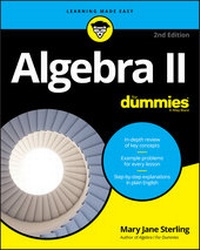
Algebra II For Dummies
Description

Your complete guide to acing Algebra II
Do quadratic equations make you queasy? Does the mere thought of logarithms make you feel lethargic? You're not alone! Algebra can induce anxiety in the best of us, especially for the masses that have never counted math as their forte. But here's the good news: you no longer have to suffer through statistics, sequences, and series alone. Algebra II For Dummies takes the fear out of this math course and gives you easy-to-follow, friendly guidance on everything you'll encounter in the classroom and arms you with the skills and confidence you need to score high at exam time.
Gone are the days that Algebra II is a subject that only the serious 'math' students need to worry about. Now, as the concepts and material covered in a typical Algebra II course are consistently popping up on standardized tests like the SAT and ACT, the demand for advanced guidance on this subject has never been more urgent. Thankfully, this new edition of Algebra II For Dummies answers the call with a friendly and accessible approach to this often-intimidating subject, offering you a closer look at exponentials, graphing inequalities, and other topics in a way you can understand.
* Examine exponentials like a pro
* Find out how to graph inequalities
* Go beyond your Algebra I knowledge
* Ace your Algebra II exams with ease
Whether you're looking to increase your score on a standardized test or simply succeed in your Algebra II course, this friendly guide makes it possible.
More details
Other editions
Additional editions
Content
Chapter 1
Going Beyond Beginning Algebra
IN THIS CHAPTER
Abiding by (and using) the rules of algebra
Adding the multiplication property of zero to your repertoire
Raising your exponential power
Looking at special products and factoring
Algebra is a branch of mathematics that people study before they move on to other areas or branches in mathematics and science. For example, you use the processes and mechanics of algebra in calculus to complete the study of change; you use algebra in probability and statistics to study averages and expectations; and you use algebra in chemistry to work out the balance between chemicals. Algebra all by itself is esthetically pleasing, but it springs to life when used in other applications.
Any study of science or mathematics involves rules and patterns. You approach the subject with the rules and patterns you already know, and you build on those rules with further study. The reward is all the new horizons that open up to you.
Any discussion of algebra presumes that you're using the correct notation and terminology. Algebra I (check out Algebra I For Dummies [Wiley]) begins with combining terms correctly, performing operations on signed numbers, and dealing with exponents in an orderly fashion. You also solve the basic types of linear and quadratic equations. Algebra II gets into more types of functions, such as exponential and logarithmic functions, and topics that serve as launching spots for other math courses.
Going into a bit more detail, the basics of algebra include rules for dealing with equations, rules for using and combining terms with exponents, patterns to use when factoring expressions, and a general order for combining all the above. In this chapter, I present these basics so you can further your study of algebra and feel confident in your algebraic ability. Refer to these rules whenever needed as you investigate the many advanced topics in algebra.
Outlining Algebraic Properties
Mathematicians developed the rules and properties you use in algebra so that every student, researcher, curious scholar, and bored geek working on the same problem would get the same answer - no matter the time or place. You don't want the rules changing on you every day (and I don't want to have to write a new book every year!); you want consistency and security, which you get from the strong algebra rules and properties that I present in this section.
Keeping order with the commutative property
The commutative property applies to the operations of addition and multiplication. It states that you can change the order of the values in a particular operation without changing the final result:
Commutative property of addition
Commutative property of multiplication
If you add 2 and 3, you get 5. If you add 3 and 2, you still get 5. If you multiply 2 times 3, you get 6. If you multiply 3 times 2, you still get 6.
Algebraic expressions usually appear in a particular order, which comes in handy when you have to deal with variables and coefficients (multipliers of variables). The number part comes first, followed by the letters, in alphabetical order. But the beauty of the commutative property is that 2xyz is the same as x2zy. You have no good reason to write the expression in that second, jumbled order, but it's helpful to know that you can change the order around when you need to.
Maintaining group harmony with the associative property
Like the commutative property (see the previous section), the associative property applies only to the operations of addition and multiplication. The associative property states that you can change the grouping of operations without changing the result:
Associative property of addition
Associative property of multiplication
You can use the associative property of addition or multiplication to your advantage when simplifying expressions. And if you throw in the commutative property when necessary, you have a powerful combination. For instance, when simplifying , you can start by dropping the parentheses (thanks to the associative property). You then switch the middle two terms around, using the commutative property of addition. You finish by reassociating the terms with parentheses and combining the like terms:
The steps in the previous process involve a lot more detail than you really need. You probably did the problem, as I first stated it, in your head. I provide the steps to illustrate how the commutative and associative properties work together; now you can apply them to more complex situations.
Distributing a wealth of values
The distributive property states that you can multiply each term in an expression within parentheses by the multiplier outside the parentheses and not change the value of the expression. It takes one operation, multiplication, and spreads it out over terms that you add to and subtract from one another:
Distributing multiplication over addition
Distributing multiplication over subtraction
For instance, you can use the distributive property on the problem to make your life easier. You distribute the 12 over the fractions by multiplying each fraction by 12 and then combining the results:
Finding the answer with the distributive property is much easier than changing all the fractions to equivalent fractions with common denominators of 12, combining them, and then multiplying by 12.
You can use the distributive property to simplify equations - in other words, you can prepare them to be solved. You also do the opposite of the distributive property when you factor expressions; see the section "Implementing Factoring Techniques" later in this chapter.
Checking out an algebraic ID
The numbers zero and one have special roles in algebra - as identities. You use identities in algebra when solving equations and simplifying expressions. You need to keep an expression equal to the same value, but you want to change its format, so you use an identity in one way or another:
The additive identity is zero. Adding zero to a number doesn't change that number; it keeps its identity.
The multiplicative identity is one. Multiplying a number by one doesn't change that number; it keeps its identity.
Applying the additive identity
One situation that calls for the use of the additive identity is when you want to change the format of an expression so you can factor it. For instance, take the expression and add 0 to it. You get , which doesn't do much for you (or me, for that matter). But how about replacing that 0 with both 9 and ? You now have , which you can write as and factor into . Why in the world do you want to do this? Go to Chapter 11 and read up on conic sections to see why. By both adding and subtracting 9, you add 0 - the additive identity.
Making multiple identity decisions
You use the multiplicative identity extensively when you work with fractions. Whenever you rewrite fractions with a common denominator, you actually multiply by one. If you want the fraction to have a denominator of 6x, for example, you multiply both the numerator and denominator by 3:
Now you're ready to rock and roll with a fraction to your liking.
Singing along in-verses
You face two types of inverses in algebra: additive inverses and multiplicative inverses. The additive inverse matches up with the additive identity and the multiplicative inverse matches up with the multiplicative identity. The additive inverse is connected to zero, and the multiplicative inverse is connected to one.
A number and its additive inverse add up to zero. A number and its multiplicative inverse have a product of one. For example, and 3 are additive inverses; the multiplicative inverse of is . Inverses come into play big-time when you're solving equations and want to isolate the variable. You use inverses by adding them to get zero next to the variable or by multiplying them to get one as a multiplier (or coefficient) of the variable.
Ordering Your Operations
When mathematicians switched from words to symbols to describe mathematical processes, their goal was to make dealing with problems as simple as possible; however, at the same time, they wanted everyone to know what was meant by an expression and for everyone to get the same answer to the same problem. Along with the special notation came a special set of rules on how to handle more than one operation in an expression. For instance, if you do the problem , you have to decide when to add, subtract, multiply, divide, take the root, and deal with the exponent.
The order of operations dictates that you follow this sequence:
- Raise to powers or find roots.
- Multiply or divide.
- Add or subtract.
If you have to perform more than one operation from the same level, work those operations moving from left to right. If any...
