

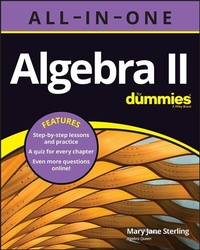
Algebra II All-in-One For Dummies
Description

Algebra II can be a tough nut to crack when you first meet it. But with the right tools...well, she's still tough but she gets a heckuva lot easier to manage. In Algebra II All-in-One For Dummies you'll find your very own step-by-step roadmap to solving even the most challenging Algebra II problems, from conics and systems of equations to exponential and logarithmic functions.
In the book, you'll discover the ins and outs of function transformation and evaluation, work out your brain with complex and imaginary numbers, and apply formulas from statistics and probability theory. You'll also find:
* Accessible and practical lessons and practice for second year high-school or university algebra students
* End-of-chapter quizzes that help you learn - and remember! - key algebraic concepts, such as quadratic equations, graphing techniques, and matrices
* One-year access to additional chapter quizzes online, where you can track your progress and get real-time feedback!
Your own personal mathematical toolbox for some of the most useful and foundational math you'll learn in school, this Algebra II All-in-One For Dummies combines hands-on techniques, methods, and strategies from a variety of sources into one, can't-miss reference. You'll get the insights, formulas, and practice you need, all in a single book (with additional quizzes online!) that's ideal for students and lifelong learners alike!
More details
Other editions
Additional editions
Person
Content
Part 1: Getting to First Base with the Basics 5
Chapter 1: Beginning at the Beginning of Algebra 7
Chapter 2: Taking on Linear Equations and Inequalities 35
Chapter 3: Handling Quadratic and Other Polynomial Equations 59
Chapter 4: Controlling Quadratic and Rational Inequalities 89
Chapter 5: Soothing the Rational, the Radical, and the Negative 109
Chapter 6: Giving Graphing a Gander 139
Part 2: Figuring on Functions 171
Chapter 7: Formulating Functions 173
Chapter 8: Specializing in Quadratic Functions 201
Chapter 9: Plugging In Polynomials 229
Chapter 10: Acting Rationally with Functions 271
Chapter 11: Exploring Exponential and Logarithmic Functions 303
Chapter 12: Transforming and Critiquing Functions 343
Part 3: Using Conics and Systems of Equations 365
Chapter 13: Slicing the Way You Like It: Conic Sections 367
Chapter 14: Solving Systems of Linear Equations 405
Chapter 15: Solving Systems of Nonlinear Equations 435
Chapter 16: Solving Systems of Inequalities 455
Part 4: Making Lists and Checking for Imaginary Numbers 473
Chapter 17: Getting More Complex with Imaginary Numbers 475
Chapter 18: Making Moves with Matrices 493
Chapter 19: Seeking Out Sequences and Series 521
Chapter 20: Everything You Wanted to Know about Sets and Counting 545
Part 5: Applying Known Formulas 575
Chapter 21: Manipulating Formulas 577
Chapter 22: Taking on Applications 597
Index 613
Chapter 1
Beginning at the Beginning of Algebra
IN THIS CHAPTER
Recognizing and using the rules of algebra
Adding products to your list
Raising your exponential power and taming radicals
Looking at special products and factoring
Algebra is a branch of mathematics that people study before they move on to other areas or branches of mathematics and science. For example, you use the processes and mechanics of algebra in calculus to complete the study of change; you use algebra in probability and statistics to study averages and expectations; and you use algebra in chemistry to solve equations involving chemicals.
Any study of science or mathematics involves rules and patterns. You approach the subject with the rules and patterns you already know, and you build on them with further study. And any discussion of algebra presumes that you're using the correct notation and terminology.
Going into a bit more detail, the basics of algebra include rules for dealing with equations, rules for using and combining terms with exponents, patterns to use when factoring expressions, and a general order for combining all of the above. In this chapter, I present these basics so you can further your study of algebra and feel confident in your algebraic ability. Refer to these rules whenever needed as you investigate the many advanced topics in algebra.
Following the Order of Operations and Other Properties
Mathematicians developed the rules and properties you use in algebra so that every student, researcher, curious scholar, and bored geek working on the same problem would get the same answer - regardless of the time or place. You don't want the rules changing on you every day; you want consistency and security, which you get from the strong algebra rules and properties presented in this section.
Ordering your operations
When mathematicians switched from words to symbols to describe mathematical processes, their goal was to make dealing with problems as simple as possible; however, at the same time, they wanted everyone to know what was meant by an expression and for everyone to get the same answer to the same problem. Along with the special notation came a special set of rules on how to handle more than one operation in an expression. For instance, if you do the problem , you have to decide when to add, subtract, multiply, divide, take the root, and deal with the exponent.
The order of operations dictates that you follow this sequence:
- Perform all operations inside/on grouping symbols (parentheses, brackets, braces, fraction lines, and so on).
- Raise to powers or find roots.
- Multiply and divide, moving from left to right.
- Add and subtract, moving from left to right.
Q. Simplify: .
A. . Follow the order of operations. The radical acts like a grouping symbol, so you subtract what's in the radical first: .
Raise the power and find the root: .
Multiply and divide, working from left to right: .
Add and subtract, moving from left to right: .
Q. Simplify: .
A. .
Follow the order of operations: The fraction line serves as a grouping symbol, so you simplify the numerator and denominator separately before dividing. Also, the radical is a grouping symbol, so the value under the radical is determined before finding the square root. Under the radical, first square the -3, then multiply, and finally subtract. You can then take the root.
Now multiply the two numbers in the denominator: .
Apply the two operations, and perform those operations before dividing: or .
1 Simplify: .
2 Simplify: .
Examining various properties
Mathematics has a wonderful structure that you can depend on in every situation. Most importantly, it uses various properties, such as associative, commutative, distributive, and so on. These properties allow you to adjust mathematical statements and expressions without changing their values. You make them more usable without changing the outcome.
Property
Description
Math Statement
Commutative (of addition)
You can change the order of the values in an addition statement without changing the final result.
Commutative (of multiplication)
You can change the order of the values in a multiplication statement without changing the final result.
Associative (of addition)
You can change the grouping of operations in an addition statement without changing the final result.
Associative (of multiplication)
You can change the grouping of operations in a multiplication statement without changing the final result.
Distributive (multiplication over addition)
You can multiply each term in an expression within parentheses by the multiplier outside the parentheses and not change the value of the expression. It takes one operation, multiplication, and spreads it out over terms that you add to one another.
Distributive (multiplication over subtraction)
You can multiply each term in an expression within parentheses by the multiplier outside the parentheses and not change the value of the expression. It takes one operation, multiplication, and spreads it out over terms that you subtract from one another.
Identity (of addition)
The additive identity is zero. Adding zero to a number doesn't change that number; it keeps its identity.
Identity (of multiplication)
The multiplicative identity is 1. Multiplying a number by 1 doesn't change that number; it keeps its identity.
Multiplication property of zero
The only way the product of two or more values can be zero is for at least one of the values to actually be zero.
Additive inverse
A number and its additive inverse add up to zero.
Multiplicative inverse
A number and its multiplicative inverse have a product of 1. The only exception is that zero does not have a multiplicative inverse.
,
Q. Use the commutative and associative properties of addition to simplify the expression: .
A. . First, reverse the order of the terms in the parentheses using the commutative property: .
Next, reassociate the terms: .
Finally, add the two terms in the parentheses: .
Q. Use the distributive property to simplify the expression: .
A. 5.
Q. Use the multiplicative identity to find a common denominator and add the terms: .
A. . Multiply the first fraction by 1 in the form of the fraction , and the second fraction by :
Q. Use an additive inverse to solve the equation for y.
A. y = 112 - 3x. Add to each side of the equation:
Q. Apply the multiplication property of zero to solve the equation: .
A. -5, 4, 0. At least one of the factors has to equal 0. So, if , then the product is 0. Or, if , then the second factor is 0 and the product is 0. Likewise if , then the third factor is 0 and the product is 0.
Q. Use the additive inverse to add and subtract a number that makes the expression factorable as the square of a binomial.
A. . Adding and subtracting 25 will do the trick:
3 Use the associative and commutative properties of multiplication to simplify .
4 Use the distributive property to simplify .
5 Use a multiplicative inverse to solve the equation for the value of x.
THE BIRTH OF NEGATIVE NUMBERS
In the early days of algebra, negative numbers weren't an accepted entity. Mathematicians had a hard time explaining exactly what the numbers illustrated; it was too tough to come up with concrete examples. One of the first mathematicians to accept negative numbers was Fibonacci, an Italian mathematician. When he was working on a financial problem, he saw that he needed what amounted to a negative number to finish the problem. He described it as a loss and proclaimed, "I have shown this to be insoluble unless it is conceded that the man had a debt."
Specializing in Products and "FOIL"
Multiplying numbers and variables is a pretty standard procedure in algebra, and you can take advantage of some of the rules, such as distributing and associating, to solve problems. Another timesaver is to use special situations. You don't want to slug through a messy multiplication process when there's an easier and...
