

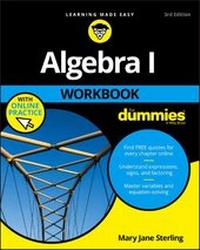
Algebra I Workbook For Dummies
Description

More details
Other editions
Additional editions
Person
Content
Introduction 1
About This Book 1
Foolish Assumptions 2
Icons Used in This Book 3
Beyond the Book 3
Where to Go from Here 4
Part 1: Getting Down to the Nitty-Gritty on Basic Operations 5
Chapter 1: Deciphering Signs in Numbers 7
Chapter 2: Incorporating Algebraic Properties 17
Chapter 3: Making Fractions and Decimals Behave 25
Chapter 4: Exploring Exponents 45
Chapter 5: Taming Rampaging Radicals 55
Chapter 6: Simplifying Algebraic Expressions 67
Part 2: Changing the Format of Expressions 77
Chapter 7: Specializing in Multiplication Matters 79
Chapter 8: Dividing the Long Way to Simplify Algebraic Expressions 91
Chapter 9: Figuring on Factoring 103
Chapter 11: Factoring Trinomials and Special Polynomials 117
Part 3: Seek and Ye Shall Find Solutions 131
Chapter 12: Lining Up Linear Equations 133
Chapter 13: Muscling Up to Quadratic Equations 151
Chapter 14: Yielding to Higher Powers 167
Chapter 15: Reeling in Radical and Absolute Value Equations 179
Chapter 16: Getting Even with Inequalities 189
Part 4: Solving Story Problems and Sketching Graphs 203
Chapter 17: Facing Up to Formulas 205
Chapter 18: Making Formulas Work in Basic Story Problems 219
Chapter 19: Relating Values in Story Problems 233
Chapter 20: Measuring Up with Quality and Quantity Story Problems 243
Chapter 21: Getting a Handle on Graphing 255
Part 5: The Part of Tens 283
Chapter 22: Ten Common Errors That Get Noticed 285
Chapter 23: Ten Quick Tips to Make Algebra a Breeze 291
Index 295
Introduction
Some of my earliest grade-school memories include receiving brand-new workbooks at the beginning of the school year. The pages of these workbooks were crisp, pristine, beautiful - and intimidating at the same time. But it didn't take long for those workbooks to become well-used and worn. My goal with Algebra I Workbook For Dummies with Online Practice is to give you that same workbook experience - without the intimidation, of course.
Remember, mathematics is a subject that has to be handled. You can read English literature and understand it without having to actually write it. You can read about biological phenomena and understand them, too, without taking part in an experiment. Mathematics is different. You really do have to do it, practice it, play with it, and use it. Only then does the mathematics become a part of your knowledge and skills. And what better way to get your fingers wet than by jumping into this workbook? Remember only practice, practice, and some more practice can help you master algebra! Have at it!
About This Book
This book is filled with algebra problems you can study, solve, and learn from. As you proceed through this book, you'll see plenty of road signs that clearly mark the way. You'll find explanations, examples, and other bits of info to make this journey as smooth an experience as possible. You also get to do your own grading with the solutions I provide at the end of each chapter. You can even go back and change your answers to the correct ones, if you made an error. No, you're not cheating. You're figuring out how to correctly work algebra problems. (Actually, changing answers to the correct ones is a great way to learn from your mistakes.)
I've organized this book very much like the way I organized Algebra I For Dummies (Wiley), which you may already have: I introduce basic concepts and properties first and then move on to the more complex ones. That way, if you're pretty unsteady on your feet, algebra-wise, you can begin at the beginning and build your skills and your confidence as you progress through the different chapters.
But maybe you don't need practice problems from beginning to end. Maybe you just need a bit of extra practice with specific types of algebra problems. One nice thing about this workbook is that you can start wherever you want. If your nemesis is graphing, for example, you can go straight to the chapters that focus on graphing. Formulas your problem area? Then go to the chapters that deal with formulas.
Bottom line: You do need to understand and know how to use the basic algebra concepts to start anywhere in this workbook. But, after you have those down, you can pick and choose where you want to work. You can jump in wherever you want and work from there.
I've also used the following conventions in this book to make things consistent and easy to understand, regardless which practice problems you're tackling:
- New terms are italicized and are closely followed by a clear definition.
- I bold the answers to the examples and the practice questions for easy identification. However, I don't bold the punctuation that follows the answer because I want to prevent any confusion with periods and decimal points that could be considered part of the answer.
- Algebra uses a lot of letters to represent numbers. In general, I use letters at the beginning of the alphabet (a, b, c, k) to represent constants - numbers that don't change all the time but may be special to a particular situation. The letters at the end of the alphabet usually represent variables - what you're solving for. I use the most commonly used letters (x, y, and z) for variables. And all constants and variables are italicized. And if, for any reason, I don't follow this convention, I let you know so that you aren't left guessing. (You may see breaks from the convention in some old, traditional formulas, for example, or when you want a particular letter to stand for someone's age, which just may happen to start with the letter A.)
- I use the corresponding symbols to represent the math operations of addition, subtraction, multiplication, and division: +, -, ×, and ÷. But keep the following special rules in mind when using them in algebra and in this book:
- Subtraction (-) is an operation, but that symbol also represents opposite of, minus, and negative. When you get to the different situations, you can figure out how to interpret the wording, based on the context.
- Multiplication (×) is usually indicated with a dot (·) or parentheses ( ) in algebra. In this book, I use parentheses most often, but you may occasionally see a × symbol. Don't confuse the × symbol with the italicized variable, x.
- Division (÷) is sometimes indicated with a slash (/) or fraction line. I use these interchangeably in the problems throughout this book.
Foolish Assumptions
When writing this book, I made the following assumptions about you, my dear reader:
- You already have reasonable experience with basic algebra concepts and want an opportunity to practice those skills.
- You took or currently are taking Algebra I, but you need to brush up on certain areas.
- Your son, daughter, grandson, granddaughter, niece, nephew, or special someone is taking Algebra I. You haven't looked at an equation for years, and you want to help him or her.
- You love math, and your idea of a good time is solving equations on a rainy afternoon while listening to your iPod.
Icons Used in This Book
In this book, I include icons that help you find key ideas and information. Of course, because this entire workbook is chock-full of important nuggets of information, I highlight only the crème-de-la-crème information with these icons:
You find this icon throughout the book, highlighting the examples that cover the techniques needed to do the practice problems. Before you attempt the problems, look over an example or two, which can help you get started.
This icon highlights hints or suggestions that can save you time and energy, help you ease your way through the problems, and cut down on any potential frustration.
This icon highlights the important algebraic rules or processes that you want to remember, both for the algebra discussed in that particular location as well as for general reference later.
Although this icon isn't in red, it does call attention to particularly troublesome points. When I use this icon, I identify the tricky elements and tell you how to avoid trouble - or what to do to get out of it.
Beyond the Book
Be sure to check out the free Cheat Sheet for a handy guide of algebra fundamentals, such as the order of operations, rules for exponents, and more. To get this Cheat Sheet, simply go to www.dummies.com and search for "Algebra I Workbook" in the Search box.
The online practice that comes free with this book contains extra practice questions that correspond with each chapter in the book. To gain access to the online practice, all you have to do is register. Just follow these simple steps:
- Find your PIN access code located on the inside front cover of this book.
- Go to Dummies.com and click Activate Now.
- Find your product (Algebra I Workbook For Dummies with Online Practice) and then follow the on-screen prompts to activate your PIN.
Now you're ready to go! You can go back to the program at http://testbanks.wiley.com as often as you want - simply log on with the username and password you created during your initial login. No need to enter the access code a second time.
Tip: If you have trouble with your PIN or can't find it, contact Wiley Product Technical Support at 877-762-2974 or go to http://support.wiley.com.
Where to Go from Here
Ready to start? All psyched and ready to go? Then it's time to take this excursion in algebra. Yes, this workbook is a grand adventure just waiting for you to take the first step. Before you begin your journey, however, I have a couple of recommendations:
- That you have a guidebook handy to help you with the trouble spots. One such guide is my book, Algebra I For Dummies (Wiley), which, as a companion to this book, mirrors most of the topics presented here. You can use it - or any well-written introductory algebra book - to fill in the gaps.
- That you pack a pencil with an eraser. It's the teacher and mathematician in me who realizes that mistakes can be made, and they erase easier when in pencil. That scratched-out blobby stuff is just not pretty.
When you're equipped with the preceding items, you need to decide where to start. No, you don't have to follow any particular path. You can venture out on your own, making your own decisions, taking your time, moving from topic to topic. You can do what you want. Or you can always stay with the security of the grand plan and start with the first chapter and carefully proceed through to the end. It's your decision, and any choice is...
