

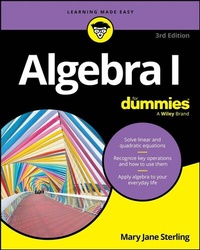
Algebra I For Dummies
Description

Feel confident in Algebra I
Algebra I For Dummies, 3rd Edition is your clear guide to grasping basic algebra. With the easy-to-follow explanations in this book, you'll understand variables, polynomials, absolute value, linear equations, and beyond. The content matches right up with Algebra I curricula and teaching methods, so you can follow right along in class and shine at exam time. For first-time learners and those looking for a refresher, this Dummies guide makes algebra truly approachable.
Inside:
- Get simple explanations paired with practical examples
- Stay on track with a fresh approach to common teaching methods
- Find tips and tricks for solving equations quicker and easier
- Learn key operations, linear and quadratic equations, and everyday applications
Perfect for anyone seeking a solid algebra foundation, Algebra I For Dummies, 3rd Edition also explains the "why" behind the math, setting you up for success in your mathematical education journey.
More details
Other editions
Additional editions
Person
Mary Jane Sterling is a math educator with more than 35 years of experience as a Professor of Mathematics at Bradley University. She continues to participate in activities providing math information and fun math activities for all ages.
Content
INTRODUCTION 1
About This Book 2
Foolish Assumptions 3
Icons Used in This Book 3
Beyond the Book 4
Where to Go from Here 4
PART 1: STARTING OFF WITH THE BASICS 5
CHAPTER 1: Assembling Your Tools 7
CHAPTER 2: Assigning Signs: Positive and Negative Numbers 17
CHAPTER 3: Figuring Out Fractions and Dealing with Decimals 33
CHAPTER 4: Exploring Exponents and Raising Radicals 53
CHAPTER 5: Doing Operations in Order and Checking Your Answers 71
PART 2: FIGURING OUT FACTORING 89
CHAPTER 6: Working with Numbers in Their Prime 91
CHAPTER 7: Sharing the Fun: Distribution 105
CHAPTER 8: Getting to First Base with Factoring 123
CHAPTER 9: Getting the Second Degree 135
CHAPTER 10: Factoring Special Cases 155
PART 3: WORKING EQUATIONS 169
CHAPTER 11: Establishing Ground Rules for Solving Equations 171
CHAPTER 12: Solving Linear Equations 183
CHAPTER 13: Taking a Crack at Quadratic Equations 203
CHAPTER 14: Distinguishing Equations with Distinctive Powers 223
CHAPTER 15: Rectifying Inequalities 243
PART 4: APPLYING ALGEBRA 263
CHAPTER 16: Taking Measure with Formulas 265
CHAPTER 17: Formulating for Profit and Pleasure 281
CHAPTER 18: Sorting Out Story Problems 293
CHAPTER 19: Going Visual: Graphing 311
CHAPTER 20: Lining Up Graphs of Lines 325
PART 5: THE PART OF TENS 343
CHAPTER 21: The Ten Best Ways to Avoid Pitfalls 345
GLOSSARY 359
INDEX 363
Chapter 1
Assembling Your Tools
IN THIS CHAPTER
Giving names to the basic numbers
Reading the signs - and interpreting the language
Operating in a timely fashion
You've probably heard the word algebra on many occasions, and you know that it has something to do with mathematics. Perhaps you remember that algebra has enough information to require taking two separate high school algebra classes - Algebra I and Algebra II. But what exactly is algebra? What is it really used for?
This book answers these questions and more, providing the straight scoop on some of the contributions to algebra's development, what it's good for, how algebra is used, and what tools you need to make it happen. In this chapter, you find some of the basics necessary to more easily find your way through the different topics in this book. I also point you toward these topics.
In a nutshell, algebra is a way of generalizing arithmetic. Through the use of variables (letters representing numbers) and formulas or equations involving those variables, you solve problems. The problems may be in terms of practical applications, or they may be puzzles for the pure pleasure of solving. Algebra uses positive and negative numbers, integers, fractions, operations, and symbols to analyze the relationships between values. It's a systematic study of numbers and their relationship, and it uses specific rules.
Beginning with the Basics: Numbers
Where would mathematics and algebra be without numbers? A part of everyday life, numbers are the basic building blocks of algebra. Numbers give you a value to work with. Where would civilization be today if not for numbers? Without numbers to figure the distances, slants, heights, and directions, the pyramids would never have been built. Without numbers to figure out navigational points, the Vikings would never have left Scandinavia. Without numbers to examine distance in space, humankind could not have landed on the moon. Without numbers, UPC codes and ISBNs wouldn't help with purchasing items. Without numbers, we wouldn't have computers! Eek!
Even the simple tasks and the most common of circumstances require a knowledge of numbers. Suppose that you wanted to figure out the amount of gasoline it takes to get from home to work and back each day. You need a number for the total miles between your home and business and another number for the total miles your car can run on a gallon of gasoline.
The different sets of numbers are important because what they look like and how they behave can set the scene for particular situations or help to solve particular problems. It's sometimes really convenient to declare, "I'm only going to look at whole-number answers," because whole numbers do not include fractions or negatives. You could easily end up with a fraction if you're working through a problem that involves a number of cars or people. Who wants half a car or, heaven forbid, a third of a person?
Algebra uses different sets of numbers in different circumstances. I describe the different types of numbers here.
AHA ALGEBRA
Dating back to about 2000 B.c. with the Babylonians, algebra seems to have developed in slightly different ways in different cultures. The Babylonians were solving three-term quadratic equations, while the Egyptians were more concerned with linear equations. The Hindus made further advances in about the sixth century A.d. In the seventh century, Brahmagupta of India provided general solutions to quadratic equations and had interesting takes on 0. The Hindus regarded irrational numbers as actual numbers - although not everybody held to that belief.
The sophisticated communication technology that exists in the world now was not available then, but early civilizations still managed to exchange information over the centuries. In A.d. 825, al-Khowarizmi of Baghdad wrote the first algebra textbook. One of the first solutions to an algebra problem, however, is on an Egyptian papyrus that is about 3,500 years old. Known as the Rhind Mathematical Papyrus after the Scotsman who purchased the 1-foot-wide, 18-foot-long papyrus in Egypt in 1858, the artifact is preserved in the British Museum - with a piece of it in the Brooklyn Museum. Scholars determined that in 1650 B.c., the Egyptian scribe Ahmes copied some earlier mathematical works onto the Rhind Mathematical Papyrus.
One of the problems reads, "Aha, its whole, its seventh, it makes 19." The aha isn't an exclamation. The word aha designated the unknown. Can you solve this early Egyptian problem? It would be translated, using current algebra symbols, as: . The unknown is represented by the x, and the solution is . It's not hard; it's just messy.
Really real numbers
Real numbers are just what the name implies. In contrast to imaginary numbers, they represent real values - no pretend or make-believe. Real numbers cover the gamut and can take on any form - fractions or whole numbers, decimal numbers that can go on forever and ever without end, positives and negatives. The variations on the theme are endless.
Imagining imaginary numbers
Imaginary numbers aren't something you've just dreamt about. But they are something that mathematicians dreamed up! They were tired of having to stop solving problems whenever they came to an expression involving . So, being clever and inventive, they designated that could be represented with the letter i. Putting that into the problem, they were able to finish and find a solution, although the i did indicate that the answer was imaginary. You find out more about imaginary numbers in Chapter 13.
Counting on natural numbers
A natural number (also called a counting number) is a number that comes naturally. What numbers did you first use? Remember someone asking, "How old are you?" You proudly held up four fingers and said, "Four!" The natural numbers are the numbers starting with 1 and going up by ones: 1, 2, 3, 4, 5, 6, 7, and so on into infinity. You'll find lots of counting numbers in Chapter 6, where I discuss prime numbers and factorizations.
Wholly whole numbers
Whole numbers aren't a whole lot different from natural numbers. Whole numbers are just all the natural numbers plus a 0: 0, 1, 2, 3, 4, 5, and so on into infinity.
Whole numbers act like natural numbers and are used when whole amounts (no fractions) are required. Zero can also indicate none. Algebraic problems often require you to round the answer to the nearest whole number. This makes perfect sense when the problem involves people, cars, animals, houses, or anything that shouldn't be cut into pieces.
Integrating integers
Integers allow you to broaden your horizons a bit. Integers incorporate all the qualities of whole numbers and their opposites (called their additive inverses). Integers can be described as being positive and negative whole numbers and zero: . -3, -2, -1, 0, 1, 2, 3, . .
Integers are popular in algebra. When you solve a long, complicated problem and come up with an integer, you can be joyous because your answer is probably right. After all, it's not a fraction! This doesn't mean that answers in algebra can't be fractions or decimals. It's just that most textbooks and reference books try to stick with nice answers to increase the comfort level and avoid confusion. This is my plan in this book, too, and was always my plan when teaching. After all, who wants a messy answer, even though, in real life, that's more often the case. I use integers in Chapters 8 and 9, where you find out how to solve equations.
Being reasonable: Rational numbers
Rational numbers act rationally! What does that mean? In this case, acting rationally means that the decimal equivalent of the rational number behaves. The decimal ends somewhere, or it has a repeating pattern to it. That's what constitutes "behaving."
Some rational numbers have decimals that end such as: 3.4, 5.77623, -4.5. Other rational numbers have decimals that repeat the same pattern, such as , or . The horizontal bar over the 164 and the 6 lets you know that these numbers repeat forever.
In all cases, rational numbers can be written as fractions. Each rational number has a fraction that it's equal to. So one definition of a rational number is any number that can be written as a fraction, , where p and q are integers (except q can't be 0). If a number can't be written as a fraction, then it isn't a rational number. Rational numbers appear in Chapter 13, where you see quadratic equations, and in Part 4, where the applications are presented.
Restraining irrational numbers
Irrational numbers are just what you may expect from their name - the opposite of rational numbers. An irrational number cannot be written as a fraction, and decimal values for irrationals never end and never have a nice pattern to them. Whew! Talk about irrational! For example, pi, with its...
