

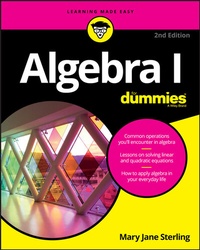
Algebra I For Dummies
2nd Edition
Published on 26. May 2016
384 pages
978-1-119-29759-8 (ISBN)
Description

Algebra I For Dummies, 2nd Edition (9781119293576) was previously published as Algebra I For Dummies, 2nd Edition (9780470559642). While this version features a new Dummies cover and design, the content is the same as the prior release and should not be considered a new or updated product.
Factor fearlessly, conquer the quadratic formula, and solve linear equations
There's no doubt that algebra can be easy to some while extremely challenging to others. If you're vexed by variables, Algebra I For Dummies, 2nd Edition provides the plain-English, easy-to-follow guidance you need to get the right solution every time!
Now with 25% new and revised content, this easy-to-understand reference not only explains algebra in terms you can understand, but it also gives you the necessary tools to solve complex problems with confidence. You'll understand how to factor fearlessly, conquer the quadratic formula, and solve linear equations.
* Includes revised and updated examples and practice problems
* Provides explanations and practical examples that mirror today's teaching methods
* Other titles by Sterling: Algebra II For Dummies and Algebra Workbook For Dummies
Whether you're currently enrolled in a high school or college algebra course or are just looking to brush-up your skills, Algebra I For Dummies, 2nd Edition gives you friendly and comprehensible guidance on this often difficult-to-grasp subject.
Factor fearlessly, conquer the quadratic formula, and solve linear equations
There's no doubt that algebra can be easy to some while extremely challenging to others. If you're vexed by variables, Algebra I For Dummies, 2nd Edition provides the plain-English, easy-to-follow guidance you need to get the right solution every time!
Now with 25% new and revised content, this easy-to-understand reference not only explains algebra in terms you can understand, but it also gives you the necessary tools to solve complex problems with confidence. You'll understand how to factor fearlessly, conquer the quadratic formula, and solve linear equations.
* Includes revised and updated examples and practice problems
* Provides explanations and practical examples that mirror today's teaching methods
* Other titles by Sterling: Algebra II For Dummies and Algebra Workbook For Dummies
Whether you're currently enrolled in a high school or college algebra course or are just looking to brush-up your skills, Algebra I For Dummies, 2nd Edition gives you friendly and comprehensible guidance on this often difficult-to-grasp subject.
More details
Other editions
New editions
Additional editions
Mary Jane Sterling
Algebra I For Dummies
Book
07/2016
2nd Edition
Wiley
€24.00
Shipment within 15-20 days
Person
Mary Jane Sterling (Peoria, Illinois) is the author of Algebra I For Dummies, Algebra Workbook For Dummies, Algebra II For Dummies, Algebra II Workbook For Dummies, and five other For Dummies books. She has been at Bradley University in Peoria, Illinois for nearly 30 years, teaching algebra, business calculus, geometry, finite mathematics, and whatever interesting material comes her way.
Content
- Intro
- Title Page
- Copyright Page
- Table of Contents
- Introduction
- About This Book
- Conventions Used in This Book
- What You're Not to Read
- Foolish Assumptions
- How This Book Is Organized
- Part 1: Starting Off with the Basics
- Part 2: Figuring Out Factoring
- Part 3: Working Equations
- Part 4: Applying Algebra
- Part 5: The Part of Tens
- Icons Used in This Book
- Where to Go from Here
- Part 1 Starting Off with the Basics
- Chapter 1 Assembling Your Tools
- Beginning with the Basics: Numbers
- Really real numbers
- Counting on natural numbers
- Wholly whole numbers
- Integrating integers
- Being reasonable: Rational numbers
- Restraining irrational numbers
- Picking out primes and composites
- Speaking in Algebra
- Taking Aim at Algebra Operations
- Deciphering the symbols
- Grouping
- Defining relationships
- Taking on algebraic tasks
- Chapter 2 Assigning Signs: Positive and Negative Numbers
- Showing Some Signs
- Picking out positive numbers
- Making the most of negative numbers
- Comparing positives and negatives
- Zeroing in on zero
- Going In for Operations
- Breaking into binary operations
- Introducing non-binary operations
- Operating with Signed Numbers
- Adding like to like: Same-signed numbers
- Adding different signs
- Subtracting signed numbers
- Multiplying and dividing signed numbers
- Working with Nothing: Zero and Signed Numbers
- Associating and Commuting with Expressions
- Reordering operations: The commutative property
- Associating expressions: The associative property
- Chapter 3 Figuring Out Fractions and Dealing with Decimals
- Pulling Numbers Apart and Piecing Them Back Together
- Making your bow to proper fractions
- Getting to know improper fractions
- Mixing it up with mixed numbers
- Following the Sterling Low-Fraction Diet
- Inviting the loneliest number one
- Figuring out equivalent fractions
- Realizing why smaller or fewer is better
- Preparing Fractions for Interactions
- Finding common denominators
- Working with improper fractions
- Taking Fractions to Task
- Adding and subtracting fractions
- Multiplying fractions
- Dividing fractions
- Dealing with Decimals
- Changing fractions to decimals
- Changing decimals to fractions
- Chapter 4 Exploring Exponents and Raising Radicals
- Multiplying the Same Thing Over and Over and Over
- Powering up exponential notation
- Comparing with exponents
- Taking notes on scientific notation
- Exploring Exponential Expressions
- Multiplying Exponents
- Dividing and Conquering
- Testing the Power of Zero
- Working with Negative Exponents
- Powers of Powers
- Squaring Up to Square Roots
- Chapter 5 Doing Operations in Order and Checking Your Answers
- Ordering Operations
- Gathering Terms with Grouping Symbols
- Checking Your Answers
- Making sense or cents or scents . . .
- Plugging in to get a charge of your answer
- Curbing a Variable's Versatility
- Representing numbers with letters
- Attaching factors and coefficients
- Interpreting the operations
- Doing the Math
- Adding and subtracting variables
- Adding and subtracting with powers
- Multiplying and Dividing Variables
- Multiplying variables
- Dividing variables
- Doing it all
- Part 2 Figuring Out Factoring
- Chapter 6 Working with Numbers in Their Prime
- Beginning with the Basics
- Composing Composite Numbers
- Writing Prime Factorizations
- Dividing while standing on your head
- Getting to the root of primes with a tree
- Wrapping your head around the rules of divisibility
- Getting Down to the Prime Factor
- Taking primes into account
- Pulling out factors and leaving the rest
- Chapter 7 Sharing the Fun: Distribution
- Giving One to Each
- Distributing first
- Adding first
- Distributing Signs
- Distributing positives
- Distributing negatives
- Reversing the roles in distributing
- Mixing It Up with Numbers and Variables
- Negative exponents yielding fractional answers
- Working with fractional powers
- Distributing More Than One Term
- Distributing binomials
- Distributing trinomials
- Multiplying a polynomial times another polynomial
- Making Special Distributions
- Recognizing the perfectly squared binomial
- Spotting the sum and difference of the same two terms
- Working out the difference and sum of two cubes
- Chapter 8 Getting to First Base with Factoring
- Factoring
- Factoring out numbers
- Factoring out variables
- Unlocking combinations of numbers and variables
- Changing factoring into a division problem
- Grouping Terms
- Chapter 9 Getting the Second Degree
- The Standard Quadratic Expression
- Reining in Big and Tiny Numbers
- FOILing
- FOILing basics
- FOILed again, and again
- Applying FOIL to a special product
- UnFOILing
- Unwrapping the FOILing package
- Coming to the end of the FOIL roll
- Making Factoring Choices
- Combining unFOIL and the greatest common factor
- Grouping and unFOILing in the same package
- Chapter 10 Factoring Special Cases
- Befitting Binomials
- Factoring the difference of two perfect squares
- Factoring the difference of perfect cubes
- Factoring the sum of perfect cubes
- Tinkering with Multiple Factoring Methods
- Starting with binomials
- Ending with binomials
- Knowing When to Quit
- Incorporating the Remainder Theorem
- Synthesizing with synthetic division
- Choosing numbers for synthetic division
- Part 3 Working Equations
- Chapter 11 Establishing Ground Rules for Solving Equations
- Creating the Correct Setup for Solving Equations
- Keeping Equations Balanced
- Balancing with binary operations
- Squaring both sides and suffering the consequences
- Taking a root of both sides
- Undoing an operation with its opposite
- Solving with Reciprocals
- Making a List and Checking It Twice
- Doing a reality check
- Thinking like a car mechanic when checking your work
- Finding a Purpose
- Chapter 12 Solving Linear Equations
- Playing by the Rules
- Solving Equations with Two Terms
- Devising a method using division
- Making the most of multiplication
- Reciprocating the invitation
- Extending the Number of Terms to Three
- Eliminating the extra constant term
- Vanquishing the extra variable term
- Simplifying to Keep It Simple
- Nesting isn't for the birds
- Distributing first
- Multiplying or dividing before distributing
- Featuring Fractions
- Promoting practical proportions
- Transforming fractional equations into proportions
- Solving for Variables in Formulas
- Chapter 13 Taking a Crack at Quadratic Equations
- Squaring Up to Quadratics
- Rooting Out Results from Quadratic Equations
- Factoring for a Solution
- Zeroing in on the multiplication property of zero
- Assigning the greatest common factor and multiplication property of zero to solving quadratics
- Solving Quadratics with Three Terms
- Applying Quadratic Solutions
- Figuring Out the Quadratic Formula
- Imagining the Worst with Imaginary Numbers
- Chapter 14 Distinguishing Equations with Distinctive Powers
- Queuing Up to Cubic Equations
- Solving perfectly cubed equations
- Working with the not-so-perfectly cubed
- Going for the greatest common factor
- Grouping cubes
- Solving cubics with integers
- Working Quadratic-Like Equations
- Rooting Out Radicals
- Powering up both sides
- Squaring both sides twice
- Solving Synthetically
- Chapter 15 Rectifying Inequalities
- Translating between Inequality and Interval Notation
- Intervening with interval notation
- Grappling with graphing inequalities
- Operating on Inequalities
- Adding and subtracting inequalities
- Multiplying and dividing inequalities
- Solving Linear Inequalities
- Working with More Than Two Expressions
- Solving Quadratic and Rational Inequalities
- Working without zeros
- Dealing with more than two factors
- Figuring out fractional inequalities
- Working with Absolute-Value Inequalities
- Working absolute-value equations
- Working absolute-value inequalities
- Part 4 Applying Algebra
- Chapter 16 Taking Measure with Formulas
- Measuring Up
- Finding out how long: Units of length
- Putting the Pythagorean theorem to work
- Working around the perimeter
- Spreading Out: Area Formulas
- Laying out rectangles and squares
- Tuning in triangles
- Going around in circles
- Pumping Up with Volume Formulas
- Prying into prisms and boxes
- Cycling cylinders
- Scaling a pyramid
- Pointing to cones
- Rolling along with spheres
- Chapter 17 Formulating for Profit and Pleasure
- Going the Distance with Distance Formulas
- Calculating Interest and Percent
- Compounding interest formulas
- Gauging taxes and discounts
- Working Out the Combinations and Permutations
- Counting down to factorials
- Counting on combinations
- Ordering up permutations
- Chapter 18 Sorting Out Story Problems
- Setting Up to Solve Story Problems
- Working around Perimeter, Area, and Volume
- Parading out perimeter and arranging area
- Adjusting the area
- Pumping up the volume
- Making Up Mixtures
- Mixing up solutions
- Tossing in some solid mixtures
- Investigating investments and interest
- Going for the green: Money
- Going the Distance
- Figuring distance plus distance
- Figuring distance and fuel
- Going 'Round in Circles
- Chapter 19 Going Visual: Graphing
- Graphing Is Good
- Grappling with Graphs
- Making a point
- Ordering pairs, or coordinating coordinates
- Actually Graphing Points
- Graphing Formulas and Equations
- Lining up a linear equation
- Going around in circles with a circular graph
- Throwing an object into the air
- Curling Up with Parabolas
- Trying out the basic parabola
- Putting the vertex on an axis
- Sliding and multiplying
- Chapter 20 Lining Up Graphs of Lines
- Graphing a Line
- Graphing the equation of a line
- Investigating Intercepts
- Sighting the Slope
- Formulating slope
- Combining slope and intercept
- Getting to the slope-intercept form
- Graphing with slope-intercept
- Marking Parallel and Perpendicular Lines
- Intersecting Lines
- Graphing for intersections
- Substituting to find intersections
- Part 5 The Part of Tens
- Chapter 21 The Ten Best Ways to Avoid Pitfalls
- Keeping Track of the Middle Term
- Distributing: One for You and One for Me
- Breaking Up Fractions (Breaking Up Is Hard to Do)
- Renovating Radicals
- Order of Operations
- Fractional Exponents
- Multiplying Bases Together
- A Power to a Power
- Reducing for a Better Fit
- Negative Exponents
- Chapter 22 The Ten Most Famous Equations
- Albert Einstein's Theory of Relativity
- The Pythagorean Theorem
- The Value of e
- Diameter and Circumference Related with Pi
- Isaac Newton's Formula for the Force of Gravity
- Euler's Identity
- Fermat's Last Theorem
- Monthly Loan Payments
- The Absolute-Value Inequality
- The Quadratic Formula
- Index
- EULA
