

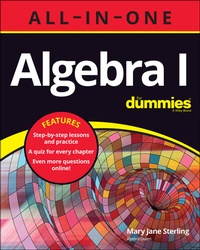
Algebra I All-in-One For Dummies
Description

A solid understanding of algebra is the key to unlocking other areas of math and science that rely on the concepts and skills that happen in a foundational Algebra class. Algebra I All-In-One For Dummies is the key! With it, you'll get everything you need to solve the mystery of Algebra I.
This book proves that algebra is for everyone with straightforward, unit-based instruction, hundreds of examples and practice problems, and two quizzes for every chapter - one in the book and another (totally different!) online. From graph and word problems to the FOIL method and common algebra terminology, Algebra I All-In-One For Dummies walks you step-by-step through ALL the concepts you need to know to slay your Algebra I class.
In this handy guide, you'll also:
* Receive instruction and tips on how to handle basic and intermediate algebraic tasks such as factoring and equation simplification
* Banish math anxiety forever by developing an intuitive understanding of how algebra works
* Get a handle on graphing problems and functions, as well as inequalities and word problems
Algebra I All-In-One For Dummies is a must-read for Algebra students looking for an everything-in-one-book supplement to their coursework, as well as anyone hoping to brush up on their math before tackling a related subject, such as physics, chemistry, or a more advanced math topic.
More details
Other editions
Additional editions
Person
Content
Chapter 1
Assembling Your Tools: Number Systems
IN THIS CHAPTER
Identifying the different types of numbers
Placing numbers on a number line
Becoming familiar with the vocabulary
Recognizing the operations of algebra
You've undoubtedly heard the word algebra on many occasions, and you know that it has something to do with mathematics. Perhaps you remember that algebra has enough stuff in it to require taking two separate high school algebra classes - Algebra I and Algebra II. But what exactly is algebra? What is it really used for?
This book answers these questions and more, providing the straight scoop on some of the contributions to algebra's development, what it's good for, how algebra is used, and what tools you need to make it happen. In this chapter, you find some of the basics necessary to make it easier to find your way through the different topics in this book.
In a nutshell, algebra is a way of generalizing arithmetic. Through the use of variables (letters representing numbers) and formulas or equations involving those variables, you solve problems. The problems may be in terms of practical applications, or they may be puzzles for the pure pleasure of the solving. Algebra uses positive and negative numbers, integers, fractions, operations, and symbols to analyze the relationships between values. It's a systematic study of numbers and their relationships, and it uses specific rules.
Identifying Numbers by Name
Where would mathematics and algebra be without numbers? Numbers aren't just a part of everyday life, they are the basic building blocks of algebra. Numbers give you a value to work with. Where would civilization be today if not for numbers? Without numbers to figure the distances, slants, heights, and directions, the pyramids would never have been built. Without numbers to figure out navigational points, the Vikings would never have left Scandinavia. Without numbers to examine distance in space, humankind could not have landed on the moon.
Even the simplest tasks and the most common of circumstances require a knowledge of numbers. Suppose that you wanted to figure the amount of gasoline it takes to get from home to work and back each day. You need a number for the total miles between your home and business, and another number for the total miles your car can run on a gallon of gasoline.
The different sets of numbers are important because what they look like and how they behave can set the scene for particular situations or help to solve particular problems. It's sometimes really convenient to declare, "I'm only going to look at whole-number answers," because whole numbers don't include fractions or negatives. You could easily end up with a fraction if you're working through a problem that involves a number of cars or people. Who wants half a car or, heaven forbid, a third of a person?
Algebra uses different sets of numbers, in different circumstances. I describe the different types of numbers here.
Realizing real numbers
Real numbers are just what the name implies. In contrast to imaginary numbers, they represent real values - no pretend or make-believe. Real numbers cover the gamut and can take on any form - fractions or whole numbers, decimal numbers that can go on forever and ever without end, positives and negatives. The variations on the theme are endless.
Counting on natural numbers
A natural number (also called a counting number) is a number that comes naturally. What numbers did you first use? Remember someone asking, "How old are you?" You proudly held up four fingers and said, "Four!" The natural numbers are the numbers starting with 1 and going up by ones: 1, 2, 3, 4, 5, 6, 7, and so on into infinity. You'll find lots of counting numbers in Chapter 8, where I discuss prime numbers and factorizations.
Whittling out whole numbers
Whole numbers aren't a whole lot different from natural numbers. Whole numbers are just all the natural numbers plus a 0: 0, 1, 2, 3, 4, 5, and so on into infinity.
Whole numbers act like natural numbers and are used when whole amounts (no fractions) are required. Zero can also indicate none. Algebraic problems often require you to round the answer to the nearest whole number. This makes perfect sense when the problem involves people, cars, animals, houses, or anything that shouldn't be cut into pieces.
Integrating integers
Integers allow you to broaden your horizons a bit. Integers incorporate all the qualities of whole numbers and their opposites (called their additive inverses). Integers can be described as being positive and negative whole numbers and zero: -3, -2, -1, 0, 1, 2, 3.
Integers are popular in algebra. When you solve a long, complicated problem and come up with an integer, you can be joyous because your answer is probably right. After all, it's not a fraction! This doesn't mean that answers in algebra can't be fractions or decimals. It's just that most textbooks and reference books try to stick with nice answers to increase the comfort level and avoid confusion. This is my plan in this book, too. After all, who wants a messy answer - even though, in real life, that's more often the case. I use integers in Chapter 14 and those later on, where you find out how to solve equations.
Being reasonable: Rational numbers
Rational numbers act rationally! What does that mean? In this case, acting rationally means that the decimal equivalent of the rational number behaves. The decimal eventually ends somewhere, or it has a repeating pattern to it. That's what constitutes "behaving."
Some rational numbers have decimals that end such as: 3.4, 5.77623, -4.5. Other rational numbers have decimals that repeat the same pattern, such as , or . The horizontal bar over the 164 and the 6 lets you know that these numbers repeat forever.
In all cases, rational numbers can be written as fractions. Each rational number has a fraction that it's equal to. So one definition of a rational number is any number that can be written as a fraction, , where p and q are integers (except q can't be 0). If a number can't be written as a fraction, then it isn't a rational number. Rational numbers appear in Chapter 16, where you see quadratic equations, and later, when the applications are presented.
Restraining irrational numbers
Irrational numbers are just what you may expect from their name: the opposite of rational numbers. An irrational number cannot be written as a fraction, and decimal values for irrationals never end and never have a nice pattern to them. Whew! Talk about irrational! For example, p, with its never-ending decimal places, is irrational. Irrational numbers are often created when using the quadratic formula, as you see in Chapter 16, because you find the square roots of numbers that are not perfect squares, such as: .
Picking out primes and composites
A number is considered to be prime if it can be divided evenly only by 1 and by itself. The prime numbers are: 2, 3, 5, 7, 11, 13, 17, 19, 23, 29, 31, and so on. The only prime number that's even is 2, the first prime number. Mathematicians have been studying prime numbers for centuries, and prime numbers have them stumped. No one has ever found a formula for producing all the primes. Mathematicians just assume that prime numbers go on forever.
A number is composite if it isn't prime - if it can be divided by at least one number other than 1 and itself. So the number 12 is composite because it's divisible by 1, 2, 3, 4, 6, and 12. Chapter 8 deals with primes, but you also see them throughout the chapters, where I show you how to factor primes out of expressions.
Numbers can be classified in more than one way, the same way that a person can be classified as male or female, tall or short, blonde or brunette, and so on. The number -3 is negative, it's an integer, it's an odd number, it's rational, and it's real. The number -3 is also a negative prime number. You should be familiar with all these classifications so that you can read mathematics correctly.
Zero: It's Complicated
Zero is a very special number. It wasn't really used in any of the earliest counting systems. In fact, there is no symbol for zero in the Roman numerals!
Zero is a very useful number, but it also comes with its challenges. You can't divide by zero, but you can add zero to a number and multiply a number by 0. You'll find zero popping up in the most interesting places!
Imagining imaginary numbers
Yes, there are imaginary numbers in mathematics. These numbers were actually created by mathematicians who didn't like not finishing a problem! They would be trying to solve a quadratic equation and be stumped by the situation where they needed the square root of a negative number. There was no way to deal with this.
So some clever mathematicians came up with a solution. They declared that must be equal to i. Yes, the i stands for...
