

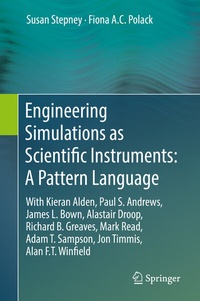
Engineering Simulations as Scientific Instruments: A Pattern Language
Description

This book describes CoSMoS (Complex Systems Modelling and Simulation), a pattern-based approach to engineering trustworthy simulations that are both scientifically useful to the researcher and scientifically credible to third parties. This approach emphasises three key aspects to this development of a simulation as a scientific instrument: the use of explicit models to capture the scientific domain, the engineered simulation platform, and the experimental results of running simulations; the use of arguments to provide evidence that the scientific instrument is fit for purpose; and the close co-working of domain scientists and simulation software engineers.
In Part I the authors provide a managerial overview: the rationale for and benefits of using the CoSMoS approach, and a small worked example to demonstrate it in action. Part II is a catalogue of the core patterns. Part III lists more specific "helper" patterns, showing possible routes to a simulation. Finally Part IV documents CellBranch, a substantial case study developed using the CoSMoS approach.
More details
Other editions
Additional editions
Content
Part I, Overview of the CoSMoS Approach.- CoSMoS: Rationale and Concepts.- What's In It for Me?.- The CoSMoS Approach in Miniature.- Part II, The Core CoSMoS Pattern Language.- The CoSMoS Simulation Pattern.- Discovery Phase Patterns: Building the Domain Model.- Development Phase Patterns: Developing the Platform.- Exploration Phase Patterns: Using the Platform.- Structured Argumentation Patterns.- Part III, The CoSMoS Helper Patterns.- Modelling and Documentation Patterns.- Real-World Simulation Patterns.- Part IV, CellBranch Case Study.- Introduction to the CellBranch Simulation.- CellBranch: Increment 1: Single Transcription Factor.- CellBranch: Increment 1: Discovery Phase.- CellBranch: Increment 1: Development Phase.- CellBranch: Increment 1: Exploration Phase.- CellBranch: Increment 2: Multiple Transcription Factors.- CellBranch: Increment 2: Discovery Phase.- CellBranch: Increment 2: Development Phase.- CellBranch: Increment 2: Exploration Phase.- CellBranch: Lessons and Code.
