

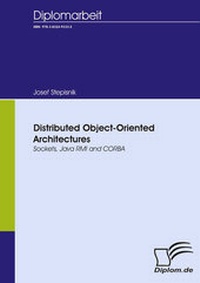
Distributed Object-Oriented Architectures
Sockets, Java RMI and CORBA
1st Edition
Published on 3. May 2007
109 pages
978-3-8324-9333-2 (ISBN)
Description

This document intends to offer a detailed discussion of selected distributed object-oriented architectures at conceptual level.
The first part of the discussion offers a comprehensive overview of the Socket architecture in Java 2 and Berkeley UNIX and the distributed object model of Java Remote Method Invocation and the Common Object Request Broker Architecture.
The second part concludes the discussion with a comparative study of selected features with emphasis on the Common Object Request Broker Architecture and Java Remote Method Invocation.
Major Issues Include
· The TCP/IP Protocol Suite. We provide an introductory overview of the TCP/IP protocol suite and its architecture including layers and protocols. The TCP/IP architecture is based on three concepts: processes, layers and protocols.
· Sockets in Berkeley Unix. We present the Berkeley UNIX socket architecture in relation to the Internet communication domain and illustrate connection-oriented and a connectionless models of communication.
· Sockets in Java 2. We describe the Java 2 socket architecture, outline selected socket operations, introduce related packages and classes and conclude with a framework for a connection-oriented and connectionless model of communication.
· Remote Method Invocation in Java 2. We present a distributed object model in Java RMI, provide an overview of related interfaces, classes and packages and discuss security related issues. We conclude with the development of a framework for a distributed object application.
· Common Object Request Broker Architecture. We introduce a distributed object model for the Common Object Request Broker Architecture and outline design concepts including the Interface Definition Language and the Interoperable Naming Service. We conclude with the development of a framework for a distributed object application.
· Comparative Study of Distributed Architectures. We present a comparative study of socket architectures and distributed object models introduced in part one of this document.
Sources of Information and References
This document is based on specifications, guidelines, Internet drafts and Internet standards issued by the Object Management Group consortium, Sun Microsystems, Inc. and the Internet Engineering Task Force - IETF.
In particular, the material for the TCP/IP protocol suit was obtained from IETF. Its responsibility includes the dissemination of Internet Drafts, referred to as Ready for Comments - RFCs. The chapters on the Java 2 Socket API and the Java Remote Method Invocation architecture are based on specifications provided by Sun Microsystems, Inc. The Sockets API in Berkeley UNIX is outlined in the corresponding documentation of Release 4.2. The Common Object Request Broker Architecture is documented in great detail in the form of specifications and introductory material issued by the Object Management Group consortium.
The first part of the discussion offers a comprehensive overview of the Socket architecture in Java 2 and Berkeley UNIX and the distributed object model of Java Remote Method Invocation and the Common Object Request Broker Architecture.
The second part concludes the discussion with a comparative study of selected features with emphasis on the Common Object Request Broker Architecture and Java Remote Method Invocation.
Major Issues Include
· The TCP/IP Protocol Suite. We provide an introductory overview of the TCP/IP protocol suite and its architecture including layers and protocols. The TCP/IP architecture is based on three concepts: processes, layers and protocols.
· Sockets in Berkeley Unix. We present the Berkeley UNIX socket architecture in relation to the Internet communication domain and illustrate connection-oriented and a connectionless models of communication.
· Sockets in Java 2. We describe the Java 2 socket architecture, outline selected socket operations, introduce related packages and classes and conclude with a framework for a connection-oriented and connectionless model of communication.
· Remote Method Invocation in Java 2. We present a distributed object model in Java RMI, provide an overview of related interfaces, classes and packages and discuss security related issues. We conclude with the development of a framework for a distributed object application.
· Common Object Request Broker Architecture. We introduce a distributed object model for the Common Object Request Broker Architecture and outline design concepts including the Interface Definition Language and the Interoperable Naming Service. We conclude with the development of a framework for a distributed object application.
· Comparative Study of Distributed Architectures. We present a comparative study of socket architectures and distributed object models introduced in part one of this document.
Sources of Information and References
This document is based on specifications, guidelines, Internet drafts and Internet standards issued by the Object Management Group consortium, Sun Microsystems, Inc. and the Internet Engineering Task Force - IETF.
In particular, the material for the TCP/IP protocol suit was obtained from IETF. Its responsibility includes the dissemination of Internet Drafts, referred to as Ready for Comments - RFCs. The chapters on the Java 2 Socket API and the Java Remote Method Invocation architecture are based on specifications provided by Sun Microsystems, Inc. The Sockets API in Berkeley UNIX is outlined in the corresponding documentation of Release 4.2. The Common Object Request Broker Architecture is documented in great detail in the form of specifications and introductory material issued by the Object Management Group consortium.
More details
Other editions
Additional editions
Book
04/2007
1st Edition
Diplomica Verlag
€58.00
Shipment within 7-9 days
Person
Josef Stepisnik obtained degrees in Electrical Engineering and Communications Engineering from a federal technical institute of higher education in Austria.
In addition, he received a diploma in Computer Science, a five-year degree program, with emphasis on theoretical computer science from a technical university in Austria. His diploma theses focused on distributed object models.
In addition, he received a diploma in Computer Science, a five-year degree program, with emphasis on theoretical computer science from a technical university in Austria. His diploma theses focused on distributed object models.
Content
1 - Abstract [Seite 5]
2 - Kurzfassung [Seite 7]
3 - Introduction [Seite 9]
4 - Contents [Seite 13]
5 - 1 The TCP/IP Protocol Suite [Seite 19]
5.1 - 1.1 Architecture [Seite 19]
5.2 - 1.2 Layers and Protocols [Seite 23]
5.3 - 1.3 Organizations and Standards [Seite 26]
6 - 2 Sockets in Berkeley Unix [Seite 29]
6.1 - 2.1 Architecture [Seite 29]
6.2 - 2.2 Connection-Oriented Model of Communication [Seite 36]
6.3 - 2.3 Connectionless Model of Communication [Seite 39]
7 - 3 Sockets in Java 2 [Seite 43]
7.1 - 3.1 Architecture [Seite 43]
7.2 - 3.2 Connection-Oriented Model of Communication [Seite 51]
7.3 - 3.3 Connectionless Model of Communication [Seite 53]
8 - 4 Remote Method Invocation - RMI [Seite 57]
8.1 - 4.1 Distributed Object Model in Java RMI [Seite 57]
8.2 - 4.2 Architecture [Seite 59]
8.3 - 4.3 Security Considerations in Java RMI [Seite 63]
8.4 - 4.4 Application Development Process in RMI [Seite 65]
9 - 5 Common Object Request Broker Architecture - CORBA [Seite 68]
9.1 - 5.1 Distributed Object Model in CORBA [Seite 68]
9.2 - 5.2 Interface Definition Language [Seite 70]
9.3 - 5.3 Interoperable Naming Service [Seite 71]
9.4 - 5.4 Portable Object Adapter [Seite 73]
9.5 - 5.5 Application Development Process in CORBA [Seite 74]
10 - 6 Comparative Study of Distributed Architectures [Seite 79]
10.1 - 6.1 Sockets in Java 2 and Berkeley UNIX [Seite 79]
10.2 - 6.2 Java RMI and CORBA [Seite 88]
10.3 - 6.3 Conclusions and Comparative Tables [Seite 100]
11 - 7 Summary [Seite 103]
2 - Kurzfassung [Seite 7]
3 - Introduction [Seite 9]
4 - Contents [Seite 13]
5 - 1 The TCP/IP Protocol Suite [Seite 19]
5.1 - 1.1 Architecture [Seite 19]
5.2 - 1.2 Layers and Protocols [Seite 23]
5.3 - 1.3 Organizations and Standards [Seite 26]
6 - 2 Sockets in Berkeley Unix [Seite 29]
6.1 - 2.1 Architecture [Seite 29]
6.2 - 2.2 Connection-Oriented Model of Communication [Seite 36]
6.3 - 2.3 Connectionless Model of Communication [Seite 39]
7 - 3 Sockets in Java 2 [Seite 43]
7.1 - 3.1 Architecture [Seite 43]
7.2 - 3.2 Connection-Oriented Model of Communication [Seite 51]
7.3 - 3.3 Connectionless Model of Communication [Seite 53]
8 - 4 Remote Method Invocation - RMI [Seite 57]
8.1 - 4.1 Distributed Object Model in Java RMI [Seite 57]
8.2 - 4.2 Architecture [Seite 59]
8.3 - 4.3 Security Considerations in Java RMI [Seite 63]
8.4 - 4.4 Application Development Process in RMI [Seite 65]
9 - 5 Common Object Request Broker Architecture - CORBA [Seite 68]
9.1 - 5.1 Distributed Object Model in CORBA [Seite 68]
9.2 - 5.2 Interface Definition Language [Seite 70]
9.3 - 5.3 Interoperable Naming Service [Seite 71]
9.4 - 5.4 Portable Object Adapter [Seite 73]
9.5 - 5.5 Application Development Process in CORBA [Seite 74]
10 - 6 Comparative Study of Distributed Architectures [Seite 79]
10.1 - 6.1 Sockets in Java 2 and Berkeley UNIX [Seite 79]
10.2 - 6.2 Java RMI and CORBA [Seite 88]
10.3 - 6.3 Conclusions and Comparative Tables [Seite 100]
11 - 7 Summary [Seite 103]
