

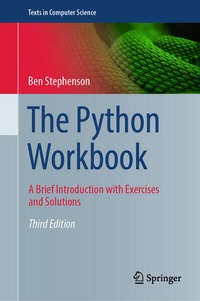
The Python Workbook
Description

The Python Workbook is a student-friendly compendium of 212 exercises that span a variety of academic disciplines and everyday situations paired with concise introductions to the programming concepts needed to complete them. Accessible and easy to follow, the textbook encourages development of programming skills through active practice and hands-on learning.
Thoroughly updated and expanded, this strong revised edition includes new sections on debugging, additional exercises in all chapters, and extensive revisions that reflect current practice, increase clarity, and ease comprehension. The exercises and solutions require no prior background knowledge, beyond the material covered in a typical introductory Python course.
Topics and features:
- includes a mixture of classic exercises from the fields of computer science and mathematics, along with exercises that connect to other academic disciplines
- presents the solutions to approximately half of the exercises
- provides annotations alongside the solutions, explaining the approach taken to solve the problem and relevant aspects of Python syntax
- contains exercises that encourage the development of programming skills using if statements, loops, functions, lists, dictionaries, files, and recursion
- examines common errors and how to correct them
- offers a variety of exercises of different lengths and difficulties
Undergraduate students enrolled in their first programming course will find this book ideal for their needs. Their programming and debugging skills will be enhanced by reading its chapters, completing its exercises, and studying the provided solutions.
More details
Other editions
Additional editions
Person
Dr. Ben Stephenson is a Teaching Professor in the Department of Computer Science at the University of Calgary, Canada. Recipient of the 2023 CS-CAN | INFO-CAN Excellence in Teaching Award, he also completed a two-year term as SIGCSE Technical Symposium Co-Chair. He also has authored the successful Springer textbook Fundamentals of Discrete Math for Computer Science .
Content
1. Introduction to Programming.- 2. Decision Making.- 3. Repetition.- 4. Functions.- 5. Lists.- 6. Dictionaries.- 7. Files and Exceptions.- 8. Recursion.
