

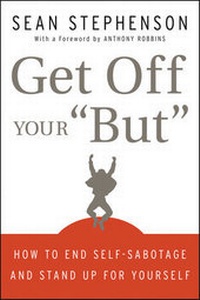
Get Off Your "But"
How to End Self-Sabotage and Stand Up for Yourself
Published on 30. March 2009
240 pages
978-0-470-44805-2 (ISBN)
Description

"Sean is an amazing person with an important message."
--President Bill Clinton
"Sean Stephenson is the Yoda of personal development, with lesspointy ears."
--Jimmy Kimmel, host of ABC's Jimmy Kimmel Live
"As we struggle with inertia to become the best that we can be,Sean Stephenson's book informs and inspires us to stand up and keepmoving forward. Thank you, Sean, for your life, your work, and yourabundant sharing."
--Ken Blanchard, coauthor, The One Minute Manager
"Sean Stephenson is a hero to me. When you read his book, hewill be a hero to you as well. His moving stories about himself andothers who have found the gifts in their pain will teach you somuch about courage and, just as important, you will learn how tobuild your own sense of confidence when it comes to health, career,relationships, and more. Do yourself a favor read this book!"
--Susan Jeffers, Ph.D., author, Feel the Fear and Do ItAnyway and Embracing Uncertainty
Reviews / Votes
In Stephenson's powerful and practical debut, the psychotherapist and professional speaker reveals how to banish self-doubt and insecurity in a world where they may seem omnipresent. Beginning with the source of his own struggle, a rare and painful disease that causes his bones to weaken and break under minimal pressure, Stephenson offers a structured approach to a wide array of topics, including dating, weight loss, lack of motivation, friendship, finances, and goals. While his advice is encouraging and insightful, Stephenson's text is also notable for examples, mottos and resonant personal stories of enormous obstacles and accomplishments (his work with the Clinton administration, attaining his Ph.D., opening his own private practice). Though his unwavering optimism can be daunting (bringing one's day-to-day gripes into sharp relief), Stephenson is empowering and uplifting throughout, and should prove helpful whether facing a lifelong challenge or a more immediate battle. (May) (PublishersWeekly.com, May 18, 2009)More details
Other editions
Additional editions
Book
05/2009
1st Edition
Jossey-Bass
€19.00
Shipment within 10-20 days
Persons
Sean Clinch Stephenson is one of the leading authorities on the deconstruction of self-sabotage (what he calls getting people off their BUTs). A psychotherapist and internationally known professional speaker, he publishes the international men's online magazine InnerGameMagazine.com and has a private psychotherapy practice.
Content
Acknowledgments.
Foreword by Anthony Robbins.
Born to Kick BUT: The Short Story of a Big Life.
Lesson 1 Start Connecting.
How Rene Got Off His BUT.
Lesson 2 Watch What You Say to Yourself!
How Bobby Got Off His BUT.
Lesson 3 Master Your Physical Confidence.
How Andréa Got Off Her BUT.
Lesson 4 Focus Your Focus.
How Mike Got Off His BUT .
Lesson 5 Choose Your Friends Wisely.
How Peter Got Off His BUT.
Lesson 6 Take Full Responsibility.
One Last Thing . . .
Resources.
The Author.
BORN TO KICK BUT The Short Story of a Big Life
Most parents pray that their baby will come out with all ten toes and ten fingers. And I did! Except they were all broken. As I made my entry into the world on May 5, 1979, the sudden silence of the doctors in the delivery room said it all: we've got trouble. Something was drastically wrong. My arms and legs flopped around like a rag doll's. The crown of my head was not just mildly misshapen from the pressure of the birth canal; it looked like a deformed piece of Silly Putty. As the doctors would soon learn, almost every bone in my tiny body had been crushed by the stress of being born. They told my parents to prepare for the worst: "There's a good chance Sean will die within twenty-four hours." The doctors quickly determined that I had been born with a genetic disorder that caused my bones to be incredibly brittle. The slightest touch could break my bones, so they ordered that no one should touch me or hold me close. For the first few weeks of my life, I was kept immobilized in the intensive care unit of Chicago's Children's Hospital. I was not a happy camper. My cries were not those of a fussy baby in need of a quick poopy-diaper change, but blood-curdling cries of pain. I like to say now that I was being considerate-I cried during only two long periods of the day: when the sun was up and when it was down.
Birth had not been good to me. X-rays showed that it would be quicker to count the number of bones that weren't broken in my body than those that were. To contain the massive trauma, doctors built a tiny cast that encased most of my body, and propped me on a pillow with my arms and legs sticking straight out. The nurses announced that I looked like King Tut on his throne-the Field Museum had opened its King Tut exhibit just that month. Could I be the reincarnated soul of an ancient Egyptian VIP? The return of the pharaoh's spirit remains purely speculative, but he and I did turn out to have one thing in common: despite the pain of my birth and first days on earth, my life would be filled with adventures fit for a king. The doctors explained to my parents that I had been born with Osteogenesis Imperfecta, commonly called OI or brittle bones disorder. My mom and dad could hardly pronounce it, let alone fathom the endless challenges it would present for them. Those challenges started on the day of my birth. They couldn't swaddle me up in a cute little blanket and take me home to the nursery they had prepared for my arrival, or let my big sister, Heidi, cuddle me. No, they had to leave me in a sterile room in the care of (almost) complete strangers.
After the delivery, my mother lay in a hospital bed all by herself. She had been told to grieve, either for the impending loss of her baby-I might die at any minute-or for the ongoing loss of not having a "normal" baby. My parents were told that I would never grow up physically, that my growth would be permanently stunted. My bones would be as fragile as glass: little-even no-impact could cause them to break. The stress of a sneeze could shatter my ribs. And then a nurse came into my mom's room with a really big hypodermic. "What's this for?" my mom asked. "To dry up your mother's milk." "What would I want to do that for?" "Well," said the nurse, holding the syringe in the air and preparing to inject it, "why would you want to nurse a baby like that?" I'm surprised my mom didn't grab the needle and stab the nurse. Needless to say, my mom refused the shot. Then she and my dad began to refuse many other things. Their greatest gift to me was refusing to lose faith in my survival. They never thought about me in a negative way-not once. They never said, "We would be happy about the birth of our son . . . BUT he is never going to be normal." In fact, they weren't compelled in the slightest to sit back on their BUTS! They never stopped loving me exactly as I was, then and now. They never lost faith that I was okay and was going to survive. They never succumbed to any doubt or ambivalence about me as a human being, their son. They never thought, "Sure, Sean's a great kid, BUT . . ." They never gave up on me. My mom went home, and pumped breast milk. My dad visited me in the hospital in the city every day to feed me the tiny bottles of Mom's milk that she had sent with love from home. And I didn't die-in fact, despite the odds, I was more and more ready to live. I owed my fighting spirit to my parents, who from day one were solidly committed to seeing me survive, succeed, and develop into a powerful force on this planet. It wasn't an easy road to travel, when taking even one step could break my leg.
While other kids my age were progressing from squirming to crawling to wobbling to walking, I went from not moving at all to my own take on crawling. My family called it "scootching." This maneuver, which entailed alternately shifting my shoulders and rear, was like an army crawl-very flat to the ground, except on my back. At first, I moved about as quickly as a moderately fast snail. Eventually, when I developed the muscles to log-roll my body around the house, I achieved a much quicker land speed. Sitting up-a milestone for other babies-was beyond my capabilities. At that time, my muscle structure was not developed enough to sit myself up from a lying-down position. I was shocked the first time I saw someone with my condition prop himself upright on his own. That "Aha!" moment occurred a few years later, at Chicago's Shriners Hospital, where I received regular medical treatment. There, I came face-to-face with someone whose physical appearance actually resembled mine! I had spent my whole life around "normal-looking" people, so to finally see someone who was my height, used a wheelchair, and actually had the exact same facial features was both startling and overwhelming. Imagine living your whole life on a planet where everyone is ten feet tall and has green skin. Then one day you turn the corner and you're toe to toe with someone your own height and your own skin color. It was a huge revelation and a huge relief. My years in and out of hospitals also gave me an important insight: other people had problems too. I learned that there were far more debilitating conditions than mine. I saw a man who had to endure the agonizing pain of third-degree burns over most of his body. There were people paralyzed from the neck down, who could only breathe on ventilators. Some children had immune systems so chaotic they couldn't leave the sterile hospital environment. At least I had feeling and movement throughout my body. All the major systems in my body (digestive, respiratory, cardiovascular, reproductive, and so on) worked just fine. It was the other stuff-the everyday parts most people take for granted-that were a problem for me. For example, a small but crucial challenge I faced when I was growing up was reaching the top of my head. My arms have never been long enough. And though that might not sound like a big deal, it is. Putting on a baseball cap, brushing my hair, or-more important-scratching an annoying itch were all out of the question without the assistance of others. Standing was also out of the question. I've never had the bone density to support my body in a standing position, so walking has never been possible. Even if I could support the weight on my legs, I still couldn't walk, because my muscles are more developed and stronger than my bones. Over the years, they have bent and twisted my legs into a permanent position that makes walking impossible. Before that happened, though, surgeons had attempted to straighten my legs by inserting metal rods. Unfortunately, my body rejected the rods, actually forcing them right out of my bones over a period of months. The most intense sensation of physical pain I've ever experienced was the day the doctors removed a rod from my left leg. They gave me just a topical anesthetic to prep the skin for the incision, and told me it wouldn't hurt that bad. Uh-huh. Right! I'll never forget it. They took hold of the tip of the rod that was already poking out of the bone and began to pull. A scalding hot rrripp! shot up my leg and straight into the base of my brain. It felt as if someone were turning my leg inside out, as if they'd inserted a giant vacuum cleaner into my kneecap and sucked out my entire lower leg bone. From that moment on, I had no interest in getting another rod put into my body, especially because it wouldn't have improved my chances of walking or made me any taller. I basically reached my full height-three feet tall-in about the third grade, and haven't grown since.
I've had four wheelchairs in my life-five, if you count the super-sporty, low-profile, turquoise green racing chair that I use for exercise. But even the regular ones got way more interesting from time to time. My parents soon became very creative with my wheelchairs. They built me great floats-an elaborate cardboard "costume" we put around my chair for me to show off three times a year: Halloween, Fourth of July parades, and...
Most parents pray that their baby will come out with all ten toes and ten fingers. And I did! Except they were all broken. As I made my entry into the world on May 5, 1979, the sudden silence of the doctors in the delivery room said it all: we've got trouble. Something was drastically wrong. My arms and legs flopped around like a rag doll's. The crown of my head was not just mildly misshapen from the pressure of the birth canal; it looked like a deformed piece of Silly Putty. As the doctors would soon learn, almost every bone in my tiny body had been crushed by the stress of being born. They told my parents to prepare for the worst: "There's a good chance Sean will die within twenty-four hours." The doctors quickly determined that I had been born with a genetic disorder that caused my bones to be incredibly brittle. The slightest touch could break my bones, so they ordered that no one should touch me or hold me close. For the first few weeks of my life, I was kept immobilized in the intensive care unit of Chicago's Children's Hospital. I was not a happy camper. My cries were not those of a fussy baby in need of a quick poopy-diaper change, but blood-curdling cries of pain. I like to say now that I was being considerate-I cried during only two long periods of the day: when the sun was up and when it was down.
Brittle Bones
Birth had not been good to me. X-rays showed that it would be quicker to count the number of bones that weren't broken in my body than those that were. To contain the massive trauma, doctors built a tiny cast that encased most of my body, and propped me on a pillow with my arms and legs sticking straight out. The nurses announced that I looked like King Tut on his throne-the Field Museum had opened its King Tut exhibit just that month. Could I be the reincarnated soul of an ancient Egyptian VIP? The return of the pharaoh's spirit remains purely speculative, but he and I did turn out to have one thing in common: despite the pain of my birth and first days on earth, my life would be filled with adventures fit for a king. The doctors explained to my parents that I had been born with Osteogenesis Imperfecta, commonly called OI or brittle bones disorder. My mom and dad could hardly pronounce it, let alone fathom the endless challenges it would present for them. Those challenges started on the day of my birth. They couldn't swaddle me up in a cute little blanket and take me home to the nursery they had prepared for my arrival, or let my big sister, Heidi, cuddle me. No, they had to leave me in a sterile room in the care of (almost) complete strangers.
My Parents Didn't Sit on Their BUTS
After the delivery, my mother lay in a hospital bed all by herself. She had been told to grieve, either for the impending loss of her baby-I might die at any minute-or for the ongoing loss of not having a "normal" baby. My parents were told that I would never grow up physically, that my growth would be permanently stunted. My bones would be as fragile as glass: little-even no-impact could cause them to break. The stress of a sneeze could shatter my ribs. And then a nurse came into my mom's room with a really big hypodermic. "What's this for?" my mom asked. "To dry up your mother's milk." "What would I want to do that for?" "Well," said the nurse, holding the syringe in the air and preparing to inject it, "why would you want to nurse a baby like that?" I'm surprised my mom didn't grab the needle and stab the nurse. Needless to say, my mom refused the shot. Then she and my dad began to refuse many other things. Their greatest gift to me was refusing to lose faith in my survival. They never thought about me in a negative way-not once. They never said, "We would be happy about the birth of our son . . . BUT he is never going to be normal." In fact, they weren't compelled in the slightest to sit back on their BUTS! They never stopped loving me exactly as I was, then and now. They never lost faith that I was okay and was going to survive. They never succumbed to any doubt or ambivalence about me as a human being, their son. They never thought, "Sure, Sean's a great kid, BUT . . ." They never gave up on me. My mom went home, and pumped breast milk. My dad visited me in the hospital in the city every day to feed me the tiny bottles of Mom's milk that she had sent with love from home. And I didn't die-in fact, despite the odds, I was more and more ready to live. I owed my fighting spirit to my parents, who from day one were solidly committed to seeing me survive, succeed, and develop into a powerful force on this planet. It wasn't an easy road to travel, when taking even one step could break my leg.
Growing Up the Hard Way
While other kids my age were progressing from squirming to crawling to wobbling to walking, I went from not moving at all to my own take on crawling. My family called it "scootching." This maneuver, which entailed alternately shifting my shoulders and rear, was like an army crawl-very flat to the ground, except on my back. At first, I moved about as quickly as a moderately fast snail. Eventually, when I developed the muscles to log-roll my body around the house, I achieved a much quicker land speed. Sitting up-a milestone for other babies-was beyond my capabilities. At that time, my muscle structure was not developed enough to sit myself up from a lying-down position. I was shocked the first time I saw someone with my condition prop himself upright on his own. That "Aha!" moment occurred a few years later, at Chicago's Shriners Hospital, where I received regular medical treatment. There, I came face-to-face with someone whose physical appearance actually resembled mine! I had spent my whole life around "normal-looking" people, so to finally see someone who was my height, used a wheelchair, and actually had the exact same facial features was both startling and overwhelming. Imagine living your whole life on a planet where everyone is ten feet tall and has green skin. Then one day you turn the corner and you're toe to toe with someone your own height and your own skin color. It was a huge revelation and a huge relief. My years in and out of hospitals also gave me an important insight: other people had problems too. I learned that there were far more debilitating conditions than mine. I saw a man who had to endure the agonizing pain of third-degree burns over most of his body. There were people paralyzed from the neck down, who could only breathe on ventilators. Some children had immune systems so chaotic they couldn't leave the sterile hospital environment. At least I had feeling and movement throughout my body. All the major systems in my body (digestive, respiratory, cardiovascular, reproductive, and so on) worked just fine. It was the other stuff-the everyday parts most people take for granted-that were a problem for me. For example, a small but crucial challenge I faced when I was growing up was reaching the top of my head. My arms have never been long enough. And though that might not sound like a big deal, it is. Putting on a baseball cap, brushing my hair, or-more important-scratching an annoying itch were all out of the question without the assistance of others. Standing was also out of the question. I've never had the bone density to support my body in a standing position, so walking has never been possible. Even if I could support the weight on my legs, I still couldn't walk, because my muscles are more developed and stronger than my bones. Over the years, they have bent and twisted my legs into a permanent position that makes walking impossible. Before that happened, though, surgeons had attempted to straighten my legs by inserting metal rods. Unfortunately, my body rejected the rods, actually forcing them right out of my bones over a period of months. The most intense sensation of physical pain I've ever experienced was the day the doctors removed a rod from my left leg. They gave me just a topical anesthetic to prep the skin for the incision, and told me it wouldn't hurt that bad. Uh-huh. Right! I'll never forget it. They took hold of the tip of the rod that was already poking out of the bone and began to pull. A scalding hot rrripp! shot up my leg and straight into the base of my brain. It felt as if someone were turning my leg inside out, as if they'd inserted a giant vacuum cleaner into my kneecap and sucked out my entire lower leg bone. From that moment on, I had no interest in getting another rod put into my body, especially because it wouldn't have improved my chances of walking or made me any taller. I basically reached my full height-three feet tall-in about the third grade, and haven't grown since.
My "Costumized" Wheelchair
I've had four wheelchairs in my life-five, if you count the super-sporty, low-profile, turquoise green racing chair that I use for exercise. But even the regular ones got way more interesting from time to time. My parents soon became very creative with my wheelchairs. They built me great floats-an elaborate cardboard "costume" we put around my chair for me to show off three times a year: Halloween, Fourth of July parades, and...
