

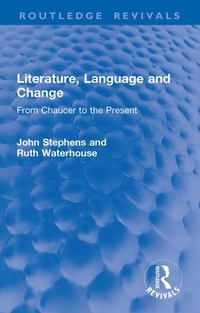
Literature, Language and Change
From Chaucer to the Present
Published on 1. June 2026
314 pages
978-1-040-94912-2 (ISBN)
Description

How did the rise of polite society change the language of literature? What was the effect of Romanticism on poetic word order? How does knowing the answers to these questions alter the meaning of a text for us?
Reading literature is a quest for sense, involving us in a need to grasp both how meaning is produced by the words on the page and how history, culture and ideology have influenced the choice of those words. Literary English changes from period to period as it reflects variations in the society and culture in which it is produced - variations in the ways writers construct images of their world, shifts in the relationships between readers, texts and writers, and linguistic change.
First published in 1990, Literature, Language and Change offers a historical perspective on literary English, from the mid-fourteenth century to the twentieth century. Through detailed analyses of individual texts and comparisons with texts from different periods, Stephens and Waterhouse build up a picture of the important and distinctive characteristics of each period and of the changes between them.
Reading literature is a quest for sense, involving us in a need to grasp both how meaning is produced by the words on the page and how history, culture and ideology have influenced the choice of those words. Literary English changes from period to period as it reflects variations in the society and culture in which it is produced - variations in the ways writers construct images of their world, shifts in the relationships between readers, texts and writers, and linguistic change.
First published in 1990, Literature, Language and Change offers a historical perspective on literary English, from the mid-fourteenth century to the twentieth century. Through detailed analyses of individual texts and comparisons with texts from different periods, Stephens and Waterhouse build up a picture of the important and distinctive characteristics of each period and of the changes between them.
More details
Series
Language
English
Place of publication
London
United Kingdom
Publishing group
Taylor & Francis Ltd
Target group
College/higher education
File size
36,95 MB
ISBN-13
978-1-040-94912-2 (9781040949122)
Copyright in bibliographic data and cover images is held by Nielsen Book Services Limited or by the publishers or by their respective licensors: all rights reserved.
Schweitzer Classification
Other editions
Additional editions
Book
06/2026
1st Edition
Routledge
€185.50
Shipment within 15-20 days
Content
1. Approaches to decoding the language of literature 2. Syntagm and paradigm from Chaucer to Milton 3. Revolutions in literary English 4. A shifting focus: the nineteenth century 5. The twentieth century: struggles with the word 6. 'This mad instead': figurative language 7. Conclusion
