

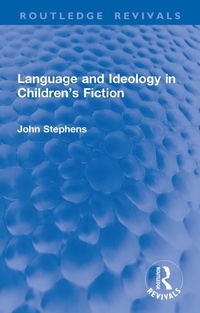
Language and Ideology in Children's Fiction
Published on 1. June 2026
322 pages
978-1-040-94973-3 (ISBN)
Description

When children read fiction, they are exposed to the beliefs which inform and structure their society. Books encourage child readers to internalize particular ways of seeing the world and help shape their development as individuals. Although this process forms a key part of their education, it remains largely invisible. As well as a story, fictions impart a significance to readers - often without revealing its presence or ground - and therefore have considerable potential to socialize their audience.
First published in 1992, Language and Ideology in Children's Fiction analyzes this process and shows how fictions can work to constrain or liberate audience responses. He explores picture books as well as historical, realistic, and fantastic fictions to show how both a character within the narrative and the implied reader are positioned within ideology. The author considers areas of ideology not previously examined and offers new perspectives on realism and fantasy. The book will be of interest to linguists and teachers as well as to the general reader.
First published in 1992, Language and Ideology in Children's Fiction analyzes this process and shows how fictions can work to constrain or liberate audience responses. He explores picture books as well as historical, realistic, and fantastic fictions to show how both a character within the narrative and the implied reader are positioned within ideology. The author considers areas of ideology not previously examined and offers new perspectives on realism and fantasy. The book will be of interest to linguists and teachers as well as to the general reader.
More details
Series
Language
English
Place of publication
London
United Kingdom
Publishing group
Taylor & Francis Ltd
Target group
College/higher education
File size
28,84 MB
ISBN-13
978-1-040-94973-3 (9781040949733)
Copyright in bibliographic data and cover images is held by Nielsen Book Services Limited or by the publishers or by their respective licensors: all rights reserved.
Schweitzer Classification
Other editions
Additional editions
John Stephens
Language and Ideology in Children's Fiction
Book
06/2026
1st Edition
Routledge
€185.50
Shipment within 15-20 days
Person
John Stephens is Emeritus Professor in the Department of English, Macquarie University, Australia. He has taught and researched children's literature for almost 30 years but continues to maintain interests in other fields of literary, film and cultural studies, under the conviction that children's literature studies should maintain an active dialogue with other areas of research. In recognition of his contribution to research in children's literature, John was recipient of the International Brothers Grimm Award in 2007 and the Anne Devereaux Jordan Award in 2014. He was elected a Life Fellow of IRSCL in August 2015.
Content
Introduction: Examining ideology in children's fiction 1. Ideology, discourse and narrative fiction 2. Readers and subject positions in children's fiction 3. Not by words alone: language, intertextuality, society 4. Ideology, carnival and interrogative texts 5. Primary scenes: the family and picture books 6. Contemplating otherness: ideology and historical fiction 7. Words of power: fantasy and realism as linguistically constituted modes
