

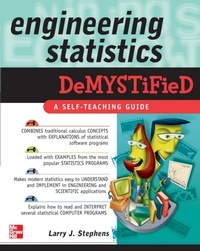
Engineering Statistics Demystified
1st Edition
Published on 3. January 2007
458 pages
978-0-07-171089-3 (ISBN)
Description

United States audience includes 120,000-plus engineering students and 60,000-plus science majors who are required to take a calculus-based statistics course Includes examples from MINITAB, EXCEL, STATISTIXS, SAS, SPSS, and MAPLE statistical software programs
More details
Other editions
Additional editions
Larry Stephens
Engineering Statistics Demystified
Book
01/2007
McGraw-Hill Professional
€25.98
Article not available at the moment
Content
- Intro
- Contents
- Preface
- Acknowledgments
- CHAPTER 1 Treatment of Data Using EXCEL, MINITAB, SAS, SPSS, and STATISTIX
- 1.1 Graphical Displays of Data
- 1.2 Descriptive Measures of Data
- 1.3 Measures of Relative Standing
- Exercises
- Summary
- CHAPTER 2 Probability
- 2.1 Sample Space, Events, and Operations on Events
- 2.2 The Multiplicative Rule, Permutations, and Combinations
- 2.3 Probability
- 2.4 The Axioms of Probability
- 2.5 Some Elementary Theorems (Rules) of Probability
- 2.6 Conditional Probability
- 2.7 Bayes' Theorem
- 2.8 Mathematical Expectation
- Exercises
- Summary
- CHAPTER 3 Probability Distributions for Discrete Random Variables
- 3.1 Random Variables
- 3.2 The Mean and Standard Deviation of a Probability Distribution
- 3.3 Chebyshev's Theorem
- 3.4 The Binomial Distribution
- 3.5 The Hypergeometric Distribution
- 3.6 The Geometric Distribution
- 3.7 The Negative Binomial Distribution
- 3.8 The Poisson Distribution
- 3.9 The Multinomial Distribution
- 3.10 Simulation
- Exercises
- Summary
- CHAPTER 4 Probability Densities for Continuous Random Variables and Introduction to MAPLE
- 4.1 Continuous Random Variables
- 4.2 The Normal Distribution
- 4.3 The Normal Approximation to the Binomial Distribution
- 4.4 The Uniform Distribution
- 4.5 The Log-Normal Distribution
- 4.6 The Gamma Distribution
- 4.7 The Beta Distribution
- 4.8 The Weibull Distribution
- 4.9 Joint Distributions-Discrete and Continuous
- 4.10 Checking Data for Normality
- 4.11 Transforming Observations to Near Normality
- 4.12 Simulation
- Exercises
- Summary
- CHAPTER 5 Sampling Distributions
- 5.1 Populations and Samples
- 5.2 The Sampling Distribution of the Mean (s Known)
- 5.3 The Sampling Distribution of the Mean (s Unknown)
- 5.4 The Sampling Distribution of the Proportion
- 5.5 The Sampling Distribution of the Variance
- Exercises
- Summary
- CHAPTER 6 Inferences Concerning Means
- 6.1 Point Estimation
- 6.2 Interval Estimation
- 6.3 Basic Concepts of Testing Hypotheses
- 6.4 Testing Hypothesis About a Single Mean
- 6.5 The Relationship between Tests of Hypothesis and Confidence Intervals
- 6.6 Inferences Concerning Two Means-Independent and Large Samples
- 6.7 Inferences Concerning Two Means-Independent and Small Samples
- 6.8 Inferences Concerning Two Means-Dependent Samples
- Exercises
- Summary
- CHAPTER 7 Inferences Concerning Variances
- 7.1 The Estimation of Variances
- 7.2 Hypotheses Concerning One Variance
- 7.3 Hypotheses Concerning Two Variances
- Exercises
- Summary
- CHAPTER 8 Inferences Concerning Proportions
- 8.1 Estimation of Proportions
- 8.2 Hypotheses Concerning One Proportion
- 8.3 Hypotheses Concerning Two Proportions
- 8.4 Hypotheses Concerning Several Proportions
- 8.5 The Analysis of r × c Tables
- Exercises
- Summary
- Final Examinations
- Final Examination One
- Final Examination Two
- Solutions to Chapter Exercises and Final Exams
- Bibliography
- Index
