

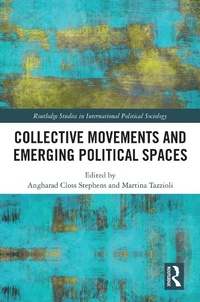
Collective Movements and Emerging Political Spaces
1st Edition
Published on 31. May 2024
244 pages
978-1-040-00777-8 (ISBN)
Description

Collective Movements and Emerging Political Spaces addresses the politics of new forms of collective movements, ranging from anti-austerity protests to migrant struggles and anticolonial demonstrations.
Drawing on examples from various countries, as well as struggles taking place across borders, this book traces the emergence of new practices of being political, described as 'collective movements'. These represent something looser than a common identity - long held as necessary for a political struggle to cohere. They also suggest a different understanding of emancipation to the promise of transformation in time. By addressing various examples of 'collective movements', the chapters in this book examine other ways of being political together, formed through relations carved in cramped spaces or small movements that rearrange our ideas about what is possible. Drawing on the temporary and fleeting nature of many migrants' struggles, the chapters develop concepts and approaches that acknowledge how such mobilisations trouble many standard political sociological categories - including nation, identity and citizenship. In combining an attentiveness to theories of affect, emotion and atmosphere, they also go beyond a focus on either individuals or collectives, to address the ways bodies are moved by the world and by others. Overall, the chapters propose new questions, methods and starting points for addressing collective movements in emerging political spaces, and for understanding how what counts as politics is being redrawn on the ground.
This book will interest students, researchers and scholars of international political sociology, human geography, international relations, critical security studies and migration studies.
Drawing on examples from various countries, as well as struggles taking place across borders, this book traces the emergence of new practices of being political, described as 'collective movements'. These represent something looser than a common identity - long held as necessary for a political struggle to cohere. They also suggest a different understanding of emancipation to the promise of transformation in time. By addressing various examples of 'collective movements', the chapters in this book examine other ways of being political together, formed through relations carved in cramped spaces or small movements that rearrange our ideas about what is possible. Drawing on the temporary and fleeting nature of many migrants' struggles, the chapters develop concepts and approaches that acknowledge how such mobilisations trouble many standard political sociological categories - including nation, identity and citizenship. In combining an attentiveness to theories of affect, emotion and atmosphere, they also go beyond a focus on either individuals or collectives, to address the ways bodies are moved by the world and by others. Overall, the chapters propose new questions, methods and starting points for addressing collective movements in emerging political spaces, and for understanding how what counts as politics is being redrawn on the ground.
This book will interest students, researchers and scholars of international political sociology, human geography, international relations, critical security studies and migration studies.
Reviews / Votes
'An impressive and compelling edited volume on collective movements and the "counter-discourses" that characterise them. In our turbulent times, this volume provides a critical outlook at the idea of movement, both as mobilisation and emergence of new political subjectivities, engaging with politics of affect and emotions to reframe pressing topics such as migration and nationalism.'Annaclaudia Martini, University of Bologna, Italy
More details
Series
Edition
1. Auflage
Language
English
Place of publication
London
United Kingdom
Publishing group
Taylor & Francis Ltd
Target group
College/higher education
Product notice
Reflowable
Illustrations
12 Line drawings, black and white; 12 Illustrations, black and white
ISBN-13
978-1-040-00777-8 (9781040007778)
Copyright in bibliographic data and cover images is held by Nielsen Book Services Limited or by the publishers or by their respective licensors: all rights reserved.
Schweitzer Classification
Other editions
Additional editions
Angharad Closs Stephens | Martina Tazzioli
Collective Movements and Emerging Political Spaces
Book
10/2025
1st Edition
Routledge
€81.70
Shipment within 10-20 days
Angharad Closs Stephens | Martina Tazzioli
Collective Movements and Emerging Political Spaces
Book
05/2024
1st Edition
Routledge
€211.80
Shipment within 10-20 days
Persons
Angharad Closs Stephens is Associate Professor in Human Geography at Swansea University, Cymru/Wales, UK. She is the author of National Affects: The Everyday Atmospheres of Being Political (2022), The Persistence of Nationalism: From imagined Communities to Urban Encounters (2013) and co-editor with Nick Vaughan-Williams of Terrorism and the Politics of Response (2009).
Martina Tazzioli is Associate Professor in Human Geography at the University of Bologna, Italy. She is the author of Border Abolitionism. Migration Containment and the Genealogies of Struggles and Rescue (2023), The Making of Migration: The Biopolitics of Mobility at Europe's Borders (2020), Spaces of Governmentality: Autonomous Migration and the Arab Uprisings (2015) and co-author with G. Garelli of Tunisia as a Revolutionised Space of Migration (2016). She is co-editor of Foucault and the History of our Present (2015) and Foucault and the Making of Subjects (2016). She is on the editorial collective of the journal Radical Philosophy.
Martina Tazzioli is Associate Professor in Human Geography at the University of Bologna, Italy. She is the author of Border Abolitionism. Migration Containment and the Genealogies of Struggles and Rescue (2023), The Making of Migration: The Biopolitics of Mobility at Europe's Borders (2020), Spaces of Governmentality: Autonomous Migration and the Arab Uprisings (2015) and co-author with G. Garelli of Tunisia as a Revolutionised Space of Migration (2016). She is co-editor of Foucault and the History of our Present (2015) and Foucault and the Making of Subjects (2016). She is on the editorial collective of the journal Radical Philosophy.
Content
1. Collective Movements and Emerging Political Spaces: An Introduction Part I The Conditions of Being Political 2. International Political Sociology and Problematising Critique Part II Migrant Spaces 3. The Multiple Genealogies of Abolitionism: Undoing the Detractive Rights' Logics and the Reform-Revolution Dichotomy 4. Unruly Migrations, Abolitionist Alternatives 5. CommemorAction 6. Affect, Uncertainty, and Exhaustion: Methodological Reflections on Migration Struggles and Governance Part III Affective Solidarities 7. Drowned World: Imagined Futures and Collective Movements 8. Senses of Togetherness in a Covid City 9. Foreignness /Forensis: Burdened Entanglement in the Black Mediterranean 10. The Libidinal Lives of Statues Part IV Emergent Politics 11. Examining Emerging Xenophobic Nationalism in Sweden: Transformations Between 'Good' and 'Bad' Civil Society 12. Examining the Limits of the Hospitable Nation: Hosting Schemes and Asylum Seeker's Perspectives on Destitution 13. The Paradox of Anthropocene Inaction: Knowledge Production, Mobilization, and the Securitization of Social Relations 14. From Muscular Nationalisms to Struggles for Freedom 15. Afterword: Planetary Movements
