

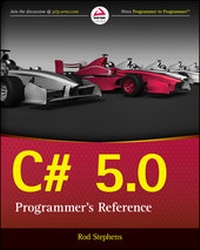
C# 5.0 Programmer's Reference
Published on 3. April 2014
960 pages
978-1-118-84697-1 (ISBN)
Description

Stay ahead of the game with this comprehensive guide to the C# programming language
Well-known C# expert Rod Stephens gives novice and experienced developers a comprehensive tutorial and reference to standard C#. This new title fully covers the latest C# language standard, C# 5.0, as well as its implementation in the 2013 release of Visual Studio. The author provides exercises and solutions; and his C# Helper website will provide readers and students with ongoing support. This resource is packed with tips, tricks, tutorials, examples, and exercises and is the perfect professional companion for programmers who want to stay ahead of the game.
Author Rod Stephens is a well-known programming authority and has written more than 25 programming books covering C#, Java, VB, and other languages. His books have sold more than 150,000 copies in multiple editions. This book's useful exercises and solutions are designed to support training and higher education adoptions.
* Learn the full range of C# programming language features
* Quickly locate information for specific language features in the reference section
* Familiarize yourself with handling data types, variables, constants, and much more
* Experiment with editing and debugging code and using LINQ
Beginning through intermediate-level programmers will benefit from the accessible style of C# 5.0 Programmer's Reference and will have access to its comprehensive range of more advanced topics. Additional support and complementary material are provided at the C# Helper website, www.csharphelper.com. Stay up-to-date and improve your programming skills with this invaluable resource.
More details
Other editions
Additional editions
Rod Stephens
C# 5.0 Programmer's Reference
Book
06/2014
Wrox Press
Unfortunately, price unknown
Article exhausted; check different version
Person
Rod Stephens is a C# and Windows programming expert withmore than 25 programming books to his credit, covering C#, Java,VB, and other programming languages. Rod's C# Helper Website(www.csharphelper.com) receives almost 1 million post views peryear, and provides tips, tricks, and code examples for professionalC# programmers.
Content
1 - Contents [Seite 17]
2 - Introduction [Seite 35]
2.1 - Who Should Read This Book [Seite 36]
2.1.1 - Approach [Seite 36]
2.1.2 - Which Edition of Visual Studio Should You Use? [Seite 37]
2.1.3 - How This Book Is Organized [Seite 38]
2.1.4 - How to Use This Book [Seite 39]
2.1.5 - Necessary Equipment [Seite 40]
2.1.6 - Conventions [Seite 40]
2.1.7 - Source Code [Seite 41]
2.1.8 - Errata [Seite 42]
2.1.9 - p2p.wrox.com [Seite 42]
2.1.10 - Important URLs [Seite 43]
3 - Part I: The C# Ecosystem [Seite 45]
3.1 - Chapter 1: The C# Environment [Seite 47]
3.1.1 - Visual Studio [Seite 47]
3.1.2 - The C# Compiler [Seite 48]
3.1.3 - The CLR [Seite 50]
3.1.4 - The .NET Framework [Seite 52]
3.1.5 - Summary [Seite 53]
3.1.6 - Exercises [Seite 54]
3.2 - Chapter 2: Writing a First Program [Seite 55]
3.2.1 - Types of Projects [Seite 55]
3.2.2 - Console Applications [Seite 58]
3.2.3 - Windows Forms Applications [Seite 60]
3.2.4 - WPF Applications [Seite 63]
3.2.5 - Windows Store Applications [Seite 65]
3.2.6 - Summary [Seite 67]
3.2.7 - Exercises [Seite 68]
3.3 - Chapter 3: Program and Code File Structure [Seite 71]
3.3.1 - Hidden Files [Seite 72]
3.3.2 - Preprocessor Directives [Seite 75]
3.3.3 - Code File Structure [Seite 81]
3.3.4 - Comments [Seite 87]
3.3.5 - Summary [Seite 92]
3.3.6 - Exercises [Seite 92]
4 - Part II: C# Language Elements [Seite 95]
4.1 - Chapter 4: Data Types, Variables, and Constants [Seite 97]
4.1.1 - Data Types [Seite 98]
4.1.2 - Variable Declaration Syntax [Seite 103]
4.1.3 - Initialization [Seite 109]
4.1.4 - Literal Type Characters [Seite 113]
4.1.5 - Data Type Conversion [Seite 116]
4.1.6 - Scope [Seite 123]
4.1.7 - Parameter Declarations [Seite 126]
4.1.8 - Properties [Seite 130]
4.1.9 - Enumerations [Seite 132]
4.1.10 - Nullable Types [Seite 136]
4.1.11 - Delegates [Seite 137]
4.1.12 - Summary [Seite 139]
4.1.13 - Exercises [Seite 140]
4.2 - Chapter 5: Operators [Seite 143]
4.2.1 - Arithmetic Operators [Seite 144]
4.2.2 - Comparison Operators [Seite 146]
4.2.3 - Logical Operators [Seite 147]
4.2.4 - Bitwise Operators [Seite 149]
4.2.5 - Conditional and Null-coalescing Operators [Seite 150]
4.2.6 - Assignment Operators [Seite 151]
4.2.7 - Operator Precedence [Seite 152]
4.2.8 - The StringBuilder Class [Seite 154]
4.2.9 - DateTime and TimeSpan Operations [Seite 155]
4.2.10 - Operator Overloading [Seite 156]
4.2.11 - Summary [Seite 161]
4.2.12 - Exercises [Seite 162]
4.3 - Chapter 6: Methods [Seite 165]
4.3.1 - Method Declarations [Seite 166]
4.3.2 - Extension Methods [Seite 179]
4.3.3 - Lambda Expressions [Seite 180]
4.3.4 - Variance [Seite 183]
4.3.5 - Asynchronous Methods [Seite 184]
4.3.6 - Summary [Seite 190]
4.3.7 - Exercises [Seite 191]
4.4 - Chapter 7: Program Control Statements [Seite 195]
4.4.1 - Decision Statements [Seite 195]
4.4.2 - Looping Statements [Seite 201]
4.4.3 - Summary [Seite 210]
4.4.4 - Exercises [Seite 210]
4.5 - Chapter 8: LINQ [Seite 213]
4.5.1 - Introduction to LINQ [Seite 215]
4.5.2 - Basic LINQ Query Syntax [Seite 217]
4.5.3 - Advanced LINQ Query Syntax [Seite 222]
4.5.4 - Other LINQ Methods [Seite 228]
4.5.5 - LINQ Extension Methods [Seite 229]
4.5.6 - LINQ to Objects [Seite 233]
4.5.7 - LINQ to XML [Seite 233]
4.5.8 - LINQ to ADO.NET [Seite 238]
4.5.9 - PLINQ [Seite 242]
4.5.10 - Summary [Seite 244]
4.5.11 - Exercises [Seite 245]
4.6 - Chapter 9: Error Handling [Seite 249]
4.6.1 - Bugs Versus Undesirable Conditions [Seite 250]
4.6.2 - try catch Blocks [Seite 264]
4.6.3 - Summary [Seite 273]
4.6.4 - Exercises [Seite 273]
4.7 - Chapter 10: Tracing and Debugging [Seite 275]
4.7.1 - The Debug Menu [Seite 276]
4.7.2 - The Debug ? Windows Submenu [Seite 278]
4.7.3 - The Breakpoints Window [Seite 279]
4.7.4 - The Immediate Window [Seite 281]
4.7.5 - Trace Listeners [Seite 282]
4.7.6 - Summary [Seite 284]
4.7.7 - Exercises [Seite 285]
5 - Part III: Object-Oriented Programming [Seite 287]
5.1 - Chapter 11: OOP Concepts [Seite 289]
5.1.1 - Classes [Seite 289]
5.1.2 - Encapsulation [Seite 292]
5.1.3 - Inheritance [Seite 294]
5.1.4 - Polymorphism [Seite 307]
5.1.5 - Summary [Seite 310]
5.1.6 - Exercises [Seite 310]
5.2 - Chapter 12: Classes and Structures [Seite 313]
5.2.1 - Classes [Seite 314]
5.2.2 - Structures [Seite 319]
5.2.3 - Constructors [Seite 326]
5.2.4 - Structure Instantiation Details [Seite 329]
5.2.5 - Garbage Collection [Seite 330]
5.2.6 - Events [Seite 334]
5.2.7 - Static Methods [Seite 342]
5.2.8 - Summary [Seite 344]
5.2.9 - Exercises [Seite 345]
5.3 - Chapter 13: Namespaces [Seite 347]
5.3.1 - Collisions in .NET [Seite 348]
5.3.2 - The using Directive [Seite 348]
5.3.3 - The Default Namespace [Seite 355]
5.3.4 - Making Namespaces [Seite 355]
5.3.5 - Resolving Namespaces [Seite 357]
5.3.6 - The global Namespace [Seite 358]
5.3.7 - Summary [Seite 359]
5.3.8 - Exercises [Seite 359]
5.4 - Chapter 14: Collection Classes [Seite 361]
5.4.1 - Arrays [Seite 362]
5.4.2 - System.Collections [Seite 365]
5.4.3 - Dictionaries [Seite 370]
5.4.4 - CollectionsUtil [Seite 375]
5.4.5 - Stacks and Queues [Seite 375]
5.4.6 - Generic Collections [Seite 379]
5.4.7 - Collection Initializers [Seite 381]
5.4.8 - Iterators [Seite 382]
5.4.9 - Summary [Seite 383]
5.4.10 - Exercises [Seite 384]
5.5 - Chapter 15: Generics [Seite 387]
5.5.1 - Advantages of Generics [Seite 388]
5.5.2 - Defining Generics [Seite 388]
5.5.3 - Instantiating Generic Classes [Seite 396]
5.5.4 - Generic Collection Classes [Seite 396]
5.5.5 - Generic Methods [Seite 396]
5.5.6 - Generics and Extension Methods [Seite 397]
5.5.7 - Summary [Seite 398]
5.5.8 - Exercises [Seite 399]
6 - Part IV: Interacting with the Environment [Seite 401]
6.1 - Chapter 16: Printing [Seite 403]
6.1.1 - Windows Forms Printing [Seite 403]
6.1.2 - WPF Printing [Seite 424]
6.1.3 - Summary [Seite 434]
6.1.4 - Exercises [Seite 434]
6.2 - Chapter 17: Configuration and Resources [Seite 437]
6.2.1 - Environment Variables [Seite 438]
6.2.2 - Registry [Seite 441]
6.2.3 - Configuration Files [Seite 446]
6.2.4 - Resource Files [Seite 449]
6.2.5 - Summary [Seite 452]
6.2.6 - Exercises [Seite 452]
6.3 - Chapter 18: Streams [Seite 455]
6.3.1 - Stream [Seite 456]
6.3.2 - FileStream [Seite 458]
6.3.3 - MemoryStream [Seite 459]
6.3.4 - BinaryReader and BinaryWriter [Seite 460]
6.3.5 - TextReader and TextWriter [Seite 462]
6.3.6 - StringReader and StringWriter [Seite 463]
6.3.7 - StreamReader and StreamWriter [Seite 465]
6.3.8 - Exists, OpenText, CreateText, and AppendText [Seite 466]
6.3.9 - Custom Stream Classes [Seite 467]
6.3.10 - Summary [Seite 467]
6.3.11 - Exercises [Seite 468]
6.4 - Chapter 19: File System Objects [Seite 469]
6.4.1 - Filesystem Permissions [Seite 470]
6.4.2 - .NET Framework Classes [Seite 470]
6.4.3 - Using the Recycle Bin [Seite 482]
6.4.4 - Summary [Seite 487]
6.4.5 - Exercises [Seite 488]
6.5 - Chapter 20: Networking [Seite 489]
6.5.1 - Networking Classes [Seite 490]
6.5.2 - Downloading Information [Seite 492]
6.5.3 - Uploading Information [Seite 499]
6.5.4 - Getting FTP Information [Seite 500]
6.5.5 - Sending E?mail [Seite 502]
6.5.6 - Sending Text Messages [Seite 504]
6.5.7 - Summary [Seite 506]
6.5.8 - Exercises [Seite 507]
7 - Part V: Advanced Topics [Seite 511]
7.1 - Chapter 21: Regular Expressions [Seite 513]
7.1.1 - Building Regular Expressions [Seite 514]
7.1.2 - Using Regular Expressions [Seite 522]
7.1.3 - Summary [Seite 527]
7.1.4 - Exercises [Seite 527]
7.2 - Chapter 22: Parallel Programming [Seite 529]
7.2.1 - Interacting with the User Interface [Seite 532]
7.2.2 - BackgroundWorker [Seite 535]
7.2.3 - Tasks [Seite 540]
7.2.4 - Threads [Seite 542]
7.2.5 - Coordinating Tasks [Seite 543]
7.2.6 - Thread-Safe Objects [Seite 547]
7.2.7 - Summary [Seite 548]
7.2.8 - Exercises [Seite 549]
7.3 - Chapter 23: ADO.NET [Seite 553]
7.3.1 - Selecting a Database [Seite 554]
7.3.2 - Using Bound Controls [Seite 555]
7.3.3 - Loading DataSets [Seite 569]
7.3.4 - Using ADO.NET [Seite 571]
7.3.5 - Summary [Seite 574]
7.3.6 - Exercises [Seite 575]
7.4 - Chapter 24: XML [Seite 577]
7.4.1 - Basic XML Syntax [Seite 578]
7.4.2 - Writing XML Data [Seite 582]
7.4.3 - Reading XML Data [Seite 591]
7.4.4 - Related Technologies [Seite 595]
7.4.5 - Summary [Seite 603]
7.4.6 - Exercises [Seite 603]
7.5 - Chapter 25: Serialization [Seite 607]
7.5.1 - XML Serialization [Seite 608]
7.5.2 - JSON Serialization [Seite 617]
7.5.3 - Binary Serialization [Seite 620]
7.5.4 - Summary [Seite 622]
7.5.5 - Exercises [Seite 622]
7.6 - Chapter 26: Reflection [Seite 625]
7.6.1 - Learning About Classes [Seite 626]
7.6.2 - Getting and Setting Properties [Seite 629]
7.6.3 - Getting Assembly Information [Seite 633]
7.6.4 - Invoking Methods [Seite 635]
7.6.5 - Running Scripts [Seite 637]
7.6.6 - Summary [Seite 641]
7.6.7 - Exercises [Seite 641]
7.7 - Chapter 27: Cryptography [Seite 645]
7.7.1 - Cryptographic Operations [Seite 646]
7.7.2 - Randomness [Seite 647]
7.7.3 - Symmetric Key Encryption [Seite 652]
7.7.4 - Asymmetric Key Encryption [Seite 658]
7.7.5 - Summary [Seite 663]
7.7.6 - Exercises [Seite 663]
8 - Part VI: Appendices [Seite 667]
8.1 - Appendix A: Solutions to Exercises [Seite 669]
8.1.1 - Chapter 1 [Seite 669]
8.1.2 - Chapter 2 [Seite 670]
8.1.3 - Chapter 3 [Seite 671]
8.1.4 - Chapter 4 [Seite 673]
8.1.5 - Chapter 5 [Seite 675]
8.1.6 - Chapter 6 [Seite 679]
8.1.7 - Chapter 7 [Seite 682]
8.1.8 - Chapter 8 [Seite 686]
8.1.9 - Chapter 9 [Seite 692]
8.1.10 - Chapter 10 [Seite 699]
8.1.11 - Chapter 11 [Seite 703]
8.1.12 - Chapter 12 [Seite 709]
8.1.13 - Chapter 13 [Seite 711]
8.1.14 - Chapter 14 [Seite 712]
8.1.15 - Chapter 15 [Seite 717]
8.1.16 - Chapter 16 [Seite 722]
8.1.17 - Chapter 17 [Seite 726]
8.1.18 - Chapter 18 [Seite 729]
8.1.19 - Chapter 19 [Seite 733]
8.1.20 - Chapter 20 [Seite 738]
8.1.21 - Chapter 21 [Seite 746]
8.1.22 - Chapter 22 [Seite 750]
8.1.23 - Chapter 23 [Seite 755]
8.1.24 - Chapter 24 [Seite 757]
8.1.25 - Chapter 25 [Seite 764]
8.1.26 - Chapter 26 [Seite 769]
8.1.27 - Chapter 27 [Seite 772]
8.2 - Appendix B: Data Types [Seite 777]
8.2.1 - Casting and Converting Values [Seite 778]
8.2.2 - Parsing Values [Seite 780]
8.3 - Appendix C: Variable Declarations [Seite 781]
8.3.1 - Initialization Expressions [Seite 782]
8.3.2 - Using [Seite 783]
8.3.3 - Enumerated Type Declarations [Seite 783]
8.4 - Appendix D: Constant Declarations [Seite 785]
8.5 - Appendix E: Operators [Seite 787]
8.5.1 - Arithmetic Operators [Seite 787]
8.5.2 - Comparison Operators [Seite 788]
8.5.3 - Logical Operators [Seite 788]
8.5.4 - Bitwise Operators [Seite 789]
8.5.5 - Assignment Operators [Seite 789]
8.5.6 - Conditional and Null-coalescing Operators [Seite 789]
8.5.7 - Operator Precedence [Seite 789]
8.5.8 - DateTime and TimeSpan Operators [Seite 791]
8.5.9 - Operator Overloading [Seite 792]
8.6 - Appendix F: Method Declarations [Seite 793]
8.6.1 - Methods [Seite 793]
8.6.2 - Property Procedures [Seite 794]
8.6.3 - Lambda Functions and Expressions [Seite 794]
8.6.4 - Extension Methods [Seite 795]
8.7 - Appendix G: Useful Attributes [Seite 797]
8.7.1 - Useful XML Serialization Attributes [Seite 797]
8.7.2 - Useful JSON Serialization Attributes [Seite 798]
8.7.3 - Binary Serialization Attributes [Seite 798]
8.7.4 - Other Useful Attributes [Seite 799]
8.8 - Appendix H: Control Statements [Seite 801]
8.8.1 - Decision Statements [Seite 801]
8.8.2 - Looping Statements [Seite 802]
8.9 - Appendix I: Error Handling [Seite 805]
8.9.1 - Throwing Exceptions [Seite 806]
8.10 - Appendix J: LINQ [Seite 807]
8.10.1 - Basic LINQ Query Syntax [Seite 807]
8.10.2 - LINQ Functions [Seite 811]
8.10.3 - LINQ to XML [Seite 812]
8.10.4 - LINQ to ADO.NET [Seite 814]
8.10.5 - PLINQ [Seite 815]
8.11 - Appendix K: Classes and Structures [Seite 817]
8.11.1 - Classes [Seite 817]
8.11.2 - Structures [Seite 818]
8.11.3 - Constructors [Seite 818]
8.11.4 - Destructors [Seite 818]
8.11.5 - Events [Seite 819]
8.12 - Appendix L: Collection Classes [Seite 821]
8.12.1 - Arrays [Seite 821]
8.12.2 - Collections [Seite 823]
8.12.3 - Iterators [Seite 824]
8.13 - Appendix M: Generic Declarations [Seite 827]
8.13.1 - Generic Classes [Seite 827]
8.13.2 - Generic Methods [Seite 828]
8.14 - Appendix N: Printing and Graphics [Seite 829]
8.14.1 - Windows Forms Printing [Seite 829]
8.14.2 - WPF Printing [Seite 839]
8.15 - Appendix O: Useful Exception Classes [Seite 843]
8.15.1 - Standard Exception Classes [Seite 843]
8.15.2 - Custom Exception Classes [Seite 846]
8.16 - Appendix P: Date and Time Format Specifiers [Seite 847]
8.16.1 - Standard Format Specifiers [Seite 847]
8.16.2 - Custom Format Specifiers [Seite 848]
8.17 - Appendix Q: Other Format Specifiers [Seite 851]
8.17.1 - Standard Numeric Format Specifiers [Seite 851]
8.17.2 - Custom Numeric Format Specifiers [Seite 853]
8.17.3 - Numeric Formatting Sections [Seite 853]
8.17.4 - Composite Formatting [Seite 854]
8.17.5 - Enumerated Type Formatting [Seite 855]
8.18 - Appendix R: Streams [Seite 857]
8.18.1 - Stream Class Summary [Seite 857]
8.18.2 - Stream [Seite 858]
8.18.3 - BinaryReader and BinaryWriter [Seite 859]
8.18.4 - TextReader and TextWriter [Seite 861]
8.18.5 - StringReader and StringWriter [Seite 862]
8.18.6 - StreamReader and StreamWriter [Seite 862]
8.18.7 - Text File Stream Methods [Seite 862]
8.19 - Appendix S: Filesystem Classes [Seite 865]
8.19.1 - Framework Classes [Seite 865]
8.19.2 - Special Folders [Seite 876]
8.19.3 - Recycle Bin [Seite 876]
8.20 - Appendix T: Regular Expressions [Seite 879]
8.20.1 - Creating Regular Expressions [Seite 879]
8.20.2 - Regular Expression Options [Seite 881]
8.20.3 - Using Regular Expressions [Seite 883]
8.21 - Appendix U: Parallel Programming [Seite 887]
8.21.1 - Interacting with the User Interface [Seite 887]
8.21.2 - PLINQ [Seite 887]
8.21.3 - BackgroundWorker [Seite 888]
8.21.4 - TPL [Seite 888]
8.21.5 - Tasks [Seite 889]
8.21.6 - Threads [Seite 891]
8.22 - Appendix V: XML [Seite 893]
8.22.1 - Special Characters [Seite 893]
8.22.2 - Writing XML Data [Seite 893]
8.22.3 - Reading XML Data [Seite 898]
8.22.4 - Related Technologies [Seite 900]
8.23 - Appendix W: Serialization [Seite 903]
8.23.1 - XML Serialization [Seite 903]
8.23.2 - JSON Serialization [Seite 905]
8.23.3 - Binary Serialization [Seite 907]
8.24 - Appendix X: Reflection [Seite 909]
8.24.1 - Type [Seite 909]
8.24.2 - MemberInfo [Seite 914]
8.24.3 - EventInfo [Seite 914]
8.24.4 - MethodInfo [Seite 915]
8.24.5 - FieldInfo [Seite 917]
8.24.6 - PropertyInfo [Seite 918]
8.24.7 - ParameterInfo [Seite 918]
9 - Index [Seite 921]
10 - Advertisement [Seite 962]
2 - Introduction [Seite 35]
2.1 - Who Should Read This Book [Seite 36]
2.1.1 - Approach [Seite 36]
2.1.2 - Which Edition of Visual Studio Should You Use? [Seite 37]
2.1.3 - How This Book Is Organized [Seite 38]
2.1.4 - How to Use This Book [Seite 39]
2.1.5 - Necessary Equipment [Seite 40]
2.1.6 - Conventions [Seite 40]
2.1.7 - Source Code [Seite 41]
2.1.8 - Errata [Seite 42]
2.1.9 - p2p.wrox.com [Seite 42]
2.1.10 - Important URLs [Seite 43]
3 - Part I: The C# Ecosystem [Seite 45]
3.1 - Chapter 1: The C# Environment [Seite 47]
3.1.1 - Visual Studio [Seite 47]
3.1.2 - The C# Compiler [Seite 48]
3.1.3 - The CLR [Seite 50]
3.1.4 - The .NET Framework [Seite 52]
3.1.5 - Summary [Seite 53]
3.1.6 - Exercises [Seite 54]
3.2 - Chapter 2: Writing a First Program [Seite 55]
3.2.1 - Types of Projects [Seite 55]
3.2.2 - Console Applications [Seite 58]
3.2.3 - Windows Forms Applications [Seite 60]
3.2.4 - WPF Applications [Seite 63]
3.2.5 - Windows Store Applications [Seite 65]
3.2.6 - Summary [Seite 67]
3.2.7 - Exercises [Seite 68]
3.3 - Chapter 3: Program and Code File Structure [Seite 71]
3.3.1 - Hidden Files [Seite 72]
3.3.2 - Preprocessor Directives [Seite 75]
3.3.3 - Code File Structure [Seite 81]
3.3.4 - Comments [Seite 87]
3.3.5 - Summary [Seite 92]
3.3.6 - Exercises [Seite 92]
4 - Part II: C# Language Elements [Seite 95]
4.1 - Chapter 4: Data Types, Variables, and Constants [Seite 97]
4.1.1 - Data Types [Seite 98]
4.1.2 - Variable Declaration Syntax [Seite 103]
4.1.3 - Initialization [Seite 109]
4.1.4 - Literal Type Characters [Seite 113]
4.1.5 - Data Type Conversion [Seite 116]
4.1.6 - Scope [Seite 123]
4.1.7 - Parameter Declarations [Seite 126]
4.1.8 - Properties [Seite 130]
4.1.9 - Enumerations [Seite 132]
4.1.10 - Nullable Types [Seite 136]
4.1.11 - Delegates [Seite 137]
4.1.12 - Summary [Seite 139]
4.1.13 - Exercises [Seite 140]
4.2 - Chapter 5: Operators [Seite 143]
4.2.1 - Arithmetic Operators [Seite 144]
4.2.2 - Comparison Operators [Seite 146]
4.2.3 - Logical Operators [Seite 147]
4.2.4 - Bitwise Operators [Seite 149]
4.2.5 - Conditional and Null-coalescing Operators [Seite 150]
4.2.6 - Assignment Operators [Seite 151]
4.2.7 - Operator Precedence [Seite 152]
4.2.8 - The StringBuilder Class [Seite 154]
4.2.9 - DateTime and TimeSpan Operations [Seite 155]
4.2.10 - Operator Overloading [Seite 156]
4.2.11 - Summary [Seite 161]
4.2.12 - Exercises [Seite 162]
4.3 - Chapter 6: Methods [Seite 165]
4.3.1 - Method Declarations [Seite 166]
4.3.2 - Extension Methods [Seite 179]
4.3.3 - Lambda Expressions [Seite 180]
4.3.4 - Variance [Seite 183]
4.3.5 - Asynchronous Methods [Seite 184]
4.3.6 - Summary [Seite 190]
4.3.7 - Exercises [Seite 191]
4.4 - Chapter 7: Program Control Statements [Seite 195]
4.4.1 - Decision Statements [Seite 195]
4.4.2 - Looping Statements [Seite 201]
4.4.3 - Summary [Seite 210]
4.4.4 - Exercises [Seite 210]
4.5 - Chapter 8: LINQ [Seite 213]
4.5.1 - Introduction to LINQ [Seite 215]
4.5.2 - Basic LINQ Query Syntax [Seite 217]
4.5.3 - Advanced LINQ Query Syntax [Seite 222]
4.5.4 - Other LINQ Methods [Seite 228]
4.5.5 - LINQ Extension Methods [Seite 229]
4.5.6 - LINQ to Objects [Seite 233]
4.5.7 - LINQ to XML [Seite 233]
4.5.8 - LINQ to ADO.NET [Seite 238]
4.5.9 - PLINQ [Seite 242]
4.5.10 - Summary [Seite 244]
4.5.11 - Exercises [Seite 245]
4.6 - Chapter 9: Error Handling [Seite 249]
4.6.1 - Bugs Versus Undesirable Conditions [Seite 250]
4.6.2 - try catch Blocks [Seite 264]
4.6.3 - Summary [Seite 273]
4.6.4 - Exercises [Seite 273]
4.7 - Chapter 10: Tracing and Debugging [Seite 275]
4.7.1 - The Debug Menu [Seite 276]
4.7.2 - The Debug ? Windows Submenu [Seite 278]
4.7.3 - The Breakpoints Window [Seite 279]
4.7.4 - The Immediate Window [Seite 281]
4.7.5 - Trace Listeners [Seite 282]
4.7.6 - Summary [Seite 284]
4.7.7 - Exercises [Seite 285]
5 - Part III: Object-Oriented Programming [Seite 287]
5.1 - Chapter 11: OOP Concepts [Seite 289]
5.1.1 - Classes [Seite 289]
5.1.2 - Encapsulation [Seite 292]
5.1.3 - Inheritance [Seite 294]
5.1.4 - Polymorphism [Seite 307]
5.1.5 - Summary [Seite 310]
5.1.6 - Exercises [Seite 310]
5.2 - Chapter 12: Classes and Structures [Seite 313]
5.2.1 - Classes [Seite 314]
5.2.2 - Structures [Seite 319]
5.2.3 - Constructors [Seite 326]
5.2.4 - Structure Instantiation Details [Seite 329]
5.2.5 - Garbage Collection [Seite 330]
5.2.6 - Events [Seite 334]
5.2.7 - Static Methods [Seite 342]
5.2.8 - Summary [Seite 344]
5.2.9 - Exercises [Seite 345]
5.3 - Chapter 13: Namespaces [Seite 347]
5.3.1 - Collisions in .NET [Seite 348]
5.3.2 - The using Directive [Seite 348]
5.3.3 - The Default Namespace [Seite 355]
5.3.4 - Making Namespaces [Seite 355]
5.3.5 - Resolving Namespaces [Seite 357]
5.3.6 - The global Namespace [Seite 358]
5.3.7 - Summary [Seite 359]
5.3.8 - Exercises [Seite 359]
5.4 - Chapter 14: Collection Classes [Seite 361]
5.4.1 - Arrays [Seite 362]
5.4.2 - System.Collections [Seite 365]
5.4.3 - Dictionaries [Seite 370]
5.4.4 - CollectionsUtil [Seite 375]
5.4.5 - Stacks and Queues [Seite 375]
5.4.6 - Generic Collections [Seite 379]
5.4.7 - Collection Initializers [Seite 381]
5.4.8 - Iterators [Seite 382]
5.4.9 - Summary [Seite 383]
5.4.10 - Exercises [Seite 384]
5.5 - Chapter 15: Generics [Seite 387]
5.5.1 - Advantages of Generics [Seite 388]
5.5.2 - Defining Generics [Seite 388]
5.5.3 - Instantiating Generic Classes [Seite 396]
5.5.4 - Generic Collection Classes [Seite 396]
5.5.5 - Generic Methods [Seite 396]
5.5.6 - Generics and Extension Methods [Seite 397]
5.5.7 - Summary [Seite 398]
5.5.8 - Exercises [Seite 399]
6 - Part IV: Interacting with the Environment [Seite 401]
6.1 - Chapter 16: Printing [Seite 403]
6.1.1 - Windows Forms Printing [Seite 403]
6.1.2 - WPF Printing [Seite 424]
6.1.3 - Summary [Seite 434]
6.1.4 - Exercises [Seite 434]
6.2 - Chapter 17: Configuration and Resources [Seite 437]
6.2.1 - Environment Variables [Seite 438]
6.2.2 - Registry [Seite 441]
6.2.3 - Configuration Files [Seite 446]
6.2.4 - Resource Files [Seite 449]
6.2.5 - Summary [Seite 452]
6.2.6 - Exercises [Seite 452]
6.3 - Chapter 18: Streams [Seite 455]
6.3.1 - Stream [Seite 456]
6.3.2 - FileStream [Seite 458]
6.3.3 - MemoryStream [Seite 459]
6.3.4 - BinaryReader and BinaryWriter [Seite 460]
6.3.5 - TextReader and TextWriter [Seite 462]
6.3.6 - StringReader and StringWriter [Seite 463]
6.3.7 - StreamReader and StreamWriter [Seite 465]
6.3.8 - Exists, OpenText, CreateText, and AppendText [Seite 466]
6.3.9 - Custom Stream Classes [Seite 467]
6.3.10 - Summary [Seite 467]
6.3.11 - Exercises [Seite 468]
6.4 - Chapter 19: File System Objects [Seite 469]
6.4.1 - Filesystem Permissions [Seite 470]
6.4.2 - .NET Framework Classes [Seite 470]
6.4.3 - Using the Recycle Bin [Seite 482]
6.4.4 - Summary [Seite 487]
6.4.5 - Exercises [Seite 488]
6.5 - Chapter 20: Networking [Seite 489]
6.5.1 - Networking Classes [Seite 490]
6.5.2 - Downloading Information [Seite 492]
6.5.3 - Uploading Information [Seite 499]
6.5.4 - Getting FTP Information [Seite 500]
6.5.5 - Sending E?mail [Seite 502]
6.5.6 - Sending Text Messages [Seite 504]
6.5.7 - Summary [Seite 506]
6.5.8 - Exercises [Seite 507]
7 - Part V: Advanced Topics [Seite 511]
7.1 - Chapter 21: Regular Expressions [Seite 513]
7.1.1 - Building Regular Expressions [Seite 514]
7.1.2 - Using Regular Expressions [Seite 522]
7.1.3 - Summary [Seite 527]
7.1.4 - Exercises [Seite 527]
7.2 - Chapter 22: Parallel Programming [Seite 529]
7.2.1 - Interacting with the User Interface [Seite 532]
7.2.2 - BackgroundWorker [Seite 535]
7.2.3 - Tasks [Seite 540]
7.2.4 - Threads [Seite 542]
7.2.5 - Coordinating Tasks [Seite 543]
7.2.6 - Thread-Safe Objects [Seite 547]
7.2.7 - Summary [Seite 548]
7.2.8 - Exercises [Seite 549]
7.3 - Chapter 23: ADO.NET [Seite 553]
7.3.1 - Selecting a Database [Seite 554]
7.3.2 - Using Bound Controls [Seite 555]
7.3.3 - Loading DataSets [Seite 569]
7.3.4 - Using ADO.NET [Seite 571]
7.3.5 - Summary [Seite 574]
7.3.6 - Exercises [Seite 575]
7.4 - Chapter 24: XML [Seite 577]
7.4.1 - Basic XML Syntax [Seite 578]
7.4.2 - Writing XML Data [Seite 582]
7.4.3 - Reading XML Data [Seite 591]
7.4.4 - Related Technologies [Seite 595]
7.4.5 - Summary [Seite 603]
7.4.6 - Exercises [Seite 603]
7.5 - Chapter 25: Serialization [Seite 607]
7.5.1 - XML Serialization [Seite 608]
7.5.2 - JSON Serialization [Seite 617]
7.5.3 - Binary Serialization [Seite 620]
7.5.4 - Summary [Seite 622]
7.5.5 - Exercises [Seite 622]
7.6 - Chapter 26: Reflection [Seite 625]
7.6.1 - Learning About Classes [Seite 626]
7.6.2 - Getting and Setting Properties [Seite 629]
7.6.3 - Getting Assembly Information [Seite 633]
7.6.4 - Invoking Methods [Seite 635]
7.6.5 - Running Scripts [Seite 637]
7.6.6 - Summary [Seite 641]
7.6.7 - Exercises [Seite 641]
7.7 - Chapter 27: Cryptography [Seite 645]
7.7.1 - Cryptographic Operations [Seite 646]
7.7.2 - Randomness [Seite 647]
7.7.3 - Symmetric Key Encryption [Seite 652]
7.7.4 - Asymmetric Key Encryption [Seite 658]
7.7.5 - Summary [Seite 663]
7.7.6 - Exercises [Seite 663]
8 - Part VI: Appendices [Seite 667]
8.1 - Appendix A: Solutions to Exercises [Seite 669]
8.1.1 - Chapter 1 [Seite 669]
8.1.2 - Chapter 2 [Seite 670]
8.1.3 - Chapter 3 [Seite 671]
8.1.4 - Chapter 4 [Seite 673]
8.1.5 - Chapter 5 [Seite 675]
8.1.6 - Chapter 6 [Seite 679]
8.1.7 - Chapter 7 [Seite 682]
8.1.8 - Chapter 8 [Seite 686]
8.1.9 - Chapter 9 [Seite 692]
8.1.10 - Chapter 10 [Seite 699]
8.1.11 - Chapter 11 [Seite 703]
8.1.12 - Chapter 12 [Seite 709]
8.1.13 - Chapter 13 [Seite 711]
8.1.14 - Chapter 14 [Seite 712]
8.1.15 - Chapter 15 [Seite 717]
8.1.16 - Chapter 16 [Seite 722]
8.1.17 - Chapter 17 [Seite 726]
8.1.18 - Chapter 18 [Seite 729]
8.1.19 - Chapter 19 [Seite 733]
8.1.20 - Chapter 20 [Seite 738]
8.1.21 - Chapter 21 [Seite 746]
8.1.22 - Chapter 22 [Seite 750]
8.1.23 - Chapter 23 [Seite 755]
8.1.24 - Chapter 24 [Seite 757]
8.1.25 - Chapter 25 [Seite 764]
8.1.26 - Chapter 26 [Seite 769]
8.1.27 - Chapter 27 [Seite 772]
8.2 - Appendix B: Data Types [Seite 777]
8.2.1 - Casting and Converting Values [Seite 778]
8.2.2 - Parsing Values [Seite 780]
8.3 - Appendix C: Variable Declarations [Seite 781]
8.3.1 - Initialization Expressions [Seite 782]
8.3.2 - Using [Seite 783]
8.3.3 - Enumerated Type Declarations [Seite 783]
8.4 - Appendix D: Constant Declarations [Seite 785]
8.5 - Appendix E: Operators [Seite 787]
8.5.1 - Arithmetic Operators [Seite 787]
8.5.2 - Comparison Operators [Seite 788]
8.5.3 - Logical Operators [Seite 788]
8.5.4 - Bitwise Operators [Seite 789]
8.5.5 - Assignment Operators [Seite 789]
8.5.6 - Conditional and Null-coalescing Operators [Seite 789]
8.5.7 - Operator Precedence [Seite 789]
8.5.8 - DateTime and TimeSpan Operators [Seite 791]
8.5.9 - Operator Overloading [Seite 792]
8.6 - Appendix F: Method Declarations [Seite 793]
8.6.1 - Methods [Seite 793]
8.6.2 - Property Procedures [Seite 794]
8.6.3 - Lambda Functions and Expressions [Seite 794]
8.6.4 - Extension Methods [Seite 795]
8.7 - Appendix G: Useful Attributes [Seite 797]
8.7.1 - Useful XML Serialization Attributes [Seite 797]
8.7.2 - Useful JSON Serialization Attributes [Seite 798]
8.7.3 - Binary Serialization Attributes [Seite 798]
8.7.4 - Other Useful Attributes [Seite 799]
8.8 - Appendix H: Control Statements [Seite 801]
8.8.1 - Decision Statements [Seite 801]
8.8.2 - Looping Statements [Seite 802]
8.9 - Appendix I: Error Handling [Seite 805]
8.9.1 - Throwing Exceptions [Seite 806]
8.10 - Appendix J: LINQ [Seite 807]
8.10.1 - Basic LINQ Query Syntax [Seite 807]
8.10.2 - LINQ Functions [Seite 811]
8.10.3 - LINQ to XML [Seite 812]
8.10.4 - LINQ to ADO.NET [Seite 814]
8.10.5 - PLINQ [Seite 815]
8.11 - Appendix K: Classes and Structures [Seite 817]
8.11.1 - Classes [Seite 817]
8.11.2 - Structures [Seite 818]
8.11.3 - Constructors [Seite 818]
8.11.4 - Destructors [Seite 818]
8.11.5 - Events [Seite 819]
8.12 - Appendix L: Collection Classes [Seite 821]
8.12.1 - Arrays [Seite 821]
8.12.2 - Collections [Seite 823]
8.12.3 - Iterators [Seite 824]
8.13 - Appendix M: Generic Declarations [Seite 827]
8.13.1 - Generic Classes [Seite 827]
8.13.2 - Generic Methods [Seite 828]
8.14 - Appendix N: Printing and Graphics [Seite 829]
8.14.1 - Windows Forms Printing [Seite 829]
8.14.2 - WPF Printing [Seite 839]
8.15 - Appendix O: Useful Exception Classes [Seite 843]
8.15.1 - Standard Exception Classes [Seite 843]
8.15.2 - Custom Exception Classes [Seite 846]
8.16 - Appendix P: Date and Time Format Specifiers [Seite 847]
8.16.1 - Standard Format Specifiers [Seite 847]
8.16.2 - Custom Format Specifiers [Seite 848]
8.17 - Appendix Q: Other Format Specifiers [Seite 851]
8.17.1 - Standard Numeric Format Specifiers [Seite 851]
8.17.2 - Custom Numeric Format Specifiers [Seite 853]
8.17.3 - Numeric Formatting Sections [Seite 853]
8.17.4 - Composite Formatting [Seite 854]
8.17.5 - Enumerated Type Formatting [Seite 855]
8.18 - Appendix R: Streams [Seite 857]
8.18.1 - Stream Class Summary [Seite 857]
8.18.2 - Stream [Seite 858]
8.18.3 - BinaryReader and BinaryWriter [Seite 859]
8.18.4 - TextReader and TextWriter [Seite 861]
8.18.5 - StringReader and StringWriter [Seite 862]
8.18.6 - StreamReader and StreamWriter [Seite 862]
8.18.7 - Text File Stream Methods [Seite 862]
8.19 - Appendix S: Filesystem Classes [Seite 865]
8.19.1 - Framework Classes [Seite 865]
8.19.2 - Special Folders [Seite 876]
8.19.3 - Recycle Bin [Seite 876]
8.20 - Appendix T: Regular Expressions [Seite 879]
8.20.1 - Creating Regular Expressions [Seite 879]
8.20.2 - Regular Expression Options [Seite 881]
8.20.3 - Using Regular Expressions [Seite 883]
8.21 - Appendix U: Parallel Programming [Seite 887]
8.21.1 - Interacting with the User Interface [Seite 887]
8.21.2 - PLINQ [Seite 887]
8.21.3 - BackgroundWorker [Seite 888]
8.21.4 - TPL [Seite 888]
8.21.5 - Tasks [Seite 889]
8.21.6 - Threads [Seite 891]
8.22 - Appendix V: XML [Seite 893]
8.22.1 - Special Characters [Seite 893]
8.22.2 - Writing XML Data [Seite 893]
8.22.3 - Reading XML Data [Seite 898]
8.22.4 - Related Technologies [Seite 900]
8.23 - Appendix W: Serialization [Seite 903]
8.23.1 - XML Serialization [Seite 903]
8.23.2 - JSON Serialization [Seite 905]
8.23.3 - Binary Serialization [Seite 907]
8.24 - Appendix X: Reflection [Seite 909]
8.24.1 - Type [Seite 909]
8.24.2 - MemberInfo [Seite 914]
8.24.3 - EventInfo [Seite 914]
8.24.4 - MethodInfo [Seite 915]
8.24.5 - FieldInfo [Seite 917]
8.24.6 - PropertyInfo [Seite 918]
8.24.7 - ParameterInfo [Seite 918]
9 - Index [Seite 921]
10 - Advertisement [Seite 962]
