

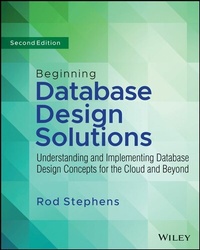
Beginning Database Design Solutions
Understanding and Implementing Database Design Concepts for the Cloud and Beyond
2nd Edition
Published on 22. February 2023
736 pages
978-1-394-15584-2 (ISBN)
Description

A concise introduction to database design concepts, methods, and techniques in and out of the cloud
In the newly revised second edition of Beginning Database Design Solutions: Understanding and Implementing Database Design Concepts for the Cloud and Beyond, Second Edition, award-winning programming instructor and mathematician Rod Stephens delivers an easy-to-understand guide to designing and implementing databases both in and out of the cloud. Without assuming any prior database design knowledge, the author walks you through the steps you'll need to take to understand, analyze, design, and build databases.
In the book, you'll find clear coverage of foundational database concepts along with hands-on examples that help you practice important techniques so you can apply them to your own database designs, as well as:
* Downloadable source code that illustrates the concepts discussed in the book
* Best practices for reliable, platform-agnostic database design
* Strategies for digital transformation driven by universally accessible database design
An essential resource for database administrators, data management specialists, and database developers seeking expertise in relational, NoSQL, and hybrid database design both in and out of the cloud, Beginning Database Design Solutions is a hands-on guide ideal for students and practicing professionals alike.
In the newly revised second edition of Beginning Database Design Solutions: Understanding and Implementing Database Design Concepts for the Cloud and Beyond, Second Edition, award-winning programming instructor and mathematician Rod Stephens delivers an easy-to-understand guide to designing and implementing databases both in and out of the cloud. Without assuming any prior database design knowledge, the author walks you through the steps you'll need to take to understand, analyze, design, and build databases.
In the book, you'll find clear coverage of foundational database concepts along with hands-on examples that help you practice important techniques so you can apply them to your own database designs, as well as:
* Downloadable source code that illustrates the concepts discussed in the book
* Best practices for reliable, platform-agnostic database design
* Strategies for digital transformation driven by universally accessible database design
An essential resource for database administrators, data management specialists, and database developers seeking expertise in relational, NoSQL, and hybrid database design both in and out of the cloud, Beginning Database Design Solutions is a hands-on guide ideal for students and practicing professionals alike.
More details
Other editions
Additional editions
Stephens
Beginning Database Design Solutions: Understanding and Implementing Database Design Concepts for the Cloud and Beyond 2nd Edition
Understanding and Implementing Database Design Concepts for the Cloud and Beyond
Book
05/2023
2nd Edition
Wiley
€51.50
Shipment within 15-20 days
Person
ROD STEPHENS is a professional programmer, sought-after technical speaker, instructor, and author. He's written 37 books and over 250 magazine articles on C#, Java, and other programming languages. He runs the popular C# Helper and VB Helper websites which have helped millions of programmers with tips, tricks, and useful example code.
Content
- Cover
- Title Page
- Copyright Page
- About The Author
- Contents
- Introduction
- Who This Book Is For
- What This Book Covers
- What You Need to Use This Book
- How This Book Is Structured
- Part I: Introduction to Databases and Database Design
- Part II: Database Design Process and Techniques
- Part III: A Detailed Case Study
- Part IV: Example Programs
- Part V: Advanced Topics
- Appendixes
- How to Use This Book
- Note to Instructors
- Note to Students
- Conventions
- Source Code
- Contacting the Author
- Disclaimer
- Part 1 Introduction to Databases and Database Design
- Chapter 1 Database Design Goals
- The Importance of Design
- Space Spat
- Information Containers
- Strengths and Weaknesses of Information Containers
- Desirable Database Features
- CRUD
- Retrieval
- Consistency
- Validity
- Easy Error Correction
- Speed
- Atomic Transactions
- ACID
- BASE
- NewSQL
- Persistence and Backups
- Low Cost and Extensibility
- Ease of Use
- Portability
- Security
- Sharing
- Ability to Perform Complex Calculations
- CAP Theorem
- Cloud Considerations
- Legal and Security Considerations
- Consequences of Good and Bad Design
- Summary
- Chapter 2 Relational Overview
- Picking a Database
- Relational Points of View
- Table, Rows, and Columns
- Relations, Attributes, and Tuples
- Keys
- Indexes
- Constraints
- Domain Constraints
- Check Constraints
- Primary Key Constraints
- Unique Constraints
- Foreign Key Constraints
- Database Operations
- Popular RDBs
- Spreadsheets
- Summary
- Chapter 3 NoSQL Overview
- The Cloud
- Picking a Database
- NoSQL Philosophy
- NoSQL Databases
- Document Databases
- Key-Value Database
- Column-Oriented Databases
- Graph Databases
- Street Networks
- Communication Networks
- Social Media Apps
- E-Commerce Programs
- Algorithms
- Hierarchical Databases
- Less Exotic Options
- Flat Files
- XML Files
- XML Basics
- XML Practices
- XML Summary
- JSON Files
- Spreadsheets
- More Exotic Options
- Object
- Deductive
- Dimensional
- Temporal
- Database Pros and Cons
- Relational
- General NoSQL
- Quick Guidelines
- Summary
- Part 2 Database Design Process and Techniques
- Chapter 4 Understanding User Needs
- Make a Plan
- Bring a List of Questions
- Functionality
- Data Needs
- Data Integrity
- Security
- Environment
- Meet the Customers
- Learn Who's Who
- Pick the Customers' Brains
- Walk a Mile in the User's Shoes
- Study Current Operations
- Brainstorm
- Look to the Future
- Understand the Customers' Reasoning
- Learn What the Customers Really Need
- Prioritize
- Verify Your Understanding
- Create the Requirements Document
- Make Use Cases
- Decide Feasibility
- Summary
- Chapter 5 Translating User Needs into Data Models
- What Are Data Models?
- User Interface Models
- Semantic Object Models
- Classes and Objects
- Cardinality
- Identifiers
- Putting It Together
- Semantic Views
- Class Types
- Simple Objects
- Composite Objects
- Compound Objects
- Hybrid Objects
- Association Objects
- Inherited Objects
- Comments and Notes
- Entity-Relationship Models
- Entities, Attributes, and Identifiers
- Relationships
- Cardinality
- Inheritance
- Additional Conventions
- Comments and Notes
- Relational Models
- Converting Semantic Object Models
- Converting ER Diagrams
- Summary
- Chapter 6 Extracting Business Rules
- What Are Business Rules?
- Identifying Key Business Rules
- Extracting Key Business Rules
- Multi-Tier Applications
- Summary
- Chapter 7 Normalizing Data
- What Is Normalization?
- First Normal Form (1NF)
- Second Normal Form (2NF)
- Third Normal Form (3NF)
- Stopping at Third Normal Form
- Boyce-Codd Normal Form (BCNF)
- Fourth Normal Form (4NF)
- Fifth Normal Form (5NF)
- Domain/Key Normal Form (DKNF)
- Essential Redundancy
- The Best Level of Normalization
- NoSQL Normalization
- Summary
- Chapter 8 Designing Databases to Support Software
- Plan Ahead
- Document Everything
- Consider Multi-tier Architecture
- Convert Domains into Tables
- Keep Tables Focused
- Use Three Kinds of Tables
- Use Naming Conventions
- Allow Some Redundant Data
- Don't Squeeze in Everything
- Summary
- Chapter 9 Using Common Design Patterns
- Associations
- Many-to-Many Associations
- Multiple Many-to-Many Associations
- Multiple-Object Associations
- Repeated Attribute Associations
- Reflexive Associations
- One-to-One Reflexive Associations
- One-to-Many Reflexive Associations
- Hierarchical Data
- Hierarchical Data with NoSQL
- Network Data
- Network Data with NoSQL
- Temporal Data
- Effective Dates
- Deleted Objects
- Deciding What to Temporalize
- Logging and Locking
- Audit Trails
- Turnkey Records
- Summary
- Chapter 10 Avoiding Common Design Pitfalls
- Lack of Preparation
- Poor Documentation
- Poor Naming Standards
- Thinking Too Small
- Not Planning for Change
- Too Much Normalization
- Insufficient Normalization
- Insufficient Testing
- Performance Anxiety
- Mishmash Tables
- Not Enforcing Constraints
- Obsession with IDs
- Not Defining Natural Keys
- Summary
- Part 3 A Detailed Case Study
- Chapter 11 Defining User Needs and Requirements
- Meet the Customers
- Pick the Customers' Brains
- Determining What the System Should Do
- Determining How the Project Should Look
- Determining What Data Is Needed for the User Interface
- Determining Where the Data Should Come From
- Determining How the Pieces of Data Are Related
- Determining Performance Needs
- Determining Security Needs
- Determining Data Integrity Needs
- Write Use Cases
- Write the Requirements Document
- Demand Feedback
- Summary
- Chapter 12 Building a Data Model
- Semantic Object Modeling
- Building an Initial Semantic Object Model
- Improving the Semantic Object Model
- Entity-Relationship Modeling
- Building an ER Diagram
- Building a Combined ER Diagram
- Improving the Entity-Relationship Diagram
- Relational Modeling
- Putting It All Together
- Summary
- Chapter 13 Extracting Business Rules
- Identifying Business Rules
- Courses
- CustomerCourses
- Customers
- Pets
- Employees
- Orders
- OrderItems
- InventoryItems
- TimeEntries
- Shifts
- Persons
- Phones
- Vendors
- Drawing a New Relational Model
- Summary
- Exercises
- Chapter 14 Normalizing and Refining
- Improving Flexibility
- Verifying First Normal Form
- Verifying Second Normal Form
- Pets
- TimeEntries
- Verifying Third Normal Form
- Summary
- Part 4 Example Programs
- Chapter 15 Example Overview
- Tool Choices
- Jupyter Notebook
- Visual Studio
- Database Adapters
- Packages in Jupyter Notebook
- Packages in Visual Studio
- Program Passwords
- Summary
- Chapter 16 MariaDB in Python
- Install MariaDB
- Run HeidiSQL
- Create the Program
- Install pymysql
- Create the Database
- Define Tables
- Create Data
- Fetch Data
- Summary
- Exercises
- Chapter 17 MariaDB in C#
- Create the Program
- Install MySqlConnector
- Create the Database
- Define Tables
- Create Data
- Fetch Data
- Summary
- Exercises
- Chapter 18 PostgreSQL in Python
- Install PostgreSQL
- Run pgAdmin
- Design the Database
- Create a User
- Create the Database
- Define the Tables
- Define the customers Table
- Define the orders Table
- Define the order_items Table
- Create the Program
- Install Psycopg
- Connect to the Database
- Delete Old Data
- Create Customer Data
- Create Order Data
- Create Order Item Data
- Close the Connection
- Perform Queries
- Summary
- Chapter 19 PostgreSQL in C#
- Create the Program
- Install Npgsql
- Connect to the Database
- Delete Old Data
- Create Customer Data
- Create Order Data
- Create Order Item Data
- Display Orders
- Summary
- Exercises
- Chapter 20 Neo4j AuraDB in Python
- Install Neo4j AuraDB
- Nodes and Relationships
- Cypher
- Create the Program
- Install the Neo4j Database Adapter
- Action Methods
- delete_all_nodes
- make_node
- make_link
- execute_node_query
- find_path
- Org Chart Methods
- build_org_chart
- query_org_chart
- Main Program
- Summary
- Chapter 21 Neo4j AuraDB in C#
- Create the Program
- Install the Neo4j Driver
- Action Methods
- DeleteAllNodes
- MakeNode
- MakeLink
- ExecuteNodeQuery
- FindPath
- Org Chart Methods
- BuildOrgChart
- QueryOrgChart
- Main
- Summary
- Chapter 22 MongoDB Atlas in Python
- Not Normal but Not Abnormal
- XML, JSON, and BSON
- Install MongoDB Atlas
- Find the Connection Code
- Create the Program
- Install the PyMongo Database Adapter
- Helper Methods
- person_string
- connect_to_db
- delete_old_data
- create_data
- query_data
- Main Program
- Summary
- Chapter 23 MongoDB Atlas in C#
- Create the Program
- Install the MongoDB Database Adapter
- Helper Methods
- PersonString
- DeleteOldData
- CreateData
- QueryData
- Main Program
- Summary
- Chapter 24 Apache Ignite in Python
- Install Apache Ignite
- Start a Node
- Without Persistence
- With Persistence
- Create the Program
- Install the pyignite Database Adapter
- Define the Building Class
- Save Data
- Read Data
- Demonstrate Volatile Data
- Demonstrate Persistent Data
- Summary
- Chapter 25 Apache Ignite in C#
- Create the Program
- Install the Ignite Database Adapter
- The Main Program
- The Building Class
- The WriteData Method
- The ReadData Method
- Demonstrate Volatile Data
- Demonstrate Persistent Data
- Summary
- Part 5 Advanced Topics
- Chapter 26 Introduction to SQL
- Background
- Finding More Information
- Standards
- Multistatement Commands
- Basic Syntax
- Command Overview
- Create Table
- Create Index
- Drop
- Insert
- Select
- SELECT Clause
- FROM Clause
- WHERE Clause
- GROUP BY Clause
- ORDER BY Clause
- Update
- Delete
- Summary
- Chapter 27 Building Databases with SQL Scripts
- Why Bother with Scripts?
- Script Categories
- Database Creation Scripts
- Basic Initialization Scripts
- Data Initialization Scripts
- Cleanup Scripts
- Saving Scripts
- Ordering SQL Commands
- Summary
- Chapter 28 Database Maintenance
- Backups
- Data Warehousing
- Repairing the Database
- Compacting the Database
- Performance Tuning
- Summary
- Chapter 29 Database Security
- The Right Level of Security
- Passwords
- Single-Password Databases
- Individual Passwords
- Operating System Passwords
- Good Passwords
- Privileges
- Initial Configuration and Privileges
- Too Much Security
- Physical Security
- Summary
- Appendix A: Exercise Solutions
- Chapter 1: Database Design Goals
- Exercise 1 Solution
- Exercise 2 Solution
- Exercise 3 Solution
- Exercise 4 Solution
- Exercise 5 Solution
- Exercise 6 Solution
- Exercise 7 Solution
- Exercise 8 Solution
- Exercise 9 Solution
- Exercise 10 Solution
- Chapter 2: Relational Overview
- Exercise 1 Solution
- Exercise 2 Solution
- Exercise 3 Solution
- Exercise 4 Solution
- Exercise 5 Solution
- Exercise 6 Solution
- Exercise 7 Solution
- Exercise 8 Solution
- Exercise 9 Solution
- Exercise 10 Solution
- Chapter 3: NoSQL Overview
- Exercise 1 Solution
- Exercise 2 Solution
- Exercise 3 Solution
- Exercise 4 Solution
- Exercise 5 Solution
- Exercise 6 Solution
- Exercise 7 Solution
- Exercise 8 Solution
- Exercise 9 Solution
- Exercise 10 Solution
- Exercise 11 Solution
- Exercise 12 Solution
- Exercise 13 Solution
- Exercise 14 Solution
- Chapter 4: Understanding User Needs
- Exercise 1 Solution
- Exercise 2 Solution
- Exercise 3 Solution
- Exercise 4 Solution
- Exercise 5 Solution
- Exercise 6 Solution
- Exercise 7 Solution
- Exercise 8 Solution
- Exercise 9 Solution
- Exercise 10 Solution
- Exercise 11 Solution
- Chapter 5: Translating User Needs into Data Models
- Exercise 1 Solution
- Exercise 2 Solution
- Exercise 3 Solution
- Exercise 4 Solution
- Exercise 5 Solution
- Exercise 6 Solution
- Exercise 7 Solution
- Exercise 8 Solution
- Chapter 6: Extracting Business Rules
- Exercise 1 Solution
- Exercise 2 Solution
- Exercise 3 Solution
- Exercise 4 Solution
- Chapter 7: Normalizing Data
- Exercise 1 Solution
- Exercise 2 Solution
- Exercise 3 Solution
- Exercise 4 Solution
- Exercise 5 Solution
- Exercise 6 Solution
- Chapter 8: Designing Databases to Support Software
- Exercise 1 Solution
- Exercise 2 Solution
- Exercise 3 Solution
- Exercise 4 Solution
- Chapter 9: Using Common Design Patterns
- Exercise 1 Solution
- Exercise 2 Solution
- Exercise 3 Solution
- Exercise 4 Solution
- Exercise 5 Solution
- Exercise 6 Solution
- Exercise 7 Solution
- Exercise 8 Solution
- Exercise 9 Solution
- Chapter 10: Avoiding Common Design Pitfalls
- Exercise 1 Solution
- Exercise 2 Solution
- Exercise 3 Solution
- Exercise 4 Solution
- Chapter 11: Defining User Needs and Requirements
- Exercise 1 Solution
- Exercise 2 Solution
- Exercise 3 Solution
- Exercise 4 Solution
- Exercise 5 Solution
- Exercise 6 Solution
- Chapter 12: Building a Data Model
- Exercise 1 Solution
- Exercise 2 Solution
- Exercise 3 Solution
- Exercise 4 Solution
- Exercise 5 Solution
- Exercise 6 Solution
- Exercise 7 Solution
- Exercise 8 Solution
- Exercise 9 Solution
- Exercise 10 Solution
- Exercise 11 Solution
- Exercise 12 Solution
- Chapter 13: Extracting Business Rules
- Exercise 1 Solution
- Exercise 2 Solution
- Exercise 3 Solution
- Exercise 4 Solution
- Exercise 5 Solution
- Chapter 14: Normalizing and Refining
- Exercise 1 Solution
- Exercise 2 Solution
- Exercise 3 Solution
- Exercise 4 Solution
- Chapter 15: Example Overview
- Exercise 1 Solution
- Exercise 2 Solution
- Exercise 3 Solution
- Exercise 4 Solution
- Exercise 5 Solution
- Exercise 6 Solution
- Chapter 16: MariaDB in Python
- Exercise 1 Solution
- Exercise 2 Solution
- Exercise 3 Solution
- Exercise 4 Solution
- Exercise 5 Solution
- Exercise 6 Solution
- Chapter 17: MariaDB in C#
- Exercise 1 Solution
- Exercise 2 Solution
- Exercise 3 Solution
- Exercise 4 Solution
- Exercise 5 Solution
- Exercise 6 Solution
- Chapter 18: PostgreSQL in Python
- Exercise 1 Solution
- Exercise 2 Solution
- Exercise 3 Solution
- Exercise 4 Solution
- Exercise 5 Solution
- Exercise 6 Solution
- Exercise 7 Solution
- Chapter 19: PostgreSQL in C#
- Exercise 1 Solution
- Exercise 2 Solution
- Exercise 3 Solution
- Exercise 4 Solution
- Exercise 5 Solution
- Exercise 6 Solution
- Exercise 7 Solution
- Chapter 20: Neo4j AuraDB in Python
- Exercise 1 Solution
- Exercise 2 Solution
- Exercise 3 Solution
- Exercise 4 Solution
- Exercise 5 Solution
- Chapter 21: Neo4j AuraDB in C#
- Exercise 1 Solution
- Exercise 2 Solution
- Exercise 3 Solution
- Exercise 4 Solution
- Exercise 5 Solution
- Exercise 6 Solution
- Exercise 7 Solution
- Chapter 22: MongoDB Atlas in Python
- Exercise 1 Solution
- Exercise 2 Solution
- Exercise 3 Solution
- Exercise 4 Solution
- Chapter 23: MongoDB Atlas in C#
- Exercise 1 Solution
- Exercise 2 Solution
- Exercise 3 Solution
- Exercise 4 Solution
- Chapter 24: Apache Ignite in Python
- Exercise 1 Solution
- Exercise 2 Solution
- Exercise 3 Solution
- Exercise 4 Solution
- Chapter 25: Apache Ignite in C#
- Exercise 1 Solution
- Exercise 2 Solution
- Exercise 3 Solution
- Exercise 4 Solution
- Chapter 26: Introduction to SQL
- Exercise 1 Solution
- Exercise 2 Solution
- Exercise 3 Solution
- Exercise 4 Solution
- Exercise 5 Solution
- Chapter 27: Building Databases with SQL Scripts
- Exercise 1 Solution
- Exercise 2 Solution
- Chapter 28: Database Maintenance
- Exercise 1 Solution
- Exercise 2 Solution
- Exercise 3 Solution
- Chapter 29: Database Security
- Exercise 1 Solution
- Exercise 2 Solution
- Exercise 3 Solution
- Appendix B: Sample Relational Designs
- Books
- Movies
- Music
- Document Management
- Customer Orders
- Employee Shifts and Timesheets
- Employees, Projects, and Departments
- Employee Skills and Qualifications
- Identical Object Rental
- Distinct Object Rental
- Students, Courses, and Grades
- Teams
- Individual Sports
- Vehicle Fleets
- Contacts
- Passengers
- Recipes
- Glossary
- Index
- EULA
