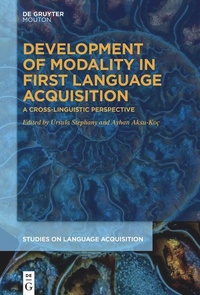
Development of Modality in First Language Acquisition
Description

This book deals with the development of modality from a crosslinguistic perspective and is closely related to two earlier volumes on the development of verb and nominal inflection in first language acquisition (SOLA 21 and 30) both methodologically and theoretically. Each of the fourteen contributions studies the early development of the form and function of expressions of deontic and dynamic agent-oriented modality or epistemic and evidential propositional modality in one of fourteen languages belonging to different morphological types and language families (seven Indo-European and seven non-Indo-European).
The analyses are mainly based on longitudinal observations of children in their 2nd and 3rd years of life in conversational interaction with their caregivers, mostly the mothers. Main issues addressed are the development of directives and modulations of information in terms of certainty and evidentiality, also taking into account children's developing social-pragmatic and cognitive skills. One of the main findings is that agent-oriented and propositional modality may develop in parallel depending on the typological characteristics of the language acquired. The decisive factor is whether notions of propositional modality are grammaticized and obligatorily expressed in the language. The findings are interpreted within non-nativist theoretical frameworks (Usage-based theories, Natural Morphology).
More details
Other editions
Additional editions