

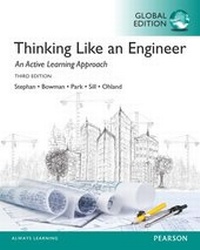
Thinking Like an Engineer: An Active Learning Approach, Global Edition
3rd Edition
Published on 27. February 2015
816 pages
978-1-292-07031-5 (ISBN)
Description

Thinking Like an Engineer: An Active Learning Approach, 3rd Edition, is specifically designed to utilise an active learning environment for first-year engineering courses.
The full text downloaded to your computer
With eBooks you can:
- search for key concepts, words and phrases
- make highlights and notes as you study
- share your notes with friends
eBooks are downloaded to your computer and accessible either offline through the Bookshelf (available as a free download), available online and also via the iPad and Android apps.
Upon purchase, you'll gain instant access to this eBook.
Time limit
The eBooks products do not have an expiry date. You will continue to access your digital ebook products whilst you have your Bookshelf installed.
All prices
More details
Other editions
Additional editions
Elizabeth Stephan | William Park | Benjamin Sill
Thinking Like an Engineer, Global Edition
Book
09/2014
3rd Edition
Pearson Education Limited
€106.65
Shipment within 10-20 days
Content
- Cover
- Title
- Copyright
- Contents
- Preface
- Acknowledgments
- Part 1 Engineering Essentials
- Engineering is an . . . Itch!
- Chapter 1 Everyday Engineering
- 1.1 Choosing a Career
- 1.2 Choosing Engineering as a Career
- 1.3 NAE Grand Challenges for engineering
- 1.4 Choosing a Specific Engineering Field
- 1.5 Engineering Technology-A Related Field
- 1.6 Gathering Information
- 1.7 Pursuing Student Opportunities
- Review Questions
- Chapter 2 Ethics
- 2.1 Ethical Decision Making
- 2.2 Plagiarism
- 2.3 Engineering Creed
- 2.4 Social responsibility
- In-Class Activities
- Chapter 3 Design and Teamwork
- 3.1 Design
- 3.2 Defining the Problem or Need
- 3.3 Criteria: Defining What Is Important
- 3.4 Generating Ideas
- 3.5 Comparing Designs and Making Decisions
- 3.6 Prototyping and Testing
- 3.7 Sustainability
- 3.8 Working in Teams
- 3.9 Experimental Design: Period Analysis
- 3.10 Project Timeline
- In-Class Activities
- Mini Design Projects
- Chapter 4 Engineering Communication
- 4.1 Basic Presentation Skills
- 4.2 Sample Presentations
- 4.3 Basic Technical Writing Skills
- 4.4 Common Technical Communication Formats
- in-Class activities
- Review Questions
- Chapter 5 Estimation
- 5.1 General Hints for Estimation
- 5.2 Estimation by Analogy
- 5.3 Estimation by Aggregation
- 5.4 Estimation by Upper and Lower Bounds
- 5.5 Estimation Using Modeling
- 5.6 Significant Figures
- 5.7 Reasonableness
- 5.8 Notation
- In-Class Activities
- Review Questions
- Chapter 6 Solvem
- 6.1 Defining Solvem
- 6.2 Representing Final Results
- 6.3 Avoiding Common Mistakes
- 6.4 examples of solvem
- In-Class Activities
- Review Questions
- Part 2 Ubiquitous Units
- Chapter 7 Fundamental Dimensions and Base Units
- 7.1The Metric System
- 7.2 Other Unit Systems
- 7.3 Conversion Procedure for Units
- 7.4 Conversions Involving Multiple Steps
- 7.5 Conversions Involving "New" Units
- 7.6 Derived Dimensions and Units
- 7.7 Equation Laws
- 7.8 Conversion Involving Equations
- In-Class Activities
- Review Questions
- Chapter 8 Universal Units
- 8.1 Force
- 8.2 Weight
- 8.3 Density
- 8.4 Amount
- 8.5 Temperature
- 8.6 Pressure
- 8.7 Gas Pressure
- 8.8 Energy
- 8.9 Power
- 8.10 Efficiency
- 8.11 Electrical Concepts
- In-Class Activities
- Review Questions
- Chapter 9 Dimensionless Numbers
- 9.1 Constants with Units
- 9.2 Common Dimensionless Numbers
- 9.3 Dimensional Analysis
- 9.4 Rayleigh's Method
- In-Class Activities
- Review Questions
- Part 3 Scrupulous Worksheets
- Time management
- Chapter 10 Excel Workbooks
- 10.1 Cell References
- 10.2 Functions in Excel
- 10.3 Logic and Conditionals
- 10.4 Lookup and Data Validation
- 10.5 Conditional Formatting
- 10.6 Sorting and Filters
- In-Class Activities
- Review Questions
- Chapter 11 Graphical Solutions
- 11.1 Graphing Terminology
- 11.2 Proper Plots
- 11.3 Available Graph Types IN EXCEL
- 11.4 Graph Interpretation
- 11.5 Meaning of Line Shapes
- 11.6 Graphical Solutions
- In-Class Activities
- Review Questions
- Chapter 12 Models and Systems
- 12.1 Linear Functions
- 12.2 Linear Relationships
- 12.3 Power Functions
- 12.4 Exponential Functions
- In-Class Activities
- Review Questions
- Chapter 13 Mathematical Models
- 13.1 Selecting a Trendline Type
- 13.2 Interpreting Logarithmic Graphs
- 13.3 Converting Scales to Log in Excel
- 13.4 Dealing with Limitations of Excel
- In-Class Activities
- Review Questions
- Chapter 14 Statistics
- 14.1 Histograms
- 14.2 Statistical Behavior
- 14.3 Distributions
- 14.4 Cumulative Distribution Functions
- 14.5 Statistical Process Control (SPC)
- 14.6 Statistics in Excel
- 14.7 Statistics in MATLAB
- In-Class Activities
- Review Questions
- Part 4 Punctilious Programming
- Some Advantages of Computers
- CHAPTER 15 Algorithms
- 15.1 Scope
- 15.2 Written Algorithms
- 15.3 Graphical Algorithms
- 15.4 Algorithm Best Practices
- In-Class Activities
- Review Questions
- Chapter 16 MATLAB variables and Data Types
- 16.1 Variable Basics
- 16.2 Numeric types and scalars:
- 16.3 Vectors
- 16.4 Matrices
- 16.5 Character Strings
- 16.6 Cell Arrays
- 16.7 Structure Arrays
- 16.8 SAVING AND RESTORING VALUES
- In-Class Activities
- Review Questions
- Chapter 17 Programs and Functions
- 17.1 Programs
- 17.2 Functions
- 17.3 Debugging Matlab Code
- In-Class Activities
- Review Questions
- Chapter 18 Input/Output In Matlab
- 18.1 Input
- 18.2 Output
- 18.3 Plotting
- 18.4 Polyfit
- 18.5 Microsoft EXCEL I/O
- In-Class Activities
- Review Questions
- Chapter 19 Logic and Conditionals
- 19.1 Relational and Logical Operators
- 19.2 Logical Variables
- 19.3 Conditional Statements in Matlab
- 19.4 Switch Statements
- 19.5 ERORS AND WARNINGS
- In-Class Activities
- Review Questions
- Chapter 20 Looping Structures
- 20.1 for Loops
- 20.2 while Loops
- 20.3 Application of Loops: GUI
- 20.3 Application of Loops: GUI
- Review Questions
- comprehension check answers
- Index
- A
- B
- C
- D
- E
- F
- G
- H
- I
- J
- K
- L
- M
- N
- O
- P
- Q
- R
- S
- T
- U
- V
- W
- X
- Y
- Z
