

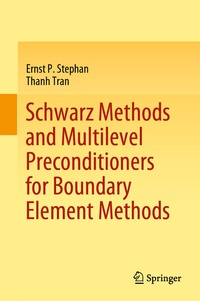
Schwarz Methods and Multilevel Preconditioners for Boundary Element Methods
Description

This book provides a comprehensive examination of preconditioners for boundary element discretisations of first-kind integral equations. Focusing on domain-decomposition-type and multilevel methods, it allows readers to gain a good understanding of the mechanisms and necessary techniques in the analysis of the preconditioners. These techniques are unique for the discretisation of first-kind integral equations since the resulting systems of linear equations are not only large and ill-conditioned, but also dense.
The book showcases state-of-the-art preconditioning techniques for boundary integral equations, presenting up-to-date research. It also includes a detailed discussion of Sobolev spaces of fractional orders to familiarise readers with important mathematical tools for the analysis. Furthermore, the concise overview of adaptive BEM, hp-version BEM, and coupling of FEM-BEM provides efficient computational tools for solving practical problems with applications in science and engineering.
More details
Other editions
Additional editions
Persons
Ernst Peter Stephan is retired professor of mathematics at Leibniz University Hannover. His research covers numerical methods for partial differential equations and boundary integral equations together with their analysis. He obtained the Frank J. Rizzo Award of the International Association for Boundary Element Methods for outstanding contributions to research in boundary element methods (BEM).
Thanh Tran is a professor of mathematics at The University of New South Wales, Sydney. His research focusses on numerical methods and numerical analysis for partial differential equations and boundary integral equations, both deterministic and stochastic.
Content
Part I: General Theory.- Part II: Two-Dimensional Problems.- Part III: Three-Dimensional Problems.- Part IV: FEM-BEM Coupling.- Part V: Problems on the Sphere.- Part VI: Appendices.- References.- Index.
