

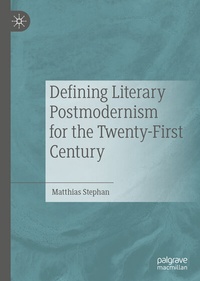
Defining Literary Postmodernism for the Twenty-First Century
Description

This book presents a definition of literary postmodernism, using detective and science fictions as a frame. Through an exploration of both prior theoretical approaches, and indicators through characteristics of postmodernist fiction, this book identifies a structural framework to both understand and apply the lessons of postmodernism for the next generation. Within a growing consensus that the postmodern era has passed, this book examines the different conceptions of postmodernism and posits a meaningful definition, one which can provide the foundation for future literary expression. This theory is then applied to genre fiction, particularly detective fiction and science fiction, demonstrating that postmodernism is found in the structure, rather than questions posed about literary expression. Finally, Matthias Stephan considers post-postmodern movements, and how they can be expressed given this definition of literary postmodernism, moving forward to the twenty-first century.
Reviews / Votes
"His useful identification and criticism of the insufficiencies of the previous attempts at a unitary definition of postmodernism is straightforwardly valuable. . one of the distinctive qualities of Defining Literary Postmodernism throughout is an interesting debate apropos McHale's use of the dominant in defining (post)modernist fiction. . postmodernism is worth understanding, and studying, as more than just the thing the present improved upon." (Ali Dehdarirad,orbit.openlibhums.org, 2021)
More details
Other editions
Additional editions
Person
Matthias Stephan is Lecturer at Aarhus University, Denmark. He researches primarily on postmodernism, and its implications in the Gothic, science fiction, and crime fiction. He is general editor for Otherness: Essays and Studies , and coordinator of the Centre for Studies in Otherness.
Content
1. Introduction.- Part I Defining Postmodernism.- 2. What Do the Theorists Say (and How Do They Fit)?.- 3. Characteristically Postmodern.- 4. Mapping the Space of Postmodernism.- Part II Postmodernism in Praxis.- 5. Whodunit? And How Do We Know? (or Do We?): The Structure of the Epistemological Investigation in Detective Fiction.- 6. What World Is This? Who Am I (in It?)?: The Structure of the Ontological Formation in Science Fiction.- 7. The Postmodern Novel: How It All Comes Together, in a Rhizomatic Way.- 8. Coda: What Comes Next? (Or What to Do with a Problem Called Postmodernism?).
