

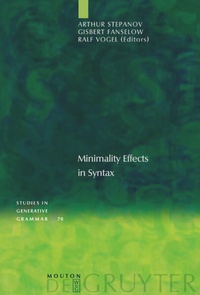
Minimality Effects in Syntax
Description

The volume is a collection of 12 papers which focus on empirical and theoretical issues associated with syntactic phenomena falling under the rubric of Relativized Minimality (Rizzi 1990) or, in more recent terms, Minimal Link Condition (MLC, Chomsky 1995). The bulk of the papers are based on the ideas presented at the Workshop "Minimal Link Effects in Minimalist and Optimality Theoretic Syntax" which took place at the University of Potsdam on March 21-22, 2002.
All contributors are prominent specialists in the topic of syntactic Minimality. The empirical phenomena brought to bear on Minimality/MLC in the present volume include, but not limited to:
- Superiority effects in multiple wh-questions, including those with 'D-linked' wh-phrase(s) (Müller, Haida, Haider)
- Stylistic Fronting in Germanic and Romance (Fisher, Poole)
- Transitive sentences in Hindi-type ergative languages (Stepanov)
- Word order 'freezing' effects in double-nominative constructions in Korean (Lee)
- Double object constructions in Greek (Anagnostoupoulou)
- Remnant constituent displacement in German and Japanese (Hale and Legendre)
Nine of the proposed accounts are couched in the Minimalist framework (Chomsky 1995, 2000, 2001), three in the framework of Optimality Theory (Prince and Smolensky 1993). Thematically, the contributions divide into three groups addressing the following major questions:
How can apparent violations of syntactic Minimality/MLC be accounted for? (Haida, Stepanov, Poole, Fisher, Anagnostopoulou)
What is the status of MLC? Is it a primitive or a theorem in the grammar? (Müller, Fanselow, Lechner, Vogel, Lee, Haider)
Can Minimality phenomena shed decisive evidence in favor of a derivational (Minimalist type) or a representational (Optimality theory like) framework? (Hale and Legendre, Haider)
More details
Other editions
Additional editions
Persons
Content
2 - Contents [Seite 5]
3 - Introduction [Seite 7]
4 - On clitics, feature movement, and double object alternations [Seite 21]
5 - PF merger in stylistic fronting and object shift [Seite 43]
6 - The MLC and derivational economy [Seite 79]
7 - Stylistic fronting: a contribution to information structure [Seite 131]
8 - The superiority conspiracy: Four constraints and a processing effect [Seite 153]
9 - Minimal links, remnant movement, and (Non-)derivational grammar [Seite 183]
10 - Extending and reducing the MLC [Seite 211]
11 - Minimality in a lexicalist Optimality Theory [Seite 247]
12 - Phrase impenetrability and wh-intervention [Seite 295]
13 - MLC violations: Implications for the syntax/phonology interface [Seite 333]
14 - Ergativity, Case and the Minimal Link Condition [Seite 373]
15 - Correspondence in OT syntax and Minimal Link effects [Seite 407]
16 - Backmatter [Seite 449]
