

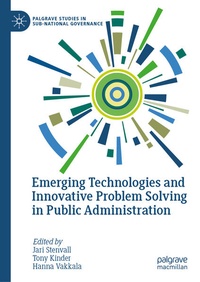
Emerging Technologies and Innovative Problem Solving in Public Administration
Description

This book examines problem solving in public administration and public management. Drawing on case studies from around the world, it assesses real-world examples to illustrate how new learning and emerging technologies are being utilized to provide solutions to issues faced by public administrators and citizens.
Problem-solving is a ubiquitous activity in public administration. From day-to-day meetings, strategic decision-making, and the implementation of new technologies, public administrators are continually faced with problems to overcome. Each chapter presents insights into a different problem and the practical solutions adopted to address it. Cases have been selected to present a variety of problems in various countries and contexts, and across different sectors, including healthcare and social care. Special attention is also given to the role of emerging technologies and artificial intelligence, including the challenges they present, as well as the ways in which they can be used by administrators and managers to enhance democracy and improve data security.
The book will appeal to scholars and students of public administration and public management, as well as practitioners.
More details
Other editions
Additional editions
Persons
Jari Stenvall is Professor of Administrative Sciences at Tampere University, Finland.
Tony Kinder is Visiting Professor at Tampere University, Finland.
Hanna Vakkala is Adjunct Professor of Administrative Sciences at the University of Lapland, Finland.
Content
Part 1: Problem Solving Method and Approach.- Chapter 1: Introduction.- Chapter 2: Homelessness in Finland - Dialectical Problem Solving.- Chapter 3: The Crowdsourcing Delphi Methodology: Forward-Oriented Problem Solving with Experts and Wisdom of Crowds.- Chapter 4: Problem-Solving in Research Literature - A Bibliometric Analysis on Collaborative Governance and Stakeholder Engagement.-Part 2: Public Services and Problem Solving.- Chapter 5: Sustainable Leadership Supporting Problem-Solving and Success.- Chapter 6: 'Failure Demand': No Easy Solutions in Finnish Primary Healthcare.- Chapter 7: Muddling Through the Embedding of an Ecosocial Perspective into Social Work Practice: A Case Study from Regional Australia.- Chapter 8: Problem-Solving in Education Setting: A Case Study of the Nurture Thru Nature (NtN) Program in the United States.- Chapter 9: Problem-Solving in Multi-Level Governance Decision-Making Contexts: Case Bergen Light Rail.-Part 3: Artificial Intelligence and Problem Solving.- Chapter 10: Behind the Big Thinkers; Can We Be Better Problem Solvers Enabled by AI?.- Chapter 11: The Government of the People, by the People, for the People Facing Challenges of AI.- Chapter 12: Leading Cities by Real Lives: A Citizen Digital Twin Approach to Welfare Economics.- Chapter 13: The Conundrum of GenAI Created Outputs - Epistemological and Methodological Mitigations.-Part 4: Critical Discussion and Conclusions.- Chapter 14: Understanding Problem-Solving from a Value (Co-)Destruction Lens: Nip Illness in the Bud?.- Chapter 15: Conclusions.
