

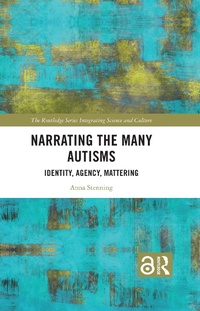
Narrating the Many Autisms
Identity, Agency, Mattering
Published on 5. March 2024
250 pages
978-1-003-85413-5 (ISBN)
Description

Autism is a profoundly contested idea. The focus of this book is not what autism is or what autistic people are, but rather, it grapples with the central question: what does it take for autistic people to participate in a shared world as equals with other people?
Drawing from her close reading of a range of texts and narratives, by autistic authors, filmmakers, bloggers, and academics, Anna Stenning highlights the creativity and imagination in these accounts and also considers the possibilities that emerge when the unexpected and novel aspects of experience are attended to and afforded their due space. Approaching these narrative accounts in the context of both the Anthropocene and neoliberalism, Stenning unpacks and reframes understandings about autism and identity, agency and mattering, across sections exploring autistic intelligibility, autistic sensibility, and community-oriented collaboration and care.
By moving away from the non-autistic stories about autism that have, over time, dominated public conception of the autistic experience and relationships, as well as the cognitive and psychoanalytic paradigms that have reduced autism and autistic people to a homogeneous group, the book instead reveals the multiplicity of autistic subjectivities and their subsequent understandings of well-being and vulnerability. It calls on readers to listen to what autistic people have to say about the possibilities of resistance and solidarity against intersecting currents and eddies of power, which endanger all who challenge the neoliberal conception of Life.
A stirring and meaningful departure from atomized accounts of neurological difference, Narrating the Many Autisms ponders big questions about its topic and finds clarity and meaning in the sense-making practices of autistic individuals and groups. It will appeal to scholarly readers across the fields of disability studies, the medical humanities, cultural studies, critical psychology, sociology, anthropology, and literature.
Drawing from her close reading of a range of texts and narratives, by autistic authors, filmmakers, bloggers, and academics, Anna Stenning highlights the creativity and imagination in these accounts and also considers the possibilities that emerge when the unexpected and novel aspects of experience are attended to and afforded their due space. Approaching these narrative accounts in the context of both the Anthropocene and neoliberalism, Stenning unpacks and reframes understandings about autism and identity, agency and mattering, across sections exploring autistic intelligibility, autistic sensibility, and community-oriented collaboration and care.
By moving away from the non-autistic stories about autism that have, over time, dominated public conception of the autistic experience and relationships, as well as the cognitive and psychoanalytic paradigms that have reduced autism and autistic people to a homogeneous group, the book instead reveals the multiplicity of autistic subjectivities and their subsequent understandings of well-being and vulnerability. It calls on readers to listen to what autistic people have to say about the possibilities of resistance and solidarity against intersecting currents and eddies of power, which endanger all who challenge the neoliberal conception of Life.
A stirring and meaningful departure from atomized accounts of neurological difference, Narrating the Many Autisms ponders big questions about its topic and finds clarity and meaning in the sense-making practices of autistic individuals and groups. It will appeal to scholarly readers across the fields of disability studies, the medical humanities, cultural studies, critical psychology, sociology, anthropology, and literature.
Reviews / Votes
"Centering autistic voices and expressive forms, Narrating the Many Autisms affirms autistic agency and creativity, with words and beyond. In this remarkable book, Anna Stenning dismantles deficit assumptions and cultural stereotypes on autistic lifeworlds to offer an original and profound reflection on the many forms of social relatedness."Professor Laura Sterponi, Berkeley School of Education, University of California Berkeley.
"Dr. Anna Stenning advances the long road towards the realization of autistic ontological agency with her new book, Narrating the Many Autisms: Agency, Identity and Belonging. She defers to autistic autobiographies, narratives, and community knowledge to make space for autistic selfhood, which she argues should be a shared practice and commitment by the neuro-majority. At the same time, Stenning considers how Western medical and educational research misrepresents and misrecognizes autism by reducing a way of being in the world to a neurological impairment."
Alice Wexler, Ed.D., Professor Emerita of Art Education at SUNY New Paltz.
More details
Series
Language
English
Place of publication
London
United Kingdom
Publishing group
Taylor & Francis Ebooks
Target group
College/higher education
Illustrations
4 Halftones, black and white; 4 Illustrations, black and white
File size
12,84 MB
ISBN-13
978-1-003-85413-5 (9781003854135)
Copyright in bibliographic data and cover images is held by Nielsen Book Services Limited or by the publishers or by their respective licensors: all rights reserved.
Schweitzer Classification
Other editions
Additional editions
Book
05/2025
1st Edition
Routledge
€67.40
Shipment within 10-20 days
Book
01/2024
1st Edition
Routledge
€206.40
Shipment within 15-20 days
Person
Anna Stenning, PhD, is a research associate at Durham University. She is the editor of a collection of essays on walking, literature, and the visual arts entitled Walking, Landscape, Environment (Routledge, 2020), and the editor of and a contributor to Neurodiversity: A New Critical Paradigm (Routledge, 2020).
Content
Introduction: Beyond the Neurological Subject Part I. On Autistic Intelligibility 1. The Matter of a First-person Perspective 2. Master narratives, Counterstories, and the Challenges of Mutual Recognition Part II. On Autistic Sensibility 3. Sensory Subjects, Facilitated 4. Competence, Communication and Connection in the Anthropocene Part III. Autistic Collaboration 5. Toward a Community-Oriented Research Strategy Conclusion: Provocations on Why Autistic People Matter
