

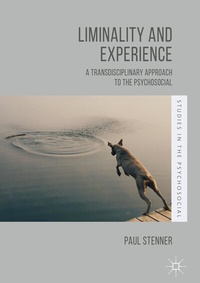
Liminality and Experience
Description

This book breathes new life into the study of liminal experiences of transition and transformation, or 'becoming'. It brings fresh insight into affect and emotion, dream and imagination, and fabulation and symbolism by tracing their relation to experiences of liminality. The author proposes a distinctive theory of the relationship between psychology and the social sciences with much to share with the arts. Its premise is that psychosocial existence is not made of 'stuff' like building blocks, but of happenings and events in which the many elements that compose our lives are temporarily drawn together. The social is not a thing but a flow of processes, and our personal subjectivity is part of that flow, 'selves' being tightly interwoven with 'others'. But there are breaks and ruptures in the flow, and during these liminal occasions our experience unravels and is rewoven. This book puts such moments at the core of the psychosocial research agenda. Of transdisciplinary scope, itwill appeal beyond psychosocial studies and social psychology to all scholars interested in the interface between experience and social (dis)order.
Reviews / Votes
"This is an ambitious and challenging text that provokes thought and forces the reader to confront their preconceptions of how we can make sense of the social world." (Mark Erickson, Sociology, January 08, 2019)
"Liminality and Experience develops an approach to thinking that can illuminate the future of psychosocial approaches on producing effects of in/stability. A central concern of Liminality and Experience is the recognition the self is formed and sustained in a wider context of social forces and structures, though is not reducible to that context." (Robbie Duschinsky and Samantha Reisz, Theory, Culture & Society, theoryculturesociety.org, May 31, 2018)
More details
Other editions
Additional editions
Person
Paul Stenner is Professor of Social Psychology at the Open University, UK. He is author of over 100 articles and several books including, with S.D. Brown, Psychology Without Foundations , and, with Monica Greco, The Emotions: A Social Science Reader. He is a Fellow of the Academy of Social Sciences and President of the International Society for Theoretical Psychology (until 2019).
Content
Chapter 1. Introduction: Throwing psychosocial studies in at the deep end.- Chapter 2. This is not. the truth: on fabulation.- Chapter 3. This is not. food: on food for thought.- Chapter 4. This is not. a pipe: on the complexity of experience.- Chapter 5. This is not. a shock: on the passage between multiple worlds.- Chapter 6. This is not. a turn to affect: feeling between ontology and anthropology.- Chapter 7. Conclusion.
