

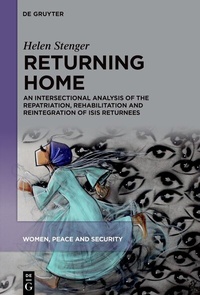
Returning Home
Description

In March 2019, ISIS was territorially defeated. ISIS members were captured and detained: men were sent to prison and women and children to camps in northern Syria. This is an unprecedented situation where for the first-time thousands of female members of a terrorist group are detained in a foreign country without access to legal mechanisms, rehabilitation or reintegration measures. What happens to the foreign women (and children) who are not repatriated from the camps? If they are repatriated, are there rehabilitation and reintegration programmes in place that account for the experiences the women had?
Most existing rehabilitation and reintegration programmes are gender-neutral; that is, they claim to be universal, and are not tailored specifically to male or female beneficiaries. Yet, typically, these programmes are influenced by implicit gender norms and assumptions, such as that men are violent perpetrators of aggression and women are victims who are peaceful and lack agency. Alongside gender norms, intersecting racial and religious dynamics also shape how governments handle the repatriation, rehabilitation and reintegration of ISIS returnees. This includes racial profiling, the conflation between Islam and extremism and more broadly the rising Islamophobia in many countries, particularly since the 'War on Terror'. These dynamics lead to an absence of rehabilitation and reintegration programmes specifically designed for women's diverse experiences, which is the subject of this book.
Returning Home examines state responses to repatriation, rehabilitation and reintegration of ISIS returnees from an intersectional perspective, with a focus on ISIS women returnees. This book addresses the biased understandings that are built into scholarship and policy responses that reinforce gendered and racialized inequalities. It outlines how these dynamics can be uncovered and redressed by designing policies that are responsive to gender differences, inequalities and harmful norms.
.
More details
Other editions
Additional editions
Person
Helen Stenger is a Research Fellow at the Centre of Excellence for the Elimination of Violence Against Women (CEVAW) at Monash University. She holds a Ph.D. in Politics and International Relations from Monash University, a Master of Arts in International Relations from Leiden University and a Master of Science in Clinical Neuropsychology from the University of Groningen. Her research interest lies at the intersection of extremism, including Islamist, far-right and Buddhist, and gender-based violence.
