

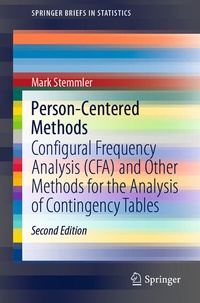
Person-Centered Methods
Description

This book offers a comprehensible overview of the statistical approach called the person-centered method. Instead of analyzing means, variances and covariances of scale scores as in the common variable-centered approach, the person-centered approach analyzes persons or objects grouped according to their characteristic patterns or configurations in contingency tables. This second edition explores the relationship between two statistical methods: log-linear modeling (LLM) and configural frequency analysis (CFA). Both methods compare expected frequencies with observed frequencies. However, while LLM searches for the underlying dependencies of the involved variables in the data (model-fitting), CFA examines significant residuals in non-fitting models.
New developments in the second edition include: Configural Mediation Models, CFA with covariates, moderator CFA, and CFA modeling branches in tree-based methods. The new developments enable the use of categorical together with continuous variables, which makes CFA a very powerful statistical tool. This new edition continues to utilize R-package confreq ( derived from Conf igural Freq uency Analysis), much updated since the first edition and newly adjusted to the new R base program 4.0. An electronic supplement is now available with 18 R-scripts and many datasets.
More details
Other editions
Additional editions
Previous edition
Person
Mark Stemmler is a Full Professor of Psychological Assessment, Quantitative Methods and Forensic Psychology at the Institute of Psychology at the University of Erlangen-Nuremberg, Germany. He received his master's degree from the Technical University Berlin in 1989 and his PhD from the Pennsylvania State University in 1993. His recent publications include Deviance and Delinquency in Childhood and Adolescence: New Approaches in Criminological Research (with S. Wallner, M. Weiss, and J. Reinecke, 2018 Springer), Assessment of Dementia (with J. Kornhuber, 2018), and Dependent Data in Social Sciences Research: Forms, Issues, and Methods of Analysis (with A. von Eye and W. Wiedermann, 2015 Springer). His research interests encompass developmental psychology, evaluation research, psychological assessment and methodology, specifically categorical data analysis. He has worked on longitudinal studies in the US and Germany.
Content
1. Introducing Person-Centered Methods.- 2. CFA Software.- 3. Significance Testing in CFA.- 4. CFA and Log-Linear Modeling.- 5. Longitudinal CFA.- 6. Other Person-Centered Methods Serving as Complimentary Tools for CFA.- 7. CFA and its Derivatives.- Glossary.- Index.
