

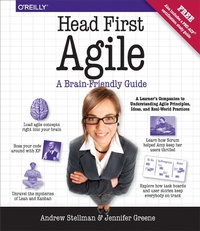
Head First Agile
A Brain-Friendly Guide to Agile Principles, Ideas, and Real-World Practices
Published on 18. September 2017
490 pages
978-1-4919-5044-9 (ISBN)
Description

Head First Agile is a complete guide to learning real-world agile ideas, practices, principles.What will you learn from this book?In Head First Agile, you'll learn all about the ideas behind agile and the straightforward practices that drive it. You'll take deep dives into Scrum, XP, Lean, and Kanban, the most common real-world agile approaches today. You'll learn how to use agile to help your teams plan better, work better together, write better code, and improve as a teambecause agile not only leads to great results, but agile teams say they also have a much better time at work. Head First Agile will help you get agile into your brain... and onto your team!Preparing for your PMI-ACP certification?This book also has everything you need to get certified, with 100% coverage of the PMI-ACP exam. Luckily, the most effective way to prepare for the exam is to get agile into your brainso instead of cramming, you're learning.Why does this book look so different?Based on the latest research in cognitive science and learning theory, Head First Agile uses a visually rich format to engage your mind, rather than a text-heavy approach that puts you to sleep. Why waste your time struggling with new concepts? This multi-sensory learning experience is designed for the way your brain really works.
More details
Other editions
Additional editions
Andrew Stellman | Jennifer Greene
Head First Agile
A Brain-Friendly Guide to Agile Principles, Ideas, and Real-World Practices
Book
10/2017
O'Reilly
€64.50
Shipment within 10-20 days
Content
- Intro
- Praise for Head First Agile
- Copyright
- Author bios
- Table of Contents
- Chapter 1: What is agile?
- The new features sound great...
- ...but things don't always go as expected
- Agile to the rescue!
- Kate tries to hold a daily standup
- Different team members have different attitudes
- A better mindset makes the practice work better
- So what is agile, anyway?
- Scrum is the most common approach to agile
- The PMI-ACP certification can help you be more agile
- Chapter 2: Agile values and principles
- Something big happened in Snowbird
- The Agile Manifesto
- Adding practices in the real world can be a challenge
- Individuals and interactions over processes and tools
- Working software over comprehensive documentation
- Customer collaboration over contract negotiation
- Responding to change over following a plan
- Question Clinic: The "which-is-BEST" question
- They think they've got a hit...
- ...but it's a flop!
- The principles behind the Agile Manifesto
- The agile principles help you deliver your product
- The agile principles help your team communicate and work together
- The new product is a hit!
- Exam Questions
- Chapter 3: Managing projects with Scrum
- Meet the Rand Hand Games team
- The Scrum events help you get your projects done
- The Scrum roles help you understand who does what
- The Scrum artifacts keep the team informed
- The Scrum values make the team more effective
- Question Clinic: The "which-comes-next" question
- A task isn't done until it's "Done" done
- Scrum teams adapt to changes throughout the Sprint
- The Agile Manifesto helps you really "get" Scrum
- Things are looking good for the team
- Exam Questions
- Chapter 4: Agile planning and estimation
- Meanwhile, back at the ranch...
- So...what's next?
- Introducing GASPs!
- No more 300-page specs...please?
- User stories help teams understand what users need
- Story points let the team focus on the relative size of each story
- The whole team estimates together
- No more detailed project plans
- Taskboards keep the team informed
- Question Clinic: The red herring
- Burndown charts help the team see how much work is left
- Velocity tells you how much your team can do in a sprint
- Burn-ups keep your progress and your scope separate from each other
- How do we know what to build?
- Story maps help you prioritize your backlog
- Personas help you get to know your users
- The news could be better...
- Restrospectives help your team improve the way they work
- Some tools to help you get more out of your retrospectives
- Exam Questions
- Chapter 5: XP (eXtreme Programming)
- Meet the team behind CircuitTrak
- Late nights and weekends lead to code problems
- XP brings a mindset that helps the team and the code
- Iterative development helps teams stay on top of changes
- Courage and respect keep fear out of the project
- Teams build better code when they work together
- Teams work best when they sit together
- XP teams value communication
- Teams work best with relaxed, rested minds
- Question Clinic: The "which-is-NOT" question
- XP teams embrace change
- Frequent feedback keeps changes small
- Bad experiences cause a rational fear of change
- XP practices give you feedback about the code
- XP teams use automated builds that run quickly
- Continuous integration prevents nasty surprises
- The weekly cycle starts with writing tests
- Agile teams get feedback from design and testing
- Pair programming
- Complex code is really hard to maintain
- When teams value simplicity, they build better code
- Simplicity is a fundamental agile principle
- Every team accumulates technical debt
- XP teams "pay down" technical debt in each weekly cycle
- Incremental design starts (and ends) with simple code
- Exam Questions
- Chapter 6: Lean/Kanban
- Trouble with Audience Analyzer 2.5
- Lean is a mindset (not a methodology)
- Lean principles help you see things differently
- More Lean principles
- Some thinking tools you haven't seen before
- More Lean thinking tools
- Categorizing waste can help you see it better
- Value stream maps help you see waste
- Trying to do too many things at once
- Anatomy of an Option
- Systems thinking helps Lean teams see the whole
- Some "improvements" didn't work out
- Lean teams use pull systems to make sure they're always working on the most valuable tasks
- Question Clinic: Least worst option
- Kanban uses a pull system to make your process better
- Use Kanban boards to visualize the workflow
- How to use Kanban to improve your process
- The team creates a workflow
- The team is delivering faster
- Cumulative flow diagrams help you manage flow
- Kanban teams talk about their policies
- Feedback loops show you how it's working
- Now the whole team is collaborating on finding better ways to work!
- Exam Questions
- Chapter 7: Preparing for the PMI-ACP Exam
- The PMI-ACP certification is valuable...
- The PMI-ACP exam is based on the content outline
- You are an agile practitioner...
- A long-term relationship for your brain
- Domain 1: Agile Principles and Mindset
- Domain 1: Exam Questions
- Domain 2: Value-Driven Delivery
- Agile teams use customer value to prioritize requirements
- Value calculations help you figure out which projects to do
- Domain 2: Exam Questions
- Domain 3: Stakeholder Engagement
- Domain 4: Team Performance
- Domain 3: Exam Questions
- Domain 4: Exam Questions
- Domain 5: Adaptive Planning
- Adapt your leadership style as the team evolves
- A few last tools and techniques
- Domain 6: Problem Detection and Resolution
- Domain 7: Continuous Improvement
- Domain 5: Exam Questions
- Domain 6: Exam Questions
- Domain 7: Exam Questions
- Are you ready for the final exam?
- Chapter 8: Professional responsibility
- Doing the right thing
- Keep the cash?
- Fly business class?
- New software
- Shortcuts
- A good price or a clean river?
- We're not all angels
- Exam Questions
- Chapter 9: Practice makes perfect
- Complete PMI-ACP Practice Exam
- Before you look at the answers...
- Index
