

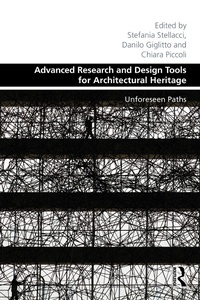
Advanced Research and Design Tools for Architectural Heritage
Unforeseen Paths
1st Edition
Published on 31. July 2024
308 pages
978-1-040-03133-9 (ISBN)
Description

Advanced Research and Design Tools for Architectural Heritage: Unforeseen Paths rethinks how to analyse, preserve, and adapt Architectural Heritage and its surroundings along unforeseen paths using a broad spectrum of advanced research and design tools. By delving into conceptual foundations and recent applications, it transcends disciplinary boundaries and leverages advanced design tools, such as space syntax, natural language processing, advanced photogrammetry, heritage building information modelling, and virtual reality.
This book offers a comprehensive collection of collaborative research studies by a team of scholars with diverse perspectives and digital expertise from long-term projects. Encompassing case studies and recent academic experiences, the volume explores notable heritage sites in Europe, Asia, and Africa. Readers are afforded a nuanced understanding of integrated tools through a forward-looking approach. By addressing critical heritage challenges, the book contributes to reshaping architecture discourse and practice.
The chapters explore the integration of advanced methodologies to address emerging societal concerns, making the book a valuable resource for architecture, archaeology, urban planning, catering to professors, trainers, and students. Additionally, its relevance extends to practitioners interested in cultural studies, urban policies, and data science, including archivists, representatives from public governmental authorities, and policy stakeholders.
This book offers a comprehensive collection of collaborative research studies by a team of scholars with diverse perspectives and digital expertise from long-term projects. Encompassing case studies and recent academic experiences, the volume explores notable heritage sites in Europe, Asia, and Africa. Readers are afforded a nuanced understanding of integrated tools through a forward-looking approach. By addressing critical heritage challenges, the book contributes to reshaping architecture discourse and practice.
The chapters explore the integration of advanced methodologies to address emerging societal concerns, making the book a valuable resource for architecture, archaeology, urban planning, catering to professors, trainers, and students. Additionally, its relevance extends to practitioners interested in cultural studies, urban policies, and data science, including archivists, representatives from public governmental authorities, and policy stakeholders.
More details
Series
Edition
1. Auflage
Language
English
Place of publication
London
United Kingdom
Publishing group
Taylor & Francis Ltd
Target group
College/higher education
Professional and scholarly
Illustrations
17 Tables, black and white; 31 Line drawings, black and white; 31 Halftones, black and white; 62 Illustrations, black and white
ISBN-13
978-1-040-03133-9 (9781040031339)
Copyright in bibliographic data and cover images is held by Nielsen Book Services Limited or by the publishers or by their respective licensors: all rights reserved.
Schweitzer Classification
Other editions
Additional editions
Stefania Stellacci | Danilo Giglitto | Chiara Piccoli
Advanced Research and Design Tools for Architectural Heritage
Unforeseen Paths
Book
05/2026
1st Edition
Routledge
€57.50
Shipment within 10-20 days
Stefania Stellacci | Danilo Giglitto | Chiara Piccoli
Advanced Research and Design Tools for Architectural Heritage
Unforeseen Paths
Book
07/2024
1st Edition
Routledge
€193.50
Shipment within 10-20 days

Stefania Stellacci | Danilo Giglitto | Chiara Piccoli
Advanced Research and Design Tools for Architectural Heritage
Unforeseen Paths
Book
05/2024
Routledge
Unfortunately, price unknown
Available (delivery time upon request)
Persons
Stefania Stellacci is an Integrated Researcher at ISTAR (Information Sciences, Technologies and Architecture Research Center) at Iscte (University Institute of Lisbon) and Invited Professor (2021-23) at Iscte. She is an architect with a MSc in Architecture (University of Ferrara, 2006), holds a postgraduate degree in Built Conservation (Roma3 University, 2007) and a PhD in Architecture (Iscte, 2018). Her research spans across critical heritage studies, multiple-criteria decision analysis, sustainable heritage management, inclusive design, and digital transformation.
Danilo Giglitto is an Associate Lecturer at Sheffield Hallam University, UK. Danilo holds a PhD from the University of Aberdeen (2017). He has several years of experience in researching at the intersection of cultural heritage, digital technologies, and social innovation, and has collaborated in several international projects exploring these themes. He has previously co-edited a book titled Digital Approaches to Inclusion and Participation in Cultural Heritage: Insights from Research and Practice in Europe (Routledge, 2023). He has published in reputable journals such as the International Journal of Heritage Studies and Museum & Society.
Chiara Piccoli is a Research Fellow and Data Scientist at the 4D Research Lab, and an affiliated researcher at the University of Amsterdam's Data Science Centre. Her research primarily focuses on urban and domestic contexts and on the use of 3D modelling and GIS mapping for historical data visualisation, analysis, and communication. Chiara holds a PhD in Archaeology (Leiden University, 2018), an MA in Archaeology (University of Siena, 2008) and an MA in Book and Digital Media Studies (Leiden University, 2010).
Danilo Giglitto is an Associate Lecturer at Sheffield Hallam University, UK. Danilo holds a PhD from the University of Aberdeen (2017). He has several years of experience in researching at the intersection of cultural heritage, digital technologies, and social innovation, and has collaborated in several international projects exploring these themes. He has previously co-edited a book titled Digital Approaches to Inclusion and Participation in Cultural Heritage: Insights from Research and Practice in Europe (Routledge, 2023). He has published in reputable journals such as the International Journal of Heritage Studies and Museum & Society.
Chiara Piccoli is a Research Fellow and Data Scientist at the 4D Research Lab, and an affiliated researcher at the University of Amsterdam's Data Science Centre. Her research primarily focuses on urban and domestic contexts and on the use of 3D modelling and GIS mapping for historical data visualisation, analysis, and communication. Chiara holds a PhD in Archaeology (Leiden University, 2018), an MA in Archaeology (University of Siena, 2008) and an MA in Book and Digital Media Studies (Leiden University, 2010).
Content
List of figures
List of tables
List of contributors
Preface
Acknowledgements
Disclaimer
1. Introduction: Unforeseen Paths towards impactful heritage-based actions
Stefania Stellacci, Chiara Piccoli, Danilo Giglitto
2. Locating 'everyday' heritage in 20th-century residential developments on the sites of demolished English country houses: a space-syntactic archaeology of place
Sam Griffiths
3. The role of urban form and architectural heritage in the 'reurbanisation' of the historical centre of Nicosia
Ilaria Geddes
4. Inclusive design to overcome isolation: space syntax analysis and the road network of Sao Tome
Rafael Abu-Raya, Sara Eloy
5. Re-thinking and re-imagining the value of the built heritage in a digital age
Richard Laing
6. Heritage sites as shared space of virtual communities: Participatory mapping through sentiment analysis
Stefania Stellacci, Sergio Moro
7. Heritage Urban Transect for computational analysis of place vulnerability: Exploring historical waterscape connectivity in Mardin
Serdar Aydin, Izzettin Kutlu, Deryanur Simsek, Berat Celebioglu
8. Subak Syntax: Decoding the hydrological socio-agricultural systems of the Bali Subak Typology
James Melsom
9. A review of Non-Destructive Techniques and modelling methods for survey and condition monitoring on Architectural Heritage
Sara Gonizzi Barsanti, Rosa De Finis, Chiara Bertolin
10. Lost and Found in Translation: Integrating architectural surveys and computational models for Seljuk madrasas
Sena Kayasue, Sevgi Altun, Berkay OEztuerk, Yusuf Sahin, Goezde Unal, Mine OEzkar
11. Tackling the information gap: Comprehensive scientific documentation of virtual reconstructions
Bob Martens, Herbert Peter
12. Visiting the ghosts of mediaeval Silves: Virtual Reality experience of 3D urban reconstruction of the past
Rui Filipe Antunes
13. The importance of training architecture students in Scan-to-BIM and HBIM for enhanced preparedness and market competitiveness
Gabriella Del Duca
Index
List of tables
List of contributors
Preface
Acknowledgements
Disclaimer
1. Introduction: Unforeseen Paths towards impactful heritage-based actions
Stefania Stellacci, Chiara Piccoli, Danilo Giglitto
2. Locating 'everyday' heritage in 20th-century residential developments on the sites of demolished English country houses: a space-syntactic archaeology of place
Sam Griffiths
3. The role of urban form and architectural heritage in the 'reurbanisation' of the historical centre of Nicosia
Ilaria Geddes
4. Inclusive design to overcome isolation: space syntax analysis and the road network of Sao Tome
Rafael Abu-Raya, Sara Eloy
5. Re-thinking and re-imagining the value of the built heritage in a digital age
Richard Laing
6. Heritage sites as shared space of virtual communities: Participatory mapping through sentiment analysis
Stefania Stellacci, Sergio Moro
7. Heritage Urban Transect for computational analysis of place vulnerability: Exploring historical waterscape connectivity in Mardin
Serdar Aydin, Izzettin Kutlu, Deryanur Simsek, Berat Celebioglu
8. Subak Syntax: Decoding the hydrological socio-agricultural systems of the Bali Subak Typology
James Melsom
9. A review of Non-Destructive Techniques and modelling methods for survey and condition monitoring on Architectural Heritage
Sara Gonizzi Barsanti, Rosa De Finis, Chiara Bertolin
10. Lost and Found in Translation: Integrating architectural surveys and computational models for Seljuk madrasas
Sena Kayasue, Sevgi Altun, Berkay OEztuerk, Yusuf Sahin, Goezde Unal, Mine OEzkar
11. Tackling the information gap: Comprehensive scientific documentation of virtual reconstructions
Bob Martens, Herbert Peter
12. Visiting the ghosts of mediaeval Silves: Virtual Reality experience of 3D urban reconstruction of the past
Rui Filipe Antunes
13. The importance of training architecture students in Scan-to-BIM and HBIM for enhanced preparedness and market competitiveness
Gabriella Del Duca
Index
