

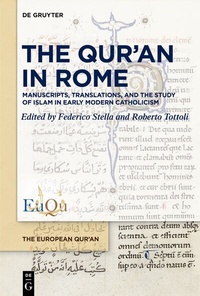
The Qur'an in Rome
Description

Despite its relevance to the subsequent development of Western Islamic studies, the intellectual contribution of early modern Catholicism is still an under-researched area. The aim of this volume is to fill this gap, offering a series of essays dealing with the study of the Qur'an and Arabic language in early modern Catholic Europe. Focusing on the circulation of manuscripts, translations and printed books, the essays highlight how Catholic Orientalism contributed to the birth and spread of Western Islamic studies, although sometimes it was still directed towards religious polemics. Among the protagonists of this period of Islamic studies, the volume will focus on Catholic priests, missionaries, religious orders (Jesuits, Franciscans, Carmelites) Eastern Christians, converts, and other prominent figures in the Catholic culture of the time. Special attention will be given to the work of Ludovico Marracci, author of a fundamental edition of the Arabic text and Latin translation of the Qur'an with an introduction, notes, refutations and religious and linguistic insights.
The volume is of interest to an audience of specialists and non-specialists interested both in Islamic and Qur'anic studies and in the history of modern Catholicism, missions, and Orientalism
More details
Other editions
Additional editions
Persons
Content
- Intro
- Acknowledgements
- Contents
- Introduction
- 1 Italian Humanists
- Traces of the Qur'an in the Books of Cardinal Domenico Capranica. An Investigation of BAV MS Vat. Lat. 7317
- The Qur'an of Guglielmo Raimondo Moncada: The Arabic Versions of Suras 21 and 22 in BAV MS Urb. Lat. 1384
- Printing the Qur'an in Rome: From the Typographia Medicea to Marracci's Paduan Edition
- 2 Europe, Rome, and the Orient
- A Qur'anic Compendium in Spanish for Use by the Inquisition (BNE MS 2076)
- George Strachan of the Mearns
- Rome as a Hub of Arabic Studies in the 17th Century: A View from Vienna
- Across Confessional Boundaries. Bibliander's Alcoran-Edition in Catholic Europe
- Marsili, the Inquisition and Oriental Studies in Bologna
- 3 Discalced Carmelites and Franciscans
- From Rome to the East: An Analysis of the Main "Roman" Anti-Islamic Sources of the De procuranda salute omnium gentium (1613)
- Dominicus Germanus de Silesia in Rome: The Roman Prodromes of a Future Qur'an Translator
- 4 The Society of Jesus and Islam
- A Solitary Jesuit Scholar and the Qur'an: The Translation and Commentary of Ignazio Lomellini
- The Islamicate Occult Library of Athanasius Kircher
- The Qur'an and the Arabic Language in the Writings of Baldassarre Loyola Mandes S.J. (1631-1667). Between Islamic Reminiscence and Catholic Controversy
- Praxis conuertendi Mahumetanos. Tirso González de Santalla's Manuductio
- 5 Ludovico Marracci
- A Harmony of Intent: Bishop Gregorio Barbarigo (1625-1697) and Ludovico Marracci (1612-1700)
- The Role of Greek and Latin Auctores in Ludovico Marracci's Alcorani Textus Universus
- From din, milla, umma to religio, secta, superstitio: Marracci's Latin-Arabic for "Religion" - A Lexical Analysis within the Historical Framework of the European History of the Modern Concept of Religion
- List of Contributors
- Index
