

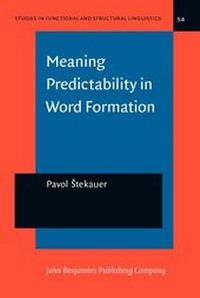
Meaning Predictability in Word Formation
Novel, context-free naming units
1st Edition
Published on 18. March 2005
XXII, 289 pages
978-90-272-9456-2 (ISBN)
Description

This book aims to contribute to a growing interest amongst psycholinguists and morphologists in the mechanisms of meaning predictability. It presents a brand-new model of the meaning-prediction of novel, context-free naming units, relating the wordformation and wordinterpretation processes. Unlike previous studies, mostly focussed on N+N compounds, the scope of this book is much wider. It not only covers all types of complex words, but also discusses a whole range of predictability-boosting and -reducing conditions. Two measures are introduced, the Predictability Rate and the Objectified Predictability Rate, in order to compare the strength of predictable readings both within a word and relative to the most predictable readings of other coinages. Four extensive experiments indicate inter alia the equal predicting capacity of native and non-native speakers, the close interconnection between linguistic and extra-linguistic factors, the important role of prototypical semes, and the usual dominance of a single central reading.
More details
Other editions
Additional editions
Book
03/2005
John Benjamins Publishing Co
€127.20
Shipment within 10-15 days
Person
Content
- Meaning Predictability in Word Formation
- Editorial page
- Title page
- LCC data
- Table of contents
- Acknowledgements
- List of abbreviations
- Introduction
- 1. Literature survey
- 1.1. General
- 1.2. The morphological tradition
- 1.2.1. Lees
- 1.2.2. Levi
- 1.2.3. Van Lint
- 1.2.4. Zimmer
- 1.2.5. Downing
- 1.2.6. Allen
- 1.3. Basic psycholinguistic models
- 1.3.1. Slot-filling models
- 1.3.2. Relation models
- 1.3.3. Analogy-based models
- 1.3.4. Combined and other models
- 1.3.5. Non-compound interpretation models
- 1.4. Summary
- 2. General word formation framework
- 2.1. An onomasiological model of word formation
- 2.2. Onomasiological Types
- 3. A theory of predictability
- 3.1. Why context-free meaning predictability?
- 3.2. Predictability - lexical meaning - conceptualisation - extra-linguistic knowledge
- 3.3. Predictability and the native/non-native speaker factor
- 3.4. Predictability and seme level
- 3.5. The meaning-prediction process
- 3.5.1. Predictability and the Onomasiological Type
- 3.6. Onomasiological Structure Rules
- 3.7. Predictability and productivity
- 3.8. Predictability and typicality
- 3.9. Predictability Rate
- 3.10. Objectified Predictability Rate
- 3.11. Hypotheses
- 4. The Experiments
- 4.1. Method
- 4.2. Experiment 1
- 4.2.1. Sample naming units
- 4.2.2. Experimental data and their analysis
- 4.2.3. Summary 1
- 4.3. Experiment 2
- 4.3.1. Sample naming units
- 4.3.2. Experimental data and their analysis
- 4.3.3. Summary 2
- 4.4. Experiment 3
- 4.4.1. Sample naming units
- 4.4.2. Experimental data and their analysis
- 4.4.3. Summary 3
- 4.5. Experiment 4
- 4.5.1. Sample naming units
- 4.5.2. Experimental data and their analysis
- 4.5.3. Discussion
- 4.5.4. Summary 4
- 4.6. Meaning predictability and associative meaning: The experimental results in the light of free association of words
- 4.6.1. Meaning predictability of conversions and the associative principle
- 4.6.2. Summary 5
- 4.6.3. Meaning predictability of two-constituent naming units and the associative principle
- 4.6.4. Summary 6
- 5. Conclusions
- 5.1. General
- 5.2. Conclusions
- Notes
- References
- Author index
- Subject index
- The series Studies In Functional And Structural Linguistics
