

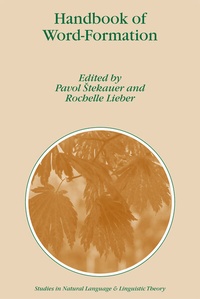
Handbook of Word-Formation
1st Edition
Published on 30. March 2006
XVIII, 470 pages
978-1-4020-3596-8 (ISBN)
Description

xiv 4. Final remarks 349 PETER HOHENHAUS: LEXICALIZATI ION AND INSTITUTIONALIZATION TITUTIONALIZATION 353 1. Introduction 353 2. Lexicalization 353 2. 1 LEXICALIZATION IN A DIACHRONIC SENSE 353 2. 2 LEXICALIZATION IN A SYNCHRONIC SENSE: LISTING/LISTEDNESS 356 2. 3 THE LEXICON AND THEORIESOF WORD-FORMATION 357 3. Institutionalization359 3. 1 TERMINOLOGY 359 3. 2 IDEAL AND REAL SPEAKERS AND THE SPEECH COMMUNITY 360 3. 3 DE-INSTITUTIONALIZATION: THE END OF A WORD'S LIFE 362 4. Problems 363 4. 1 NONCE-FORMATIONS AND NEOLOGISMS 363 4. 2 (NON-)LEXICALIZABILITY 365 4. 3 WHAT IS IN THE (MENTAL) LEXICON AND HOW DOES IT GET THERE? 367 4. 4 UNPREDICTABLE & PLAYFUL FORMATIONS, ANALOGY, FADS, AND NEW DEVELOPMENTS 369 4. 5 LEXICALIZATION BEYOND WORDS 370 ROCHELLE LIEBER: ENGLISH WORD-FORMATION PROCESSES 375 1. Introduction 375 2. Compounding 375 2. 1 DETERMINING WHAT COUNTS AS A COMPOUND 376 2. 2 ROOT COMPOUNDING 378 2. 3 SYNTHETIC COMPOUNDING 379 2. 4 STRUCTURE AND INTERPRETATION 379 3. Derivation 383 3. 1 PREFIXATION 390 3. 1. 1 Negative prefixes (un-, in-, non-, de-, dis-) 391 3. 1. 2 Locational prefixes 393 3. 1. 3 Temporal and aspectual prefixes 400 3. 1. 4 Quantitative prefixes 402 CONTENTS xv 3. 1. 5 Verbal prefixes 402 3. 2 SUFFIXATION 403 3. 2. 1 Personal nouns 403 3. 2. 2 Abstract nouns 406 3. 2. 3 Verb-forming suffixes 410 3. 2. 4 Adjective-forming suffixes 413 3. 2. 5 Collectives 417 3. 3 CONCLUSION 418 4. Conversion 418 5.
More details
Other editions
Additional editions
Pavol Stekauer | Rochelle Lieber
Handbook of Word-Formation
Book
07/2005
Springer
€235.39
Shipment within 15-20 days
Persons
Pavol Stekauer, Presov University, Presov, Slovakia / Rochelle Lieber, University of New Hampshire, Durham, NH, USA
Content
Basic Terminology.- Word-Formation and Phonology.- Word-Formation and Inflectional Morphology.- Word-Formation and Syntax.- Hans Marchand and the Marchandeans.- Chomsky's Remarks and the Transformationalist Hypothesis.- The Lexicalist Approach to Word-Formation and the Notion of the Lexicon.- Lexeme-Morpheme Base Morphology.- Onomasiological Approach to Word-Formation.- Cognitive Approach to Word-Formation.- Word-Formation in Natural Morphology.- Word-Formation in Optimality Theory.- Productivity: Theories.- Constraints on Productivity.- Lexicalization and Institutionalization.- English Word-Formation Processes.- The Latest Trends In English Word-Formation.
HANS MARCHAND AND THE MARCHANDEANS (S.99)
DIETER KASTOVSKY
1. INTRODUCTION
Hans Marchand's contribution to the theory of word-formation in general and to the description of English word-formation in particular has unquestionably been extremely influential, and his handbook The categories and types of Present-day English word-formation (1st ed. 1960, 2nd. ed. 1969) is still an unsurpassed landmark in the field.
A discussion of the basic assumptions underlying his approach is therefore certainly appropriate in the context of this volume. But what about the term 'Marchandean', which was suggested by the editors of this volume? What does it mean to be a 'Marchandean'? This certainly needs some kind of specification. Is it the fact that one has worked directly under Marchand's supervision as a research assistant, like Herbert Ernst Brekle, Leonhard Lipka, myself and Gabriele Stein (the names are given in chronological order of appointment)?
Does it mean that someone has been very much influenced by his ideas, like Klaus Hansen, although he never met him personally? Or does it mean that someone has worked as part of a circle of linguists (nowadays sometimes called the 'Tübinger Schule'), to which Marchand also belonged, but where other influences (e.g. Mario Wandruszka, Eugenio Coseriu in Romance and general linguistics, Hans-Jürgen Heringer, Otmar Werner in German linguistics) had also been very strong, as in the case of Hans Martin Gauger, Franz Hundsnurscher, Wilfried Kürschner or Christian Rohrer?
And even in the case of Marchand's assistants, these latter linguists and other influences (especially from generative-transformational grammar) are clearly visible, since none of them would take over Marchand's approach completely unchanged. Tübingen in the 1960s and 1970s was a hotbed of modern linguistics, with an active linguistic circle and a lot of cross-fertilisation also due to guests from outside. Therefore, the term 'Marchandeans' is perhaps somewhat problematic.
On the other hand, there is no denying that Marchand did have a great influence on many of us working on wordformation in Tübingen in the 1960s and 1970s and also later on, and therefore the term 'Marchandean' has a certain amount of justification, especially in view of the fact that there is a certain common theoretical basis underlying the work done by us. In the present context, it is of course not possible to take into consideration the more general influence of Marchand on many colleagues in Tübingen, who had not been members of the English Department, and I can only deal with the 'inner circle', i.e.
Marchand's research assistants as well as Klaus Hansen, who Marchand regarded as his oldest pupil, although Hansen knew Marchand only by reading his publications and by an intensive correspondence, and, second-hand, through his contacts with Brekle, Lipka, Stein and myself. Moreover, I will concentrate on contribution to word-formation and not to the many other fields in which they have been active.
Also, I will focus on those areas in which the Marchandeans have added to or modified Marchand's theory rather than sketching their overall theoretical approach, which has already been done in Stekauer (2000).
DIETER KASTOVSKY
1. INTRODUCTION
Hans Marchand's contribution to the theory of word-formation in general and to the description of English word-formation in particular has unquestionably been extremely influential, and his handbook The categories and types of Present-day English word-formation (1st ed. 1960, 2nd. ed. 1969) is still an unsurpassed landmark in the field.
A discussion of the basic assumptions underlying his approach is therefore certainly appropriate in the context of this volume. But what about the term 'Marchandean', which was suggested by the editors of this volume? What does it mean to be a 'Marchandean'? This certainly needs some kind of specification. Is it the fact that one has worked directly under Marchand's supervision as a research assistant, like Herbert Ernst Brekle, Leonhard Lipka, myself and Gabriele Stein (the names are given in chronological order of appointment)?
Does it mean that someone has been very much influenced by his ideas, like Klaus Hansen, although he never met him personally? Or does it mean that someone has worked as part of a circle of linguists (nowadays sometimes called the 'Tübinger Schule'), to which Marchand also belonged, but where other influences (e.g. Mario Wandruszka, Eugenio Coseriu in Romance and general linguistics, Hans-Jürgen Heringer, Otmar Werner in German linguistics) had also been very strong, as in the case of Hans Martin Gauger, Franz Hundsnurscher, Wilfried Kürschner or Christian Rohrer?
And even in the case of Marchand's assistants, these latter linguists and other influences (especially from generative-transformational grammar) are clearly visible, since none of them would take over Marchand's approach completely unchanged. Tübingen in the 1960s and 1970s was a hotbed of modern linguistics, with an active linguistic circle and a lot of cross-fertilisation also due to guests from outside. Therefore, the term 'Marchandeans' is perhaps somewhat problematic.
On the other hand, there is no denying that Marchand did have a great influence on many of us working on wordformation in Tübingen in the 1960s and 1970s and also later on, and therefore the term 'Marchandean' has a certain amount of justification, especially in view of the fact that there is a certain common theoretical basis underlying the work done by us. In the present context, it is of course not possible to take into consideration the more general influence of Marchand on many colleagues in Tübingen, who had not been members of the English Department, and I can only deal with the 'inner circle', i.e.
Marchand's research assistants as well as Klaus Hansen, who Marchand regarded as his oldest pupil, although Hansen knew Marchand only by reading his publications and by an intensive correspondence, and, second-hand, through his contacts with Brekle, Lipka, Stein and myself. Moreover, I will concentrate on contribution to word-formation and not to the many other fields in which they have been active.
Also, I will focus on those areas in which the Marchandeans have added to or modified Marchand's theory rather than sketching their overall theoretical approach, which has already been done in Stekauer (2000).
Table of content (1) (JPG)
Table of content (2) (JPG)
Table of content (3) (JPG)
Table of content (4) (JPG)
Table of content (5) (JPG)
Table of content (6) (JPG)
Table of content (7) (JPG)
Table of content (8) (JPG)
Table of content (9) (JPG)
Table of content (10) (JPG)
Table of content (11) (JPG)
Foreword (1) (JPG)
Foreword (2) (JPG)
Content (1) (JPG)
Content (2) (JPG)
Content (3) (JPG)
Content (4) (PDF)
