
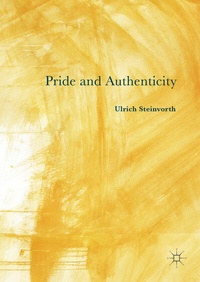
Pride and Authenticity
Description
Alles über E-Books | Antworten auf Fragen rund um E-Books, Kopierschutz und Dateiformate finden Sie in unserem Info- & Hilfebereich.
This book explores the morality of pride, a value that has been condemned through history and is still largely unwelcome in many societies. The author explores the nature of the self and free will, and how pride links to technology and rational theology. It refers to the work of Lionel Trilling, Allan Bloom, Charles Taylor and Heidegger on authenticity; Jacob Burckhardt, Stephen Toulmin, Max Weber and Mark Lilla on modernity; Christine Korsgaard on the self; John Rawls and Ruth Benedict on morality; and the Stoics and Kant on free will.
More details
Other editions
Additional editions
Person
Ulrich Steinvorth is a Professor Emeritus of the University of Hamburg, Germany, and lives in the United States. He has published books and papers in German, English and French, in political philosophy, ethics, and metaphysics. He has taught philosophy at universities in Germany, France, Turkey and Japan.

Content
System requirements
File format: PDF
Copy protection: Watermark-DRM (Digital Rights Management)
System requirements:
- Computer (Windows; MacOS X; Linux): Use the free software Adobe Reader, Adobe Digital Editions, or any other PDF viewer of your choice (see eBook Help).
- Tablet/Smartphone (Android; iOS): Install the free app Adobe Digital Editions or another reading app for eBooks, e.g., PocketBook (see eBook Help).
- E-reader: Bookeen, Kobo, Pocketbook, Sony, Tolino and many more (only limited: Kindle).
The file format PDF always displays a book page identically on any hardware. This makes PDF suitable for complex layouts such as those used in textbooks and reference books (images, tables, columns, footnotes). Unfortunately, on the small screens of e-readers or smartphones, PDFs are rather annoying, requiring too much scrolling.
This eBook uses Watermark-DRM, a „soft” copy protection. This means that there are no technical restrictions to prevent illegal distribution. However, there is a personalised watermark embedded in the eBook that can be used to identify the purchaser of the eBook in the event of misuse and to provide evidence for legal purposes.
For more information, see our eBook Help page.