

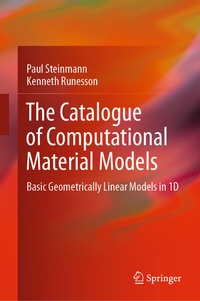
The Catalogue of Computational Material Models
Description

This book gives a comprehensive account of the formulation and computational treatment of basic geometrically linear models in 1D. To set the stage, it assembles some preliminaries regarding necessary modelling, computational and mathematical tools. Thereafter, the remaining parts are concerned with the actual catalogue of computational material models. To this end, after starting out with elasticity as a reference, further 15 different basic variants of material models (5 x each of {visco-elasticity, plasticity, visco-plasticity}, respectively) are systematically explored. The presentation for each of these basic material models is a stand-alone account and follows in each case the same structure. On the one hand, this allows, in the true sense of a catalogue, to consult each of the basic material models separately without the need to refer to other basic material models. On the other hand, even though this somewhat repetitious concept may seem tedious, it allows to compare the formulation and resulting algorithmic setting of the various basic material models and thereby to uncover, in detail, similarities and differences. In particular, the response of each basic material model is analysed for the identical histories (Zig-Zag, Sine, Ramp) of prescribed strain and stress so as to clearly showcase and to contrast to each other the characteristics of the various modelling options.
More details
Other editions
Additional editions
Persons
Paul Steinmann is Professor for Mechanics at the Friedrich-Alexander-Universität Erlangen-Nürnberg (FAU), Germany, where he heads the Institute of Applied Mechanics in the Department of Mechanical Engineering within FAU's Faculty of Engineering. He is also Director of the Glasgow Computational Engineering Centre (GCEC) in the School of Engineering at the University of Glasgow, UK. His research interests include nonlinear continuum mechanics, material modelling, coupled and multiscale problems and corresponding computational methods both for engineering as well as for biomechanical applications.
Kenneth Runesson
is Professor Emeritus of Material and Structural Mechanics at Chalmers University of Technology, Gothenburg, Sweden. His research interests include the computational modelling of coupled problems for porous media including inelasticity, damage and fracture. A trademark is control of discretization and modelling errors via space-time adaptivity.Computational homogenization and scale-bridging strategies are another major research field.
