

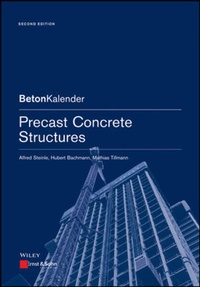
Precast Concrete Structures
Description

This book provides an introduction to this form of construction and supplies all the information necessary for conceptual and detailed design. The history of this construction method and the status of European standards are also included. Crucial to the economic and correct use of precast concrete elements is a design that suits the production and erection of such elements. Typical precast concrete designs are presented as well as the boundary conditions that must be considered. Connections between precast concrete elements require special attention, especially for horizontal loads. Therefore, the stability of precast concrete structures is explored in full. Special aspects of design, e.g. bearings, corbels, column butt joints, are shown in detail. One increasingly important application for precast concrete elements is façades, and so this topic has its own chapter. The book concludes with information on production itself so that readers gain a full understanding of precast concrete.
All material was completely revised by a new group of authors for this edition. It serves as an introduction to this subject and as a practical resource with examples for both structural engineers and architects.
More details
Other editions
Additional editions
Persons
Hubert Bachmann (b. 1959) began his career in a precasting plant in 1976 as an apprentice for concrete and precast concrete construction. After studying structural engineering and completing his doctorate at the University of Karlsruhe, he accepted a post in the structural engineering office of Ed. Züblin AG in Stuttgart in 1993, where he has worked ever since. His duties have included the detailed design of structures of all kinds plus research and development in the civil and structural engineering sectors. He has been presenting the series of Hahn lectures on precast concrete structures at the University of Stuttgart since 2003.
Mathias Tillmann (b. 1970) has been an engineering and standards consultant at Fachvereinigung Deutscher Betonfertigteilbau e.V. (FDB) since 2007 and technical director since 2008. He specialised in structural engineering during his studies at RWTH Aachen University. After attaining his diploma, he worked as a project engineer, structural engineer and designer. Mathias Tillmann has written numerous brochures, advisory documents and specialist articles on the subject of precast concrete.
All three authors have been or still are verymuch involved in construction industry organisations, many technical boards and national and international standards committees concerned with precast concrete construction.
Content
Introduction
1 General
1.1The advantages of factory production
1.2 Historical development
1.3 European standardisation
2 Design of Precast Concrete Structures
2.1 General
2.2 Tolerances and calculations for fit
2.3 Production
2.4 Transport and erection
2.5 Sustainability
2.6 Design examples
3 Stability of Precast Concrete Structures
3.1 General
3.2 Loads on stability components
3.3 Loadbearing members for stability
3.4 Distribution of horizontal loads
3.5 Analysis of stability components
3.6 Construction details
4 Precast Concrete Elements
4.1 General
4.2 Floor and roof elements
4.3 Beams
4.4 Columns
4.5 Walls
4.6 Foundations
5 Connections for Precast Concrete Construction
5.1 General
5.2 Purlin supports
5.3 Roof beam supports
5.4 Floor slab supports
5.5 Downstand beam supports
5.6 Wall element supports
5.7 Balcony slabs
5.8 Stair supports
5.9 Column/foundation
6 Individual Design Issues
6.1 General
6.2 Patch loads
6.3 Supports
6.4 Column butt joints
6.5 Wall/floor connections
6.6 Shear dowels
6.7 Welded connections
6.8 Bolted connections and screw couplers
6.9 Other forms of connection
6.10 Transport fixings
6.11 Transferring shear forces across joints
6.12 Floor diaphragms and shear walls
6.13 Shear forces in floor elements
6.14 Notched supports
6.15 Corbels
6.16 Analysis of lateral buckling
6.17 Design for fire
6.18 Pretensioning
7 Precast Concrete Façades
7.1 General
7.2 Conceptual design
7.3 Surface finishes
7.4 Joint waterproofing
7.5 Concrete sandwich panels
7.6 Suspended façade panels
7.7 Further developments for concrete façades
7.8 Building physics
7.9 Case studies
8 Production
8.1 Production methods
8.2 Concretes for precast concrete elements
8.3 Heat treatment and curing
8.4 Reinforcement
8.5 Pretensioning in prestressing beds
8.6 Quality assurance
Index
1
Introduction
This book first appeared as an article written by Alfred Steinle and Volker Hahn for the 1988 edition of the Beton-Kalender. It was reprinted in Beton-Kalender 1995 and then published as a book in the Bauingenieur-Praxis series in 1998. Hubert Bachmann, Alfred Steinle and Volker Hahn updated the information for publication in Beton-Kalender 2009 and this appeared as a new edition of the book in the Bauingenieur-Praxis series in 2010. Alfred Steinle, Hubert Bachmann, and Mathias Tillmann reconceived and completely revised the content for Beton-Kalender 2016, and it is that version that has again been published as a separate book, the third German edition, as part of the Bauingenieur-Praxis BiP series.
The first chapter looks at general aspects of precast concrete construction, its history and the status of European standardisation. The economic use of precast concrete elements is only possible when the design is carried out to suit the production and erection of such elements. Therefore, the second chapter deals with the design of precast concrete structures. Besides outlining the boundary conditions that must be observed when designing for precast concrete, the authors present a number of typical precast concrete designs.
Special attention must be paid to the connections between precast concrete elements, because these are the weak points - for horizontal loads in particular. The stability of precast concrete structures is therefore described in detail in Chapter 3. In particular, owing to the need to check critical details, proper yet simplified engineering assessments are to be preferred to computer calculations when considering stability. Chapters 4 and 5 deal with the various components of precast concrete production and the connections between those components. Specific design issues are examined in detail in Chapter 6.
Façades are becoming an increasingly important application for precast concrete elements. Chapter 7 is therefore dedicated to this topic. And it is façades in particular that are making use of new types of concrete and reinforcement. The final chapter looks at the actual manufacture of precast concrete elements so that the reader gains a full understanding of this form of construction taking into account the needs of production.
New types of concrete, new types of reinforcement, new methods of production - precast concrete construction is the chief proving ground for new developments and applications. Precast concrete therefore represent one of the most innovative forms of construction, a fact that is reflected in its growing popularity.
Although this book focuses on precast concrete from the point of view of the building industry and the authors concentrate mainly on buildings in general, it should not go unmentioned that precast concrete construction has been able to win considerable market shares in many other construction sectors through the development of economic yet bespoke solutions. Examples of these are bridges, tunnel linings, pipes, pipe bridges, towers, masts, piles, detached homes, prefabricated basements, retaining walls, room modules, prefabricated garages, noise barriers, railway sleepers, guided bus tracks, agricultural buildings, ballastless tracks, cooling tower trickle fill structures, etc. The reader is referred to the specialist literature dealing with these specialist areas. This book also only describes structural or architectural precast concrete elements for buildings and structures and not 'concrete products', i.e. small-format components manufactured and stocked in great numbers and available from trade outlets, e.g. sewage pipes, paving stones, etc.
The references at the end of each chapter have been completely recompiled and in the main contain publications of recent years. Older publications have only been retained when they illustrate potential solutions to fundamental problems that still remain valid today. In this context, the reader is referred to the earlier articles with the same title in the Beton-Kalender yearbooks of 1988, 1995, and 2009 [1-3]. References to the general literature on reinforced concrete construction have been omitted and the reader is referred to the corresponding articles in the Beton-Kalender, unless they concern areas that also touch on the specific problems of precast concrete construction.
In particular, readers should consult the publications of the Fachvereinigung Deutscher Betonfertigteilbau e.V. (, German Association for Precast Concrete Construction), e.g. [4,5], and Bindseil [6]. Furthermore, the fib manual also covers international developments in the field of precast concrete construction [7]. The Beton- und Fertigteil-Jahrbuch [8], now published under the title of Betonbauteile, regularly includes chapters on structural precast concrete elements and precast concrete architecture in addition to small-format concrete products.
The national, European and international standards that concern precast concrete construction are listed below (position as of July 2017). The list also contains the relevant publications of the Deutscher Ausschuss für Stahlbeton (, German Committee for Structural Concrete), the FDB, and the Deutscher Beton- und Bautechnik-Verein e.V. (, German Society for Concrete and Construction Technology). This list does not claim to be exhaustive. Other regulations and codes of practice can be found in the lists at the end of each chapter.
National standards (some available in English) DIN 488 Reinforcing steels Part 1:2009-08 Grades, properties, marking Part 2:2009-08 Reinforcing steel bars Part 3:2009-08 Reinforcing steel in coils, steel wire Part 4:2009-08 Welded fabric Part 5:2009-08 Lattice girders Part 6:2010-01 Assessment of conformity DIN 1045 Concrete, reinforced and prestressed concrete structures Part 1:2008-08 Design and construction (withdrawn) Part 2:2008-08 Concrete - Specification, properties, production and conformity - Application rules for DIN EN 206-1 Part 3:2012-03 Execution of structures - Application rules for DIN EN 13670, with corrigendum 1:2013-07 Part 4:2012-02 Additional rules for the production and the conformity of prefabricated elements DIN 1048 Testing concrete Part 1:1991-06 Testing of fresh concrete (withdrawn) Part 2:1991-06 Testing of hardened concrete (specimens taken in situ) (withdrawn) Part 4:1991-06 Determination of the compressive strength of hardened concrete in structures and components; application of reference lines and evaluation with special methods (withdrawn) Part 5:1991-06 Testing of hardened concrete (specimens prepared in mould) (withdrawn) DIN 1054:2010-12 Subsoil - Verification of the safety of earthworks and foundations - Supplementary rules to DIN EN 1997-1, with amendments A1:2012-08 and A2:2015-11 DIN 1164 Special cement Part 10:2013-03 Composition, requirements and conformity evaluation for cement with low effective alkali content Part 11:2003-11 Composition, specification and conformity evaluation for cement with short setting time Part 12:2005-06 Composition, specification and conformity evaluation for cement with higher quantity of organic constituents DIN 4030 Assessment of water, soil and gases for their aggressiveness to concrete Part 1:2008-06 Principles and limiting values Part 2:2008-06 Sampling and analysis of water and soil samples DIN 4102 Fire behaviour of building materials and building components Part 1:1998-05 Building materials; concepts, requirements and tests Part 2:1977-09 Building components; definitions, requirements and tests Part 3:1977-09 Fire walls and non-loadbearing external walls; definitions, requirements and tests Part 4:2016-05 Synopsis and application of classified building materials, components and special components Part 16:2015-09 'Brandschacht' tests DIN 4108 Thermal insulation and energy economy in buildings Supplement 2:2006-03 Thermal bridges - Examples for planning and...