

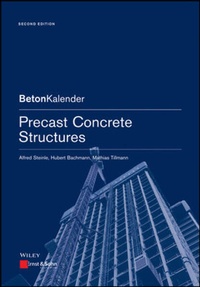
Precast Concrete Structures
2nd Edition
Published on 28. January 2019
XX, 356 pages
978-3-433-60903-3 (ISBN)
Description

Building with precast concrete elements is one of the most innovative forms of construction. This is where new types of concrete and reinforcement and new methods are tried out for the first time, as a precasting plant offers excellent conditions for industrial production.
This book provides an introduction to this form of construction and supplies all the information necessary for conceptual and detailed design. The history of this construction method and the status of European standards are also included. Crucial to the economic and correct use of precast concrete elements is a design that suits the production and erection of such elements. Typical precast concrete designs are presented as well as the boundary conditions that must be considered. Connections between precast concrete elements require special attention, especially for horizontal loads. Therefore, the stability of precast concrete structures is explored in full. Special aspects of design, e.g. bearings, corbels, column butt joints, are shown in detail. One increasingly important application for precast concrete elements is façades, and so this topic has its own chapter. The book concludes with information on production itself so that readers gain a full understanding of precast concrete.
All material was completely revised by a new group of authors for this edition. It serves as an introduction to this subject and as a practical resource with examples for both structural engineers and architects.
This book provides an introduction to this form of construction and supplies all the information necessary for conceptual and detailed design. The history of this construction method and the status of European standards are also included. Crucial to the economic and correct use of precast concrete elements is a design that suits the production and erection of such elements. Typical precast concrete designs are presented as well as the boundary conditions that must be considered. Connections between precast concrete elements require special attention, especially for horizontal loads. Therefore, the stability of precast concrete structures is explored in full. Special aspects of design, e.g. bearings, corbels, column butt joints, are shown in detail. One increasingly important application for precast concrete elements is façades, and so this topic has its own chapter. The book concludes with information on production itself so that readers gain a full understanding of precast concrete.
All material was completely revised by a new group of authors for this edition. It serves as an introduction to this subject and as a practical resource with examples for both structural engineers and architects.
More details
Other editions
Additional editions
Alfred Steinle | Hubert Bachmann | Mathias Tillmann
Precast Concrete Structures
(Package: Print + ePDF)
Book
03/2019
2nd Edition
Ernst & Sohn
€119.00
Shipment within 5-7 days
Alfred Steinle | Hubert Bachmann | Mathias Tillmann
Precast Concrete Structures
Book
03/2019
2nd Edition
Ernst & Sohn
€89.00
Shipment within 5-7 days
A. Steinle
Precast Concrete Structures 2e
Software
02/2019
Ernst & Sohn
€115.65
No shipping information available
Complete work / Part of the work
Alfred Steinle | Hubert Bachmann | Mathias Tillmann
Precast Concrete Structures
(Package: Print + ePDF)
Book
03/2019
2nd Edition
Ernst & Sohn
€119.00
Shipment within 5-7 days
Persons
Alfred Steinle (1936-2017) turned the lecture notes of Prof. Dr.-Ing. Volker Hahn, which dated from the early 1970s, into a manuscript that became the starting point for this book. After a number of years in bridge-building, Alfred Steinle also became heavily involved in precast concrete construction at Züblin. His theoretical work covered bridge-building with torsion and section deformations in box-girder bridges and in precast concrete structures within the scope of the 6M system with corbels, notched beam ends and pocket foundations. In addition, he was a key figure in many precast concrete projects such as the 6M schools, the University of Riyadh, schools with foamed concrete wall panels in Iraq, Züblin House and the construction of a modern automated precasting plant. Alfred Steinle retired in 1999 and by that time he had risen to the post of authorised signatory in the engineering office at Züblin's head office.
Hubert Bachmann (b. 1959) began his career in a precasting plant in 1976 as an apprentice for concrete and precast concrete construction. After studying structural engineering and completing his doctorate at the University of Karlsruhe, he accepted a post in the structural engineering office of Ed. Züblin AG in Stuttgart in 1993, where he has worked ever since. His duties have included the detailed design of structures of all kinds plus research and development in the civil and structural engineering sectors. He has been presenting the series of Hahn lectures on precast concrete structures at the University of Stuttgart since 2003.
Mathias Tillmann (b. 1970) has been an engineering and standards consultant at Fachvereinigung Deutscher Betonfertigteilbau e.V. (FDB) since 2007 and technical director since 2008. He specialised in structural engineering during his studies at RWTH Aachen University. After attaining his diploma, he worked as a project engineer, structural engineer and designer. Mathias Tillmann has written numerous brochures, advisory documents and specialist articles on the subject of precast concrete.
All three authors have been or still are verymuch involved in construction industry organisations, many technical boards and national and international standards committees concerned with precast concrete construction.
Hubert Bachmann (b. 1959) began his career in a precasting plant in 1976 as an apprentice for concrete and precast concrete construction. After studying structural engineering and completing his doctorate at the University of Karlsruhe, he accepted a post in the structural engineering office of Ed. Züblin AG in Stuttgart in 1993, where he has worked ever since. His duties have included the detailed design of structures of all kinds plus research and development in the civil and structural engineering sectors. He has been presenting the series of Hahn lectures on precast concrete structures at the University of Stuttgart since 2003.
Mathias Tillmann (b. 1970) has been an engineering and standards consultant at Fachvereinigung Deutscher Betonfertigteilbau e.V. (FDB) since 2007 and technical director since 2008. He specialised in structural engineering during his studies at RWTH Aachen University. After attaining his diploma, he worked as a project engineer, structural engineer and designer. Mathias Tillmann has written numerous brochures, advisory documents and specialist articles on the subject of precast concrete.
All three authors have been or still are verymuch involved in construction industry organisations, many technical boards and national and international standards committees concerned with precast concrete construction.
Content
Preface
Introduction
1 General
1.1The advantages of factory production
1.2 Historical development
1.3 European standardisation
2 Design of Precast Concrete Structures
2.1 General
2.2 Tolerances and calculations for fit
2.3 Production
2.4 Transport and erection
2.5 Sustainability
2.6 Design examples
3 Stability of Precast Concrete Structures
3.1 General
3.2 Loads on stability components
3.3 Loadbearing members for stability
3.4 Distribution of horizontal loads
3.5 Analysis of stability components
3.6 Construction details
4 Precast Concrete Elements
4.1 General
4.2 Floor and roof elements
4.3 Beams
4.4 Columns
4.5 Walls
4.6 Foundations
5 Connections for Precast Concrete Construction
5.1 General
5.2 Purlin supports
5.3 Roof beam supports
5.4 Floor slab supports
5.5 Downstand beam supports
5.6 Wall element supports
5.7 Balcony slabs
5.8 Stair supports
5.9 Column/foundation
6 Individual Design Issues
6.1 General
6.2 Patch loads
6.3 Supports
6.4 Column butt joints
6.5 Wall/floor connections
6.6 Shear dowels
6.7 Welded connections
6.8 Bolted connections and screw couplers
6.9 Other forms of connection
6.10 Transport fixings
6.11 Transferring shear forces across joints
6.12 Floor diaphragms and shear walls
6.13 Shear forces in floor elements
6.14 Notched supports
6.15 Corbels
6.16 Analysis of lateral buckling
6.17 Design for fire
6.18 Pretensioning
7 Precast Concrete Façades
7.1 General
7.2 Conceptual design
7.3 Surface finishes
7.4 Joint waterproofing
7.5 Concrete sandwich panels
7.6 Suspended façade panels
7.7 Further developments for concrete façades
7.8 Building physics
7.9 Case studies
8 Production
8.1 Production methods
8.2 Concretes for precast concrete elements
8.3 Heat treatment and curing
8.4 Reinforcement
8.5 Pretensioning in prestressing beds
8.6 Quality assurance
Index
Introduction
1 General
1.1The advantages of factory production
1.2 Historical development
1.3 European standardisation
2 Design of Precast Concrete Structures
2.1 General
2.2 Tolerances and calculations for fit
2.3 Production
2.4 Transport and erection
2.5 Sustainability
2.6 Design examples
3 Stability of Precast Concrete Structures
3.1 General
3.2 Loads on stability components
3.3 Loadbearing members for stability
3.4 Distribution of horizontal loads
3.5 Analysis of stability components
3.6 Construction details
4 Precast Concrete Elements
4.1 General
4.2 Floor and roof elements
4.3 Beams
4.4 Columns
4.5 Walls
4.6 Foundations
5 Connections for Precast Concrete Construction
5.1 General
5.2 Purlin supports
5.3 Roof beam supports
5.4 Floor slab supports
5.5 Downstand beam supports
5.6 Wall element supports
5.7 Balcony slabs
5.8 Stair supports
5.9 Column/foundation
6 Individual Design Issues
6.1 General
6.2 Patch loads
6.3 Supports
6.4 Column butt joints
6.5 Wall/floor connections
6.6 Shear dowels
6.7 Welded connections
6.8 Bolted connections and screw couplers
6.9 Other forms of connection
6.10 Transport fixings
6.11 Transferring shear forces across joints
6.12 Floor diaphragms and shear walls
6.13 Shear forces in floor elements
6.14 Notched supports
6.15 Corbels
6.16 Analysis of lateral buckling
6.17 Design for fire
6.18 Pretensioning
7 Precast Concrete Façades
7.1 General
7.2 Conceptual design
7.3 Surface finishes
7.4 Joint waterproofing
7.5 Concrete sandwich panels
7.6 Suspended façade panels
7.7 Further developments for concrete façades
7.8 Building physics
7.9 Case studies
8 Production
8.1 Production methods
8.2 Concretes for precast concrete elements
8.3 Heat treatment and curing
8.4 Reinforcement
8.5 Pretensioning in prestressing beds
8.6 Quality assurance
Index
