

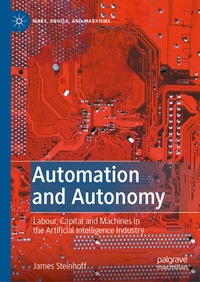
Automation and Autonomy
Description

This book argues that Marxist theory is essential for understanding the contemporary industrialization of the form of artificial intelligence (AI) called machine learning. It includes a political economic history of AI, tracking how it went from a fringe research interest for a handful of scientists in the 1950s to a centerpiece of cybernetic capital fifty years later. It also includes a political economic study of the scale, scope and dynamics of the contemporary AI industry as well as a labour process analysis of commercial machine learning software production, based on interviews with workers and management in AI companies around the world, ranging from tiny startups to giant technology firms. On the basis of this study, Steinhoff develops a Marxist analysis to argue that the popular theory of immaterial labour, which holds that information technologies increase the autonomy of workers from capital, tending towards a post-capitalist economy, does not adequately describe the situation of high-tech digital labour today. In the AI industry, digital labour remains firmly under the control of capital. Steinhoff argues that theories discerning therein an emergent autonomy of labour are in fact witnessing labour's increasing automation.
Reviews / Votes
"The author is very clear and concise in showing the reader what his objectives are and are not, and in guiding the reader through the arguments and evidence. He is explicit in reviewing what he has completed and what the next steps will be. The reader should be aware that this book is basically a philosophical treatise. . It is worth the effort to read this book." (Anthony J. Duben, Computing Reviews, August 1, 2022)More details
Other editions
Additional editions
Person
James Steinhoff
is a Postdoctoral Fellow at the University of Toronto, Canada.
