

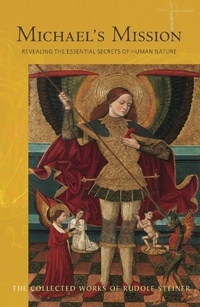
Michael's Mission
Description

'...This will generate a struggle covering the face of the whole earth. The one and only remedy for this nonsense being made of human evolution will be the path that can lead humanity to the spirit - the path of Michael, which finds its continuation in the path of Christ.' - Rudolf Steiner.
Speaking in the aftermath of the Great War, Rudolf Steiner presents a series of extraordinary lectures on the power and mission of the Archangel Michael. He paints on a broad canvas - in the context of cosmic and human evolution - revealing Michael's tasks in the past, present and future. Originally the countenance of Yahweh, Michael has metamorphosed from a 'night spirit' to a 'day spirit'. As 'the Countenance of Christ', Michael helps us find a balance between 'luciferic' and 'ahrimanic' tendencies. The old 'dualism' (such as good versus evil), says Steiner, needs to be replaced by the trinity of Lucifer-Christ-Ahriman. Filling our heart with the Christ Impulse creates an equilibrium between the luciferic influence that imbues our head and the ahrimanic influence at work in our limbs.
Rudolf Steiner describes how humanity faces three dangers in the social sphere: spiritual life could flow into the 'pit of mendacity' ruled by Ahriman, individual rights might descend into the 'pit of selfishness' (Lucifer), and economics into cultural sickness and death (Asuras). In order to prevent European-American culture from perishing, it will be necessary to turn towards contemporary 'threefold' social ideas.
Steiner also speaks about the principle of metamorphosis in connection with evolution and devolution, as evident in the design of the pillars in the newly-built Goetheanum. Architectural styles are an expression of human evolution, as can be seen in Greek temples, gothic Cathedrals, the Grail temple and the building at Dornach. Amidst many other themes, Rudolf Steiner addresses the problem of natural necessity and freedom, and the abolition of the trichotomy of body, soul and spirit at the Council of Constantinople in AD 869.
More details
Other editions
Additional editions
Persons
Content
- Intro
- Introduction, by David Jones
- LECTURE 1: DORNACH, 21 NOVEMBER 1919
- LECTURE 2: DORNACH, 22 NOVEMBER 1919
- LECTURE 3: DORNACH, 23 NOVEMBER 1919
- LECTURE 4: DORNACH, 28 NOVEMBER 1919
- LECTURE 5: DORNACH, 29 NOVEMBER 1919
- LECTURE 6: DORNACH, 30 NOVEMBER 1919
- LECTURE 7: DORNACH, 6 DECEMBER 1919
- LECTURE 8: DORNACH, 7 DECEMBER 1919
- LECTURE 9: DORNACH, 12 DECEMBER 1919
- LECTURE 10: DORNACH, 13 DECEMBER 1919
- LECTURE 11: DORNACH, 14 DECEMBER 1919
- LECTURE 12: DORNACH, 15 DECEMBER 1919
- APPENDICES
- Introduction to the Lecture of 28 November 1919
- Conclusion of the Lecture of 30 November 1919
- Introduction to the Lecture of 7 December 1919
- Notes
- Rudolf Steiner's Collected Works
- Significant Events in the Life of Rudolf Steiner
- Colour Plates
