

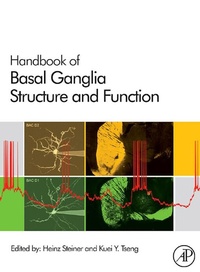
Handbook of Basal Ganglia Structure and Function
A Decade of Progress
Published on 17. March 2010
704 pages
978-0-08-091215-8 (ISBN)
Description

The Basal Ganglia comprise a group of forebrain nuclei that are interconnected with the cerebral cortex, thalamus and brainstem. Basal ganglia circuits are involved in various functions, including motor control and learning, sensorimotor integration, reward and cognition. The importance of these nuclei for normal brain function and behavior is emphasized by the numerous and diverse disorders associated with basal ganglia dysfunction, including Parkinson's disease, Tourette's syndrome, Huntington's disease, obsessive-compulsive disorder, dystonia, and psychostimulant addiction.
The Handbook of Basal Ganglia provides a comprehensive overview of the structural and functional organization of the basal ganglia, with special emphasis on the progress achieved over the last 10-15 years. Organized in six parts, the volume describes the general anatomical organization and provides a review of the evolution of the basal ganglia, followed by detailed accounts of recent advances in anatomy, cellular/molecular, and cellular/physiological mechanisms, and our understanding of the behavioral and clinical aspects of basal ganglia function and dysfunction.
- Synthesizes widely dispersed information on the behavioral neurobiology of the basal ganglia, including advances in the understanding of anatomy, cell-molecular and cell-physiological mechanisms, and behavioral/clinical aspects of function and dysfunction
- Features a truly international cast of the preeminent researchers in the field
- Fully explores the clinically relevant impact of the basal ganglia on various psychiatric and neurological diseases
More details
Other editions
New editions
Heinz Steiner | Kuei Y. Tseng
Handbook of Basal Ganglia Structure and Function
E-Book
09/2016
2nd Edition
Academic Press
€133.00
Available for download
Additional editions
Heinz Steiner | Kuei Y. Tseng
Handbook of Basal Ganglia Structure and Function: Volume 24
Book
03/2010
Academic Press
€201.79
Article exhausted; check for reprint
Content
Part A: The Basal Ganglia System and its EvolutionChapter 1. The Neuroanatomical Organization of the Basal GangliaCharles R. GerfenChapter 2. The Conservative Evolution of the Vertebrate Basal GangliaA. ReinerChapter 3. Cell Types in the Different Nuclei of the Basal GangliaDorothy E. OorschotChapter 4. Neurotransmitter Receptors in the Basal GangliaPiers C. Emson, Henry Waldvogel and Richard FaullPart B: Anatomy and Physiology of the StriatumChapter 5. The Striatal Skeleton: Medium Spiny Projection Neurons and their Lateral ConnectionsDietmar Plenz and Jeffery R. WickensChapter 6. D1 and D2 Dopamine Receptor Modulation of Striatal Glutamatergic Signaling in Striatal Medium Spiny NeuronsD. James Surmeier, Michelle Day, Tracy Gertler, Savio Chan and Weixing ShenChapter 7. The Cholinergic Interneurons of the Striatum: Intrinsic Properties Underlie Multiple Discharge PatternsJoshua A. Goldberg and Charles J. WilsonChapter 8. GABAergic Interneurons of the NeostriatumJames M. TepperChapter 9. Endocannabinoid Signaling in the StriatumDavid M. Lovinger, Margaret I. Davis and Rui M. CostaChapter 10. Nitric Oxide Signaling in the StriatumAnthony R. WestChapter 11. Adenosine-Dopamine Receptor InteractionMicaela Morelli, Simola Nicola, Popoli Patrizia and Carta Anna R.Chapter 12. Regulation of Corticostriatal Synaptic Plasticity in Physiological and Pathological ConditionsMassimiliano Di Filippo and Paolo CalabresiPart C: Anatomy and Physiology of Globus Pallidus, Subthalamic Nucleus and Substantia NigraChapter 13. Organization of the Globus PallidusHitoshi KitaChapter 14. Projections from Pallidum to StriatumPieter VoornChapter 15. The Subthalamic Nucleus: From in vitro to in vivo MechanismsStephane Charpier, Corinne Beurrier and Jeanne T. PazChapter 16. Neurophysiology of Substantia Nigra Dopaminergic Neurons: Modulation by GABAergic AfferentsJames M. TepperChapter 17. Regulation of Extracellular Dopamine: Release and ReuptakeDavid Sulzer, Hui Zhang, Marianne Benoit-Marand, and Francois GononPart D: Network Integration Chapter 18. Organization of Corticostriatal Projection Neuron TypesAnton ReinerChapter 19. Gating of Cortical Input to the StriatumJeffery R. Wickens and Gordon W. ArbuthnottChapter 20. Organization of Prefrontal-Striatal ConnectionsHenk J. Groenewegen and Harry B.M. UylingsChapter 21. Gating of Limbic Input to the Ventral StriatumPatricio O'DonnellChapter 22. Anatomical and Functional Organization of the Thalamostriatal SystemsYoland Smith, Adriana Galvan, Dinesh Raju and Thomas WichmannChapter 23. Subcortical Connections of the Basal GangliaDavid I.G. Wilson, Philip Winn and Peter RedgraveChapter 24. Integrative Networks across Basal Ganglia CircuitsSuzanne N. HaberChapter 25. Synchronous Activity in Basal Ganglia-Cortical CircuitsJ.R. Walters and D.A. BergstromPart E: Molecular Signaling in the Basal GangliaChapter 26. Second Messenger CascadesStephanie E. Bronson and Christine KonradiChapter 27. Neurotransmitter Regulation of Basal Ganglia Gene ExpressionKristen A. Keefe and Kristen A. HornerChapter 28. D1-Dopamine Receptor Supersensitivity in the StriatumCharles R. GerfenChapter 29. Psychostimulant-Induced Gene Regulation in Cortico-Striatal CircuitsHeinz SteinerChapter 30. Chromatin Remodeling: Role in Neuropathologies of the Basal GangliaJocelyne Caboche, Emmanuel Roze, Karen Brami-Cherrier and Sandrine BetuingPart F: Basal Ganglia Function and DysfunctionChapter 31. Phasic Dopamine Signaling and Basal Ganglia FunctionPeter Redgrave, Veronique Coizet and John ReynoldsChapter 32. Basal Ganglia-Mediated Motor LearningM.G. PackardChapter 33. Drug Addiction: The Neural and Psychological Basis of a Compulsive Incentive HabitDavid Belin and Barry J. EverittChapter 34. Environmental Contributions to Parkinson's disease: Cross Talk between Environmental Factors and Gene DefectsGloria E. Meredith and Susan TotterdellChapter 35.
