

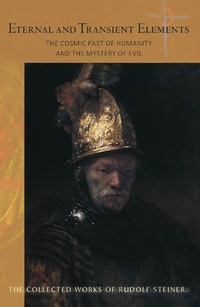
Eternal and Transient Elements in Human Life
Description

In what has been referred to as 'the most advanced course in anthroposophy', Rudolf Steiner addresses one of the great questions of our time: the role of evil in human development. He speaks of the year 666, when three time streams intersected - the familiar linear stream and two 'lateral' streams - and the reoccurrence of the 666-year rhythm in history. At the heart of this mystery is the being Sorat ('the beast'), who attempted to flood humanity with premature spiritual knowledge by inspiring the scholars of the ancient Academy of Gondishapur.
Although responsible for the saving of Aristotle's works, Steiner describes how the Academy generated tremendous but dangerous gnostic wisdom, which eventually spread through the Christian monasteries and inspired Western scientific thought. Its immediate negative impact, however, had to be counteracted by the Prophet Muhammad and the founding of Islam.
In contrast to the 666-year rhythm in history, the 333-year rhythm is connected to the healing forces of the Mystery of Golgotha. The year 333 was a central point in the post-Atlantean age, but also a pivotal moment in establishing the Christ Impulse and the new equilibrium it brought to humanity, allowing people to gain wisdom through their own efforts.
Such wisdom enables insight into three key areas: supersensible knowledge of birth and death; understanding of an individual's life; and the ability consciously to confront the adversarial beings of Lucifer and Ahriman.
Steiner addresses a host of additional themes, including occult Freemasonry in Anglo-American countries; materialism in the Roman Catholic Church; prophetic and apocalyptic vision; dualism and fatalism in pre-Christian times; and the delusion of time and space. Seeking to awaken his listeners to the urgency of the tasks ahead of them, he urges that spiritual understanding be enlivened with enthusiasm, fire and warmth of heart.
More details
Other editions
Additional editions
Persons
Content
- Intro
- Introduction, by Anna Meuss
- LECTURE 1: 6 SEPTEMBER 1918
- LECTURE 2: 7 SEPTEMBER 1918
- LECTURE 3: 8 SEPTEMBER 1918
- LECTURE 4: 13 SEPTEMBER 1918
- LECTURE 5: 14 SEPTEMBER 1918
- LECTURE 6: 15 SEPTEMBER 1918
- LECTURE 7: 20 SEPTEMBER 1918
- LECTURE 8: 21 SEPTEMBER 1918
- LECTURE 9: 22 SEPTEMBER 1918
- LECTURE 10: 4 OCTOBER 1918
- LECTURE 11: 5 OCTOBER 1918
- LECTURE 12: 6 OCTOBER 1918
- LECTURE 13: 11 OCTOBER 1918
- LECTURE 14: 12 OCTOBER 1918
- LECTURE 15: 13 OCTOBER 1918
- Notes
- Rudolf Steiner's Collected Works
- Significant Events in the Life of Rudolf Steiner
