

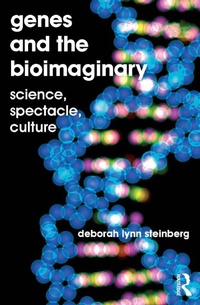
Genes and the Bioimaginary
Science, Spectacle, Culture
Published on 3. March 2016
200 pages
978-1-317-12946-2 (ISBN)
Description

Genes and the Bioimaginary examines the dramatic rise and contemporary cultural apotheosis of 'the gene'. The book traces not only the genetification of modern life but is also a journey through the complex relationship between science and culture. At the heart of this book are three interlinked questions. The first concerns the paradigmatic transformations of the 'genetics revolution': how can we understand the impact of genes on social arenas as diverse as law and agriculture, politics and medicine, genealogy and jurisprudence? Second, how has the language of genes come to pervade public discourse - as much a trope of personal narrative as of the popular imaginary? And third, how can we gain critical purchase not only on the conditions and consequences of a particular science, but on its projective seductions, the terms of its persuasion, and the dilemmas and anxieties provoked in its wake? Through a series of illuminating case studies ranging from 'gay genes' to 'Jew genes', to genes for crime; from CSI to the Innocence Project, from genetics (post)racial imaginary to its phantasies of redemption, the book examines the emergence of the gene as a pre-eminent locus of both scientific and social explanation, and as a powerful object of spectacle, projective phantasy and attachment. Genes and the Bioimaginary makes a distinctive contribution to our understanding of how knowledge comes to be not only powerful, but plausible.
Reviews / Votes
'Deborah Lynn Steinberg's account of the ideologies underlying modern genetics is by far the very best critical reading of the subject. Taking the science seriously, she unravels many of the unstated social and cultural presuppositions that are masked by the claims of genetics as an objective science. An intelligent, readable book for everyone with a genome.' Sander L. Gilman, Emory University, USA 'In Genes and the Bioimaginary, Steinberg calls us to acknowledge our collective authorship of the reproductive/transformative agencies of science. Through a well-chosen set of cases, her incisive and eloquent analytic voice offers us a passionately critical exposition of the gene, and guides us to a deeper understanding of the inseparability of scientific and cultural imaginaries.' Lucy Suchman, Lancaster University, UK 'Through the powerful notion, Bio-imaginary?, Steinberg communicates a deep understanding of the intricate dispersals of knowledge, power and bodily sensibilities found in modern day? genetics. This extraordinary book is contemporary, fascinating and a challenging intellectual intervention, jam-packed with illuminating case studies. Steinberg is dazzling when pushing theoretical boundaries. Scholars from many disciplines will be compelled to read her brilliance.' Elizabeth Ettorre, University of Liverpool, UK 'Steinberg not only questions the impacts of scientific research but the social conditions and cultural context that make it persuasive. In doing so she opens up fascinating discussions about not just the politics of science, but the purpose of it as a field. It is for this reason this book is worth reading.' Simon Copland, The Guardian "In Genes and the Bioimaginary, Deborah Lynn Steinberg, professor of Gender, Culture and Media Studies at the University of Warwick, UK, has carried out a masterful, far-ranging analysis of how the gene has come to dominate Western discourses of identity, justice, psychology, and medicine, and the ways in which projections about how genes shape our agency, wellbeing, and social worth have seduced us into placing more belief into the power of genetic science than is warranted and have thus granted it a good deal of sway in our lives... [It] is essential reading for anyone who wants to understand the ways in which contemporary genetics has covertly and overtly revived old notions of racial science and eugenics."- Gina Maranto, University of Miami, Biopolitical Times"Deborah Lynn Steinberg's account of the ideologies underlying modern genetics is by far the very best critical reading of the subject. Taking the science seriously, she unravels many of the unstated social and cultural presuppositions that are masked by the claims of genetics as an objective science. An intelligent, readable book for everyone with a genome."- Sander L. Gilman, Emory University, USA
"In Genes and the Bioimaginary, Steinberg calls us to acknowledge our collective authorship of the reproductive/transformative agencies of science. Through a well-chosen set of cases, her incisive and eloquent analytic voice offers us a passionately critical exposition of the gene, and guides us to a deeper understanding of the inseparability of scientific and cultural imaginaries."- Lucy Suchman, Lancaster University, UK
"Through the powerful notion, Bio-imaginary, Steinberg communicates a deep understanding of the intricate dispersals of knowledge, power and bodily sensibilities found in modern day genetics. This extraordinary book is contemporary, fascinating and a challenging intellectual intervention, jam-packed with illuminating case studies. Steinberg is dazzling when pushing theoretical boundaries. Scholars from many disciplines will be compelled to read her brilliance."- Elizabeth Ettorre, University of Liverpool, UK
"Steinberg not only questions the impacts of scientific research but the social conditions and cultural context that make it persuasive. In doing so she opens up fascinating discussions about not just the politics of science, but the purpose of it as a field. It is for this reason this book is worth reading."- Simon Copland, The Guardian
More details
Language
English
Place of publication
London
United Kingdom
Publishing group
Taylor & Francis Ltd
Target group
College/higher education
File size
3,48 MB
ISBN-13
978-1-317-12946-2 (9781317129462)
Copyright in bibliographic data and cover images is held by Nielsen Book Services Limited or by the publishers or by their respective licensors: all rights reserved.
Schweitzer Classification
Other editions
Additional editions
Book
06/2020
1st Edition
Routledge
€51.98
Shipment within 15-20 days
Book
06/2015
Routledge
€193.50
Shipment within 10-20 days
Person
Deborah Lynn Steinberg is Professor of Gender, Culture and Media Studies in the Department of Sociology at the University of Warwick, UK. Her books include: Bodies in Glass: Genetics, Eugenics, Embryo Ethics (1997); Made to Order: The Myth of Reproductive and Genetic Progress (1987, with P. Spallone); Border Patrols: Policing the Boundaries of Heterosexuality (1989, with D. Epstein and R. Johnson); Mourning Diana: Nation, Culture and the Performance of Grief (1999, with A. Kear); and Blairism and the War of Persuasion: Labour's Passive Revolution (2004, with R Johnson).
Content
Migration Across Boundaries
