

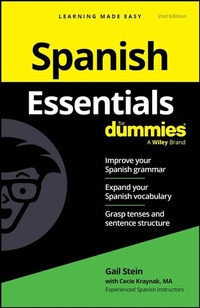
Spanish Essentials For Dummies
Description

The perfect guide for new Spanish learners and anyone looking for an expert refresher
Interested in a fast and effective guide to learning Spanish that avoids fluff and focuses on key concepts that you need to know to improve your ability to speak, write, and understand the language? Spanish Essentials For Dummies, 2nd Edition walks you through Spanish fundamentals you can use for at-home, solo learning, to supplement your progress in a Spanish class, or as a companion to language instruction.
Inside:
- Get practical tips on Spanish grammar, pronunciation, and sentence structure
- See conversational Spanish examples to amplify your learning
- Understand all the core concepts taught and tested in a typical introductory Spanish course
Perfect for Spanish students looking for a quick reference to supplement classroom or app-assisted Spanish learning, Spanish Essentials For Dummies, 2nd Edition is a great resource for everyone looking to brush up on their conversational Spanish.
More details
Other editions
Additional editions
Person
Gail Stein, MA has more than 30 years' experience teaching languages in New York City public junior and senior high schools. She is also the author of Spanish Workbook For Dummies.
Cecie Kraynak, MA has taught and tutored Spanish for more than 30 years. She is the author of Spanish For Dummies, Spanish Verbs For Dummies, and Spanish All-In-One For Dummies.
Content
Introduction 1
About This Book 1
Foolish Assumptions 2
Icons Used in This Book 2
Where to Go from Here 3
Chapter 1: Brushing Up on the Basics 5
Pronouncing Properly 5
Voicing vowels 6
Practicing diphthongs and vowel combinations 6
Verbalizing consonants 7
Understanding stress and diacritical marks 8
Counting Down 9
Using cardinal numbers 10
Using ordinal numbers 13
Dealing with Dates 14
Expressing the days of the week 14
Naming the months of the year 15
Making a date 16
Telling Time 17
Identifying Parts of Speech 20
Using nouns 20
Substituting pronouns 21
Acting with verbs 21
Describing with adjectives 22
Clarifying with adverbs 22
Joining with prepositions 23
Chapter 2: Embracing the Gender Gap 25
Being Specific with Definite Articles 25
Identifying the definite articles 26
Using definite articles 26
Omitting the definite articles 28
Contracting with definite articles 28
Table of Contents iii
Being General with Indefinite Articles 28
Identifying the indefinite articles 29
Omitting indefinite articles 29
Being Demonstrative with Adjectives 30
Explaining Gender 31
Determining the gender of nouns 31
Doing an about face with gender 32
Using the same noun for both genders 33
Changing the meaning of nouns 33
Understanding special nouns 34
Forming Plural Nouns 35
Showing Possession 36
Using de 37
Employing possessive adjectives 37
Substituting with Object Pronouns 39
Dealing with direct object pronouns 39
Understanding the personal a 40
Coping with indirect object pronouns 41
Choosing the proper pronoun 42
Constructing sentences with gustar 44
Positioning object pronouns 46
Doing double duty 47
Chapter 3: Living in the Present 49
Identifying Types of Verbs 49
Selecting Subject Pronouns 50
Being inclusive 50
Using subject pronouns 52
Omitting subject pronouns 54
Communicating in the Present Tense 55
Recognizing regular verbs 56
Changing verb stems 57
Changing the spelling of verbs 62
Modifying verbs with two changes 63
Using irregular verbs 63
Communicating with irregular verbs 65
Spotting reflexive verbs 67
Making Progress with the Present Progressive 71
Using estar to form the present progressive 71
Understanding present participles 72
Chapter 4: Being Descriptive 75
Adding Color with Adjectives 75
Making adjectives agree 75
Positioning adjectives 81
Shortening certain adjectives 82
Describing Actions with Adverbs 82
Forming adverbs 82
Positioning adverbs 85
Making Comparisons 85
Conveying equality 85
Stating inequality 85
Articulating the superlative 86
Communicating irregular comparisons 86
Expressing the absolute superlative 87
Linking with Prepositions 88
Selecting the correct one 89
Using prepositions with verbs 92
Using the right pronoun after a preposition 95
Chapter 5: Making Inquiries 97
Posing a Yes/No Question 97
Using intonation 98
Employing the tags "¿No? and ¿verdad?" 98
Using inversion 99
Responding to a Yes/No Question 99
Staying positive 100
Being negative 100
Getting the Facts 103
Using interrogative adjectives 103
Getting information with interrogative adverbs 104
Employing interrogative pronouns 105
Providing Information 107
Chapter 6: Reliving the Past 109
Living in the Past 109
Forming the preterit of regular verbs 110
Forming the preterit of spelling change verbs 111
Constructing the preterit with verbs with stem changes 112
Forming the preterit of irregular verbs 113
Using the preterit 116
Reminiscing with the Imperfect 117
Forming the imperfect of regular verbs 117
Forming the imperfect of irregular verbs 118
Using the imperfect 119
Choosing the Preterit or the Imperfect 120
Signaling the preterit 120
Signaling the imperfect 121
Creating the Present Perfect 122
Forming the present perfect 122
Using the present perfect 124
Chapter 7: Looking to the Future 127
Talking about the Future without Using the Future Tense 127
Using the present to express the future 127
Expressing the near future 128
Mastering the Future Tense 128
Forming the future of regular verbs 128
Forming the future of irregular verbs 130
Using the Future to Foretell, Predict, and Wonder 131
Chapter 8: Understanding Verb Moods and the Conditional 133
Giving Commands with the Imperative Mood 134
Forming commands with Ud and Uds 134
Forming commands with tú 135
Forming the let's command 136
Forming the Present Subjunctive 137
Creating the present subjunctive of regular verbs 137
Working with verbs irregular in the yo form 138
Tackling verbs with spelling changes 139
Coping with stem changes 141
Understanding verbs with both spelling and stem changes 143
Conjugating irregular verbs 144
Using the Present Subjunctive 144
Expressing your desires, needs, or doubts 146
Demonstrating feelings or emotions 148
Employing impersonal expressions 149
Using relative clauses 151
Examining the Present Perfect Subjunctive 152
Making Actions Conditional 153
Forming the conditional of regular verbs 153
Exploring verbs with irregular conditional forms 154
Using the conditional 155
Chapter 9: Ten Key Verb Distinctions 157
Ser versus Estar 157
Saber versus Conocer 159
Tomar versus Llevar 159
Deber versus Tener Que 160
Preguntar versus Pedir 160
Jugar versus Tocar 160
Gastar versus Pasar 161
Dejar versus Salir 161
Volver versus Devolver 161
Poder versus Saber 161
Appendix: Verb Charts 163
Index 177
Chapter 1
Brushing Up on the Basics
IN THIS CHAPTER
Perfecting your pronunciation
Counting with cardinal and ordinal numbers
Expressing dates
Telling time
Reviewing parts of speech
Pronouncing the language correctly, knowing numbers, expressing dates, relating the time of day, and recognizing parts of speech are essential Spanish skills you need in everyday life. Surely, the ability to communicate numbers, times, and dates is completely indispensable to you on a daily basis. Determining the correct part of speech to use helps you perfect your oral and written Spanish.
Pronouncing Properly
Naturally, when you speak Spanish, you want to sound as authentic as possible. The good news is that Spanish is quite easy to pronounce because it's a phonetic language. What does that mean? Simply say each word exactly as you see it and put on your best Spanish accent. Chances are you'll sound more like a native speaker than you could imagine.
The Spanish alphabet contains all the letters of the English alphabet plus ñ, which follows the letter n.
Voicing vowels
Unlike in English, each Spanish vowel is pronounced consistently. This table breaks down the basics:
Vowel
English Sound
Spanish Example
a
ah as in spa
papa (pah-pah) (potato)
e
eh as in red
ella (eh-yah) (she)
i
ee as in key
idea (ee-deh-yah) (idea)
o
oh as in no
ojo (oh-hoh) (eye)
u
oo as in do
uno (oo-noh) (one)
Practicing diphthongs and vowel combinations
Confronting diphthongs, or a combination of two vowels, gets a little tricky. Use this table to put your concerns to rest:
Diphthongs/Vowels
English Sound
Spanish Example
ae, ai, ay
ahy as in eye
aeropuerto (ahy-roh-pwehr-toh) (airport)
aire (ahy-reh) (air)
ayudo (ahy-oo-doh) (help)
au
ow as in owl
autor (ow-tohr) (author)
ea
eh-ah
fea (feh-ah) (ugly)
ei, ey
a as in day
seis (say-s) (six)
rey (rray) (king)
eo
eh-oh
leo (leh-oh) (I read)
eu
eh-oo
Europa (eh-oo-roh-pah) (Europe)
ia
ee-ah
seria (seh-ree-ah) (serious)
ie
ee-eh
siete (see-eh-teh) (seven)
io
ee-oh
avión (ah-bee-ohn) (airplane)
iu
ee-oo
ciudad (see-oo-dahd) (city)
oa, ua
wah as in watch
toalla (toh-wah-yah) (towel)
agua (ah-gwah) (water)
oe, ue
weh as in wet
oeste (wehs-teh) (west)
cuento (kwehn-toh) (tale)
oi, oy
oy as in boy
oigo (oy-goh) (I hear)
soy (soy) (I am)
ui, uy
wee as in we
cuido (kwee-doh) (I take care of)
muy (mwee) (very)
uo
woh as in woe
cuota (kwoh-tah) (quota)
Verbalizing consonants
Consonants are a snap to master because most are pronounced exactly the same as they are in English. They are b, d, f, k, l, m, n, p, s, t, w, y. Note the exceptions in the following table.
Castilian Spanish (spoken in Spain) pronounces the letters c before e or i and z as th. In Latin America, however, c before e and i and z are pronounced as s. The following table shows the differences.
Consonant
English Sound
Spanish Example
c
th in Spain
s in Latin America
k elsewhere
centro (thehn-troh) (sehn-troh) (center)
cinco (seen-koh) (five)
casa (kah-sah) (house)
ch
ch as in chair
chico (chee-koh) (boy)
g
h before e and i
hard g elsewhere
gente (hehn-teh) (people)
gira (hee-rah) (tour)
gordo (gohr-doh) (fat)
h
silent
hora (oh-rah) (hour)
j
h
junto (hoon-toh) (together)
ll
y
llama (yah-mah) (llama)
ñ
ni as in onion
niño (nee-nyoh) (child)
r
slightly rolled r
oro (oh-roh) (gold)
rr
rolled 2 or 3 times at the beginning of the word and after l, n, or s
carro (kah-rroh) (car)
rico (rree-koh) (rich)
alrededor (ahl-rreh-deh-dohr) (around)
Enrique (ehn-rree-keh) (Henry)
Israel (ees-rrah-ehl) (Israel)
v
similar to b
vaca (bah-kah) (cow)
x
s followed by a consonant
ks followed by a vowel
extra (ehs-trah) (extra)
exacto (ehks-ahk-toh) (exact)
z
th in Spain
s in Latin America
zoo (thoh)(zoo)
zoo (soh) (zoo)
Understanding stress and diacritical marks
In Spanish, words are pronounced just like they sound. Take note of the following rules for how words are stressed:
- Words ending in a vowel, an n, or an s are stressed on the next to the last syllable:
- libro (lee-broh) (book)
- bajan (bah-hahn) (they go down)
- cuadernos (kwah-dehr-nohs) (notebooks)
- Words ending in a consonant (except n or s) are stressed on the last syllable:
- felicidad (feh-lee-see-dahd) (happiness)
- hablar (ah-blahr) (to speak)
- When the preceding rules aren't followed, use an accent:
- canción (kahn-see-ohn) (song)
These diacritical marks help with stress and pronunciation:
- An acute accent (´), the most common, indicates that you put more stress on the vowel of the syllable containing the accent:
- interés (een-teh-rehs) (interest)
- A tilde (~) is only placed above an n (which is...
