

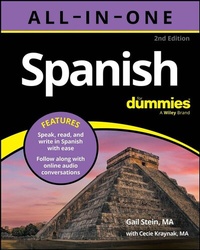
Spanish All-In-One For Dummies
Description

A comprehensive and actionable Spanish resource
Spanish All-In-One For Dummies, 2nd Edition walks you through a step-by-step roadmap of Spanish basics-including how to speak, write, and read Spanish in common, everyday situations.
This guide is packed with practice opportunities, online audio, and intuitively organized info you can use immediately as you improve your conversational Spanish. The book contains concrete and memorable lessons that stick-helping you apply what you've learned to real-world situations with ease.
Inside:
- Practice speaking, understanding, and writing Spanish with lots of examples
- Discover verb conjugation rules, sentence structures, and other grammar conventions
- Listen to Spanish conversations and work on your pronunciation
Perfect for Spanish students looking for an easy-to-follow reference to supplement their classroom learning, Spanish All-In-One For Dummies, 2nd Edition is also an essential resource for anyone who would like to brush up on their Spanish fundamentals.
More details
Other editions
Additional editions
Person
Gail Stein, MA, is a foreign language instructor who has more than 30 years' experience teaching in New York City public junior and senior high schools. She's the author of Spanish Essentials For Dummies and Spanish Workbook For Dummies.
Cecie Kraynak, MA, has more than 30 years' experience teaching Spanish. She has authored several Spanish titles in the For Dummies series.
Content
- Intro
- Title Page
- Copyright Page
- Table of Contents
- Introduction
- About This Book
- Icons Used in This Book
- Beyond This Book
- Where to Go from Here
- Book 1 Getting Started with Spanish
- Chapter 1 Sounding Like a Native Speaker
- Pronouncing Properly
- Voicing vowels
- Practicing diphthongs
- Verbalizing consonants
- Understanding Stress and Accent Marks
- Tackling Upside Down Punctuation
- Recognizing Cognates
- Using Almost Exact Cognates
- Nouns that end in -tion and -ción
- Nouns that end in -ary and -ario
- Adjectives that end -ic and -ico/a
- Adjectives that end in -ous and -oso/a
- Nouns that end in -ty and -dad
- Words that end in -ct and -cto
- Similar noun and adjectives
- Easily recognizable verbs
- Dropping that -e!
- Being Aware of False Amigos
- Chapter 2 Talking Numbers, Time, and the Weather
- Counting to Your Heart's Content
- Using cardinal numbers
- Getting sequential with ordinal numbers
- Telling Time
- Asking for and giving the time
- Exploring expressions of time
- Making Dates
- Naming the days of the week
- Naming the months and seasons
- Expressing dates
- Discussing the weather
- Chapter 3 Updating Your Personal Profile
- Expressing Greetings and Salutations
- Being formal
- Being informal
- Using ser versus estar
- Introducing Family Members
- Expressing Your Nationality
- Stating What You Do for a Living
- Uncovering Your Social Media Presence
- Getting physical: Describing yourself
- Asking how you identify
- Describing your personality
- Listing your likes
- Making Suggestions
- Forming the Let's Command
- Connecting on Social Media
- Chapter 4 Satisfying Your Appetite
- Getting Up to Speed on Table Talk
- Recognizing when you eat
- Making a restaurant reservation
- Sitting down at the table
- Ordering Your Meal
- Selecting a drink
- Starting with soup
- Choosing a salad
- Considering tapas
- Selecting your main course
- Ordering meats
- Considering fish and seafood
- Getting it done your way
- Selecting sides
- Making special requests
- Sending back food
- Finishing with desserts
- Satisfying your sweet tooth
- For fruit lovers
- Settling up
- Going to Specialty Stores
- Knowing Your Weights and Volumes
- Chapter 5 Shopping Until You Drop
- Identifying the Types of Stores
- Getting Help
- Shopping for Clothing and Footwear
- Figuring out what to buy
- Creating a colorful you
- Selecting certain fabrics
- Looking for designs and patterns
- Still searching
- Buying shoes
- Shopping at the Jewelry Store
- Buying Gifts and Souvenirs
- Sealing the Deal
- Chapter 6 Going Places: Planes, Trains, Taxis, & More
- Getting By at the Airport
- Before your flight
- In the air
- At arrivals
- Making your way through the airport
- Renting a Car
- Standing at the rental desk
- Dealing with problems
- Getting directions
- Using Public Transportation
- Using the bus
- Using the subway
- Using a taxi or rideshare
- Using the train farther away
- Cruising on the Open Seas
- Chapter 7 Finding a Place to Stay
- Checking In
- Considering Amenities, Facilities, and Services
- Addressing Special Needs
- Replacing Missing Items
- Knowing How to Handle Problems
- Eating Breakfast at Your Hotel
- Getting Help from the Concierge
- Checking Out ¡Hasta la Vista!
- Book 2 Grasping Basic Grammar
- Chapter 1 Flipping Through the Dictionary
- Getting to Know the Parts of Speech
- Nouns
- Articles
- Pronouns
- Verbs
- Adjectives
- Adverbs
- Prepositions
- Conjunctions
- Using a Bilingual Dictionary
- Chapter 2 Addressing Gender Issues
- Being Specific with Definite Articles
- Identifying the definite articles
- Using the definite articles
- Omitting definite articles
- Using contractions with definite articles
- Remaining neutral with lo
- Being General with Indefinite Articles
- Identifying the indefinite articles
- Omitting indefinite articles
- Being Demonstrative with Adjectives
- Explaining Gender
- Determining the gender of nouns
- Doing an about face with gender
- Using the same noun for both genders
- Changing the meaning of nouns
- Understanding special nouns
- Forming Plural Nouns
- Showing Possession
- Using de
- Employing possessive adjectives
- Chapter 3 Navigating Pronouns
- Getting the Lowdown on Subject Pronouns
- Meeting subject pronouns
- Applying subject pronouns
- Using tú versus Ud.
- Comparing vosotros (vosotras) versus Uds.
- Using él versus ella
- Utilizing ellos versus ellas
- Using nosotros (nosotras)
- Omitting subject pronouns
- Being inclusive
- Being Direct with Direct Object Pronouns
- Using Indirect Object Pronouns
- Picking the Right Object Pronoun for the Job
- Verbs requiring direct objects
- Verbs requiring indirect objects
- Putting Object Pronouns in Their Place
- Doubling Up with Object Pronouns
- Getting Particular with Demonstrative Pronouns
- Showing Possession with Pronouns Possessive
- Asking Questions with Interrogative Pronouns
- Understanding Reflexive Pronouns
- Focusing on Pronouns That Follow Prepositions
- Coping with Relative Pronouns
- Using que
- Selecting quien(es) and other forms
- Clarifying when there are two antecedents
- Using relative pronouns after prepositions
- Choosing lo que or lo cual
- Opting for cuyo (-a, -os, -as)
- Chapter 4 Dealing with the Here and Now: Present Tense Verbs
- Conjugating Verbs in the Present Tense
- Conjugating -ar verbs
- Conjugating -er verbs
- Conjugating -ir verbs
- Dealing with Irregulars
- Spelling-changing verbs
- Stem-changing verbs
- -ar stem changes
- -er stem changes
- -ir stem changes
- Stem change for verbs ending in -iar
- Stem change for verbs ending in -uar
- Stem change for verbs ending in -uir (not -guir)
- Verbs with spelling and stem changes
- Common verbs with irregular yo forms
- The irregular yo, tú, él (ella, Ud.), and ellos (ellas, Uds.) forms
- A few really irregular verbs
- Dealing with gustar and similar verbs
- Using gusta or gustan
- Addressing other verbs like gustar
- Noting some common, though irregular, expressions
- Common expressions that use dar
- Common expressions that use hacer
- Common expressions that use tener
- Common expressions using other verbs
- Chapter 5 Reflecting on Reflexive Verbs
- Grasping the Concept of Reflexive Verbs
- Enlisting the Aid of Reflexive Pronouns
- Doing More with Reflexive Verbs
- Reflexivity Not Always Required
- Putting Reflexive Pronouns in Their Places
- Chapter 6 Using the Present Progressive
- Focusing on Present Participles: It's an "ing" Thing
- Eyeing how present participles are used
- Turning regular verbs into present participles
- Tackling stem-changing and irregular verbs
- Expressing Progress with the Present Progressive
- Forming the present progressive
- Expressing ongoing action with other verbs
- Chapter 7 Spicing It Up with Adjectives and Adverbs
- Describing Stuff with Adjectives
- Changing an adjective's gender
- Focusing on adjective endings
- Noting exceptions to the rules
- Making adjectives plural
- Placing adjectives in the right spots
- Adjectives that follow the noun
- Adjectives that precede the noun
- Abbreviating your adjectives
- Describing Actions with Adverbs
- Forming adverbs
- Adverbial phrases
- Simple adverbs
- Adjectives versus adverbs: Choose wisely
- Keeping an eye on adverb placement
- Comparing Stuff
- Comparing equals
- Comparing inequalities
- The best: The superlative
- Even better: The absolute superlative
- Checking out the irregular comparatives
- Chapter 8 Asking Questions: Being Positive and Negative
- Facing the Spanish Inquisitions
- Asking yes/no questions
- Adjusting your intonation
- Deciphering the tags "¿No?" and "¿Verdad?"
- Flipping the word order
- Probing for information
- Using interrogative adjectives
- Using interrogative adverbs
- Using interrogative pronouns
- Yes, Sir/No, Ma'am: Answering Questions in Spanish
- Answering yes
- Answering no in oh so many ways
- Just plain "no"
- Ni . . . ni
- Nada and friends
- Ninguno
- Answering a positive question with a negative answer
- Answering information questions
- Making Exclamations
- Book 3 Mastering More Advanced Grammar
- Chapter 1 Understanding Prepositions and Conjunctions
- Meeting the Most Common Spanish Prepositions
- Telling the Difference between Prepositions
- Using a
- Utilizing de
- Using en and hasta
- Focusing on por and para
- Combining Prepositions with Infinitives
- Addressing a + infinitive
- Dealing with de + infinitive
- Tackling en + infinitive
- Eyeing con + infinitive
- Recognizing verbs that can stand alone
- Brushing Up on Prepositional Pronouns
- Connecting with Conjunctions
- Connecting equals - coordinating conjunctions
- Y (and)
- O (or)
- Ni (neither . . . nor)
- Pero (but)
- Sino (but)
- Comparing pero versus sino
- Que (that)
- Connecting subordinate clauses - subordinating conjunctions
- Apenas (as soon as)
- Así que, de modo que, de manera que (so that)
- Aunque (although)
- Como (like, as, since)
- Cuando (when)
- Luego (therefore)
- Mientras (while)
- Porque (because)
- Pues (then)
- Puesto que (since, as)
- Si (if)
- Identifying conjunctive expressions
- Chapter 2 Been There, Done That: Past (Preterit) Tense
- Conjugating Regular Verbs in the Preterit
- Regular -ar verbs
- Regular -er and -ir verbs
- Facing Some Irregularities
- Verbs with spelling changes
- Verbs ending in -car, -gar, and -zar
- Verbs that change -i to -y
- Verbs with stem changes
- Dealing with irregular verbs
- Verbs with i in the preterit stem
- Verbs with u in the preterit stem
- Verbs with -uv in the preterit stem
- Verbs with j in the preterit stem
- The preterit of dar and ver
- The preterit of ser and ir
- Using the Preterit
- Looking at Verbs That Change Meaning in the Preterit
- Chapter 3 Continuing in the Past with the Imperfect Tense
- Perfecting the Imperfect
- Knowing when to use the imperfect
- Forming the imperfect of regular verbs
- Conjugating -ar verbs
- Conjugating -er and -ir verbs
- Forming the imperfect of irregular verbs
- Comparing the Preterit and the Imperfect
- Finding Clues to the Preterit and the Imperfect
- Specifying a time period - the preterit
- Implying habitual action or repetition - the imperfect
- Chapter 4 Getting That Subjunctive Feeling
- Forming the Present Subjunctive
- Exploring regular verbs
- Working with irregular verbs
- Tackling verbs with spelling changes
- Working with verbs with stem changes
- Eyeing verbs with stem and spelling changes
- Addressing irregular verbs
- Spanning the Uses of the Present Subjunctive
- Using present subjunctive after impersonal expressions
- Using the present subjunctive to express wishing, emotion, need, and doubt
- Using present subjunctive after adjectives that express feelings or emotions
- Using present subjunctive in relative clauses
- Using present subjunctive after certain conjunctions
- Conjunctions of time
- Conjunctions of (un)certainty
- Avoiding present subjunctive
- Focusing On the Imperfect Subjunctive
- Forming the imperfect subjunctive of all verbs
- Using the imperfect subjunctive
- Using como si
- Using ojalá que
- Dreaming of possibilities with "if"
- Being polite
- Chapter 5 Being Bossy with the Imperative Mood
- Defining the Imperative Mood
- Forming Formal Commands
- Commanding with regular verbs and irregular yo form verbs
- Commanding with other verbs
- Verbs with spelling changes
- Verbs with stem changes
- Verbs with spelling and stem changes
- Irregular verbs
- Issuing Informal Commands
- Giving affirmative commands with tú
- Giving negative commands with tú
- Giving affirmative commands with vosotros
- Giving negative commands with vosotros
- Using Object Pronouns in Commands
- Focusing on single object pronouns
- Dealing with double object pronouns
- Chapter 6 Preparing for the Future and the Conditional
- Forming and Expressing the Future
- Discussing the future by using the present
- Using ir + a to express the near future
- Expressing the future tense
- Sending regular verbs to the future
- Sending irregular verbs to the future
- Using the Future Tense to Foretell, Predict, and Wonder
- Forming The Conditional Tense
- Creating the conditional of regular verbs
- Using the conditional
- Creating Conditional Sentences
- Chapter 7 Forming the Compound Tenses
- Laying the Groundwork
- Forming past participles of regular verbs
- Creating irregular past participles
- Forming the Present Perfect
- Tackling the Pluperfect
- Creating the Future Perfect and Conditional Perfect
- Forming the future perfect
- Forming the conditional perfect
- Using future perfect or conditional perfect? You decide
- Choosing the future perfect
- Choosing the conditional perfect
- Encountering the Present Perfect Subjunctive
- Forming the present perfect subjunctive
- Putting the present perfect subjunctive to good use
- Doubting the Past with the Pluperfect Subjunctive
- Forming the pluperfect subjunctive
- Putting the pluperfect subjunctive to work
- Chapter 8 Being Passive
- Defining the Passive Voice
- Focusing on the passive voice with ser
- Eyeing the passive voice in simple tenses and moods
- Using the passive voice in compound tenses and moods
- Avoiding the Passive Voice
- Book 4 Spanish at Work
- Chapter 1 Spanish for Domestic Workers
- Interviewing Applicants
- Greeting applicants
- Obtaining personal information
- Discussing experience and references
- Tackling salary and hours/days of employment
- Finishing the interview
- Accepting or rejecting the applicant
- Issuing General Directions
- Identifying the rooms in your casa
- Drawing attention to items
- Telling Your Employees What to Do
- Giving basic commands
- Providing specific cleaning instructions
- Sharing other important phrases
- Focusing on Cleaning
- Explaining the procedures
- Selecting cleaning supplies
- Recognizing Phrases for Renters
- Praising Your Employee
- Chapter 2 Spanish for Caregivers
- Interviewing a Nanny
- Starting off with greetings
- Getting personal and then some
- Verifying experience, duties, and references
- Explaining compensation
- Ending the interview
- Taking Care of Children
- Identifying baby and kid items
- Giving instructions
- Laying down the rules
- Caring for the Elderly
- Asking about their experience
- Describing the problem
- Explaining responsibilities and giving instructions
- Chapter 3 Spanish for Healthcare Workers
- Speaking at the Doctor's Office
- Setting appointments
- Being ready at registration
- Meeting the patient
- Recognizing symptoms
- Understanding a patient's history
- Administering vaccines
- Naming body parts
- Saying "aah": The physical exam
- Talking to your patients
- Ordering some tests
- Asking your patient questions
- Delivering your diagnosis
- Recommending treatment
- Referring patients to specialists
- Coping with emergencies
- Offering Care at the Dentist's Office
- Chapter 4 Spanish for Gardeners and Landscapers
- Using the Tools of the Trade
- Directing the Crew
- Mastering Lawn Care Lingo
- Mowing
- Watering
- Applying fertilizer and herbicides
- Spreading grass seed
- Laying sod
- An Abridged Version for Homeowners - Pointing Out Important Vocab
- Planting flowers
- Planting trees
- Giving simple instructions
- Asking easy questions
- Chapter 5 Spanish for Law Enforcement Pros
- Conducting an Investigation
- Introducing yourself
- Gathering basic information
- Getting an assailant's description
- Establishing locations
- Asking "What happened?"
- Serving as a witness
- Dealing with Traffic Violations
- Pulling over a driver
- Requesting a driver's information
- Explaining why you stopped the driver
- Chapter 6 Spanish for Educators and Administrators
- Admitting New Students
- Gathering personal information
- Establishing contact information
- Describing required school supplies
- Communicating with Students
- Communicating with Parents
- Praising your student
- Discussing a problem
- Calling parents at home
- Referring to school subjects
- Approaching the problem
- Handling issues and problems
- Chapter 7 Spanish for Office Managers
- Interviewing Job Candidates
- Identifying skills
- Checking previous positions
- Asking some key questions
- Explaining Compensation and Benefits
- Laying out the compensation
- How much?
- When?
- Describing lunchtimes and breaks
- Explaining vacations and sick days
- Vacation days
- Sick days
- Discussing health insurance and retirement plans
- Health insurance
- Retirement plans
- Describing Buildings, Furniture, Equipment, and Supplies
- Buildings and other key areas
- Office furniture, equipment, and supplies
- Furniture
- Equipment
- Supplies
- Training New Hires
- Mastering some useful expressions
- Issuing basic commands
- Chapter 8 Spanish for Hotel and Restaurant Personnel
- Using Spanish at Reception
- Getting some basic information
- Providing relevant details
- Instructing the Housekeeping Staff
- Stocking the cart
- Cleaning rooms
- Cleaning bathrooms
- Changing beds
- Restocking rooms and bathrooms
- Training the Laundry Room Staff
- Identifying key items
- Operating the washing machines
- Operating the dryers
- Pressing and folding items
- Communicating with the Kitchen Staff
- Identifying equipment and utensils
- Naming cooking and baking activities
- Recognizing common measurements
- Book 5 Appendixes
- Appendix A Spanish Verbs
- Regular Verbs
- -ar verbs
- trabajar (to work)
- -er verbs
- comer (to eat)
- -ir verbs
- abrir (to open)
- Stem-Changing Verbs
- -ar verbs
- pensar (e to ie) (to think)
- mostrar (o to ue) (to show)
- jugar (u to ue) (to play [a sport or game])
- -er verbs
- querer (e to ie) (to wish, want)
- volver (o to ue) (to return)
- -ir verbs
- pedir (e to i) (to ask)
- sentir (e to ie/i) (to feel)
- dormir (o to ue/u) (to sleep)
- -uir verbs (except -guir)
- construir (add y) (to construct, build)
- -eer verbs
- creer (add y) (to believe)
- -iar verbs
- guiar (i to í) (to guide)
- -uar verbs
- continuar (u to ú) (to continue)
- Spelling-Change Verbs
- -car verbs
- buscar (c to qu) (to look for)
- -gar verbs
- llegar (g to gu) (to arrive)
- -zar verbs
- lanzar (z to c) (to throw)
- Consonant + -cer or -cir verbs
- ejercer (c to z) (to exercise)
- esparcir (c to z) (to spread out)
- Vowel + -cer or -cir verbs
- conocer (c to zc) (to know)
- traducir (c to zc) (to translate)
- -ger or -gir verbs
- escoger (g to j) (to choose)
- dirigir (g to j) (to direct)
- -uir verbs
- distinguir (gu to g) (to distinguish)
- Irregular Verbs
- Appendix B Spanish-English Mini Dictionary
- Appendix C English-Spanish Mini Dictionary
- Appendix D Spanish Words That Change from Country to Country
- Index
- EULA
Chapter 1
Sounding Like a Native Speaker
IN THIS CHAPTER
Getting a handle on vowels, diphthongs, and consonants
Dealing with stress and accent marks
Identifying words that are the same in English and Spanish
Recognizing words that are very similar
Avoiding falling into traps
Some people can pick up a foreign language and sound like a native with minimal effort, whereas others struggle to lose their hometown accent. The fortunate ones can imitate the Spanish speakers they've heard in their neighborhood, on TV, in the movies, or on a You Tube broadcast. If you're not among those lucky ones, and don't have a good ear for language, this chapter gives you the practice you need to perfect your pronunciation.
This chapter also presents Spanish words that you already know: words that English has borrowed from the Spanish. Surprisingly, your everyday vocabulary is filled with words that are the same, or almost the same, in both languages. You may realize that you already know quite a bit of Spanish - you just have to pronounce the words a bit differently.
Pronouncing Properly
Naturally, when you speak Spanish, you want to sound as authentic as possible. The good news is that Spanish is quite easy to pronounce because it's a very phonetic language. What does that mean? Simply say each word exactly as you see it and put on your best Spanish accent. Chances are you'll sound more like a native than you could imagine.
The Spanish alphabet contains all the letters of the English alphabet plus ñ, which follows the letter n. In 2010, the Royal Spanish Academy (Real Academia de la Lengua Española) removed the letters ch and ll, that were previously considered part of the alphabet.
(Track 1) This track gives you the chance to practice Spanish sounds. You'll hear each letter of the alphabet in English followed by its pronunciation in Spanish.
To lay a strong foundation for learning Spanish, read the following sections that discuss the correct ways to pronounce vowels, diphthongs, vowel combinations, and consonants.
Voicing vowels
Unlike in English, each Spanish vowel is pronounced consistently. Table 1-1 gives you a breakdown to help you start.
TABLE 1-1 Pronouncing Vowels
Vowel
English Sound
Spanish Example
a
ah as in spa
papa (pah-pah) (potato)
e
eh as in red
ella (eh-yah) (she)
i
ee as in key
idea (ee-deh-yah) (idea)
o
oh as in no
ojo (oh-hoh) (eye)
u
oo as in do
uno (oo-noh) (one)
Practicing diphthongs
It gets a little tricky when you confront diphthongs, or a combinations of two vowels. Table 1-2 can help put your concerns to rest.
TABLE 1-2 Pronouncing Diphthongs
Diphthongs
English Sound
Spanish Example
ae, ai, ay
ah-eh (ay) as in eye
aeropuerto (ah-eh-roh-poo-ehr-toh) (airport)
aire (ah-eh-reh) (air)
ayuda (ah-eh-oo-dah) (help)
au
ah-oh (ow) as in owl
autor (ah-oh-tohr) (author)
ea
eh-ah
fea (feh-ah) (ugly)
ei, ey
a as in day
seis (seh-ees) (six)
rey (rreh) (king)
eo
eh-oh
leo (leh-oh) (I read)
eu
eh-oo
Europa (eh-oo-roh-pah) (Europe)
ia
ee-ah
seria (seh-ree-ah) (serious)
ie
ee-eh
siete (see-eh-teh) (seven)
io
ee-oh
avión (ah-bee-ohn) (airplane)
iu
ee-oo
ciudad (see-oo-dahd) (city)
oa, ua
oo-ah (wah) as in watch
toalla (toh-ah-yah) (towel)
agua (ah-goo-ah) (water)
oe, ue
oh-eh (weh) as in wet
oeste (oh-ehs-teh) (west)
cuento (koo-ehn-toh) (short story)
oi, oy
oh-ee (oy) as in boy
oigo (oh-ee-goh) (I hear)
soy (soh-ee) (I am)
ui, uy
oo-ee (we) as in we
cuido (koo-ee-doh) (I take care of)
muy (moo-ee) (very)
uo
oo-oh as in woe
cuota (koo-oh-tah) (quota)
Verbalizing consonants
Consonants are a snap to master because most are pronounced exactly the same as they are in English. They are: b, d, f, k, l, m, n, p, s, t, w, y. Note the exceptions in Table 1-3:
TABLE 1-3 Pronouncing Consonants
Consonant
English Sound
Spanish Example
c
s before e and i (s in Latin America and th in Spain.
k elsewhere
centro (sehn-troh) (thehn-troh) (downtown)
cinco (seen-koh) (theen-koh) (five)
casa (kah-sah) (house)
g
h before e and i
hard g elsewhere
gente (hehn-teh) (people)
gira (hee-rah) (tour)
gordo (gohr-doh) (fat)
h
silent
hora (oh-rah) (hour)
j
h
junto (hoon-toh) (together)
ll
y
llama (yah-mah) (llama)
ñ
ni as in onion
niño (nee-nyoh) (boy)
r
slightly rolled r
oro (oh-roh) (gold)
rr
rolled 2 or 3 times
at beginning of word
after l, n, or s
carro (kah-rroh) (car)
rico (rree-koh) (rich)
alrededor (ahl-rreh-deh-dohr) (around)
Enrique (ehn-rree-keh) (Henry)
Israel (ees-rrah-ehl) (Israel)
v
similar to b
vaca (bah-kah) (cow)
x
s followed by a consonant
ks followed by a vowel
extra (ehs-trah) (extra)
exacto (ehk-sahk-toh) (exact)
z
th in Spain
s in Spanish America
zoo (thoh) (zoo)
zoo (soh)
In Spain the consonant z is like the English th as in them. The letter k is used only in words of foreign origin.
Understanding Stress and Accent Marks
In Spanish, words are pronounced just like they sound. Take note of the following...
