

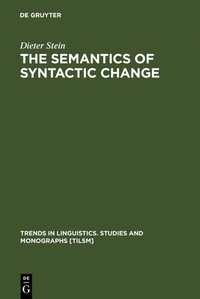
The Semantics of Syntactic Change
Aspects of the Evolution of 'do' in English
1st Edition
Published on 1. June 2011
XIII, 444 pages
978-3-11-084682-9 (ISBN)
Description

No detailed description available for "The Semantics of Syntactic Change".
More details
Series
Edition
Reprint 2011
Language
English
Place of publication
Berlin/Boston
Germany
Publishing group
de Gruyter Mouton
Target group
Professional and scholarly
US School Grade: College Graduate Student
Illustrations
Num. tabs., 32 s/w Abbildungen
32 b/w ill.Num. tabs.
File size
15,95 MB
ISBN-13
978-3-11-084682-9 (9783110846829)
Schweitzer Classification
Other editions
Additional editions
Book
09/1990
1st Edition
De Gruyter Mouton
€139.95
Shipment within 7-9 days
Content
- Intro
- Preface
- List of abbreviations
- Chapter One: Introduction
- 1. Theoretical motivation
- 2. Why re-study the development of do?
- 3. Theories and data
- 4. Heterogeneity of explanatory dimensions
- 5. Structure of presentation
- Chapter Two: Do up to the fifteenth century
- 1. Phases of do development
- 2. The origin of "meaningless periphrastic do"
- 3. Do in the Paston letters (1422-1509)
- 4. The democratization of do: a speculation
- Chapter Three: Do and discourse structure
- 1. Do as a marker of discourse-semantic prominence
- 2. Saliency and foregrounding
- 3. Foreground and contrastiveness
- 4. Local foreground structure markers
- Chapter Four: Syntax and style in the sixteenth century
- 1. Do in the sixteenth century: the quantitative problem
- 2. Standard and prose style
- 3. Main stylistic currents
- 4. Relevant stylistic structures
- 5. Imitating Latin syntax
- 6. Antithesis
- Chapter Five: The semantics of do in the fifteenth and sixteenth centuries
- 1. Analysis of a pamphlet (1521)
- 2. Authority
- 3. Rhetoric and foreground
- 4. Rhetorical questions
- 5. Negation
- 6. Intensity
- 7. Performatives, speech act verbs, and verbs of perception
- 8. Logical relationships
- 9. Standardization and synonyms
- Chapter Six: Unity and diversity: style, dialect and the semantics of do before 1600
- 1. Use and semantics
- 2. Syntactic versus semantic explanation
- 3. Do as a marker of courtly speech
- 4. Do in low texts
- 5. The demise of courtly do
- 6. A case study: Early American letters
- 7. Semantic, stylistic and dialectal diversity, and German tun
- 8. Methodological considerations
- Chapter Seven: Do in the Shakespeare corpus
- 1. An initial hypothesis
- 1.1. The problem
- 1.2. The phonotactics and frequency of thou + st
- 1.3. Methodological advantages of the Shakespeare corpus
- 2. Subcategorizations and terminological conventions
- 3. Phonotactics and periphrasis frequency
- 3.1. Differences between person and tense categories
- 3.2. Differences between phonetically defined types of verb stems in the present
- 3.3. Differences between syntactic contexts in the present
- 3.4. Generalization in the present from thou + you
- 4. Diachronic interpretation of the synchronic pattern
- 4.1. Analysis of the preterite and diachronic interpretation of the subcategorical pattern
- 4.2. Stability of the variational pattern
- 5. Further strategies of avoiding (d)st
- 6. Negatives
- Chapter Eight: Do in questions in the sixteenth and seventeenth centuries: the statistical evidence
- 1. Methodological considerations
- 2. Corpora analyzed
- 3. From raw data to indices: an example
- 4. Periphrasis frequency in questions in the sixteenth and seventeenth centuries: the evidence
- Chapter Nine: The mechanics of generalization
- 1. Individual utterance versus system
- 2. Naturalness and isolect
- 3. Micro-structure of generalization I
- 4. Rhetorical and other questions
- 5. Micro-structure of generalization II
- 6. Frequency and residuals
- 7. Poetic uses
- Chapter Ten: Third singular morphology and syntax
- 1. Inflectional ending and verbal syntax
- 2. The transition from th to s
- 3. The phonotactic factor
- 4. Parallels between third singular and do development
- Chapter Eleven: Subjunctive
- 1. Overview and purpose
- 2. Historical development of subjunctive marking
- 3. The structure of subjunctive marking in Early Modern English
- 4. The inflectional motivation of subjunctive marking
- 5. Do in subjunctives
- Chapter Twelve: Wh-questions
- 1. Motivations for analyzing wh-questions
- 2. Empirical data
- 3. Results
- 4. Interpretation
- 5. Dimensions of directionality
- Chapter Thirteen: Natural and social aspects
- 1. The semantic unity of do uses
- 1.1. The rise of epistemic do
- 1.2. Do in negation
- 1.3. Exclamatives
- 1.4. Emphatic do
- 1.5. Typology and grammaticalization
- 1.6. Semantics of do and inversion
- 1.7. Further word-order factors
- 2. Natural tendencies
- 2.1. Motivations for naturalness
- 2.2. Natural tendencies in the development of do
- 3. Semantic directionality: subjectivization
- 4. Social and varietal aspects
- 4.1. Do and written standard
- 4.2. The diversity of do meanings
- 4.3. Order and grammar
- 4.4. Medium and meanings of do
- 4.5.The unfashionableness of thou
- Conclusion
- Appendices
- Bibliography
- Index
