

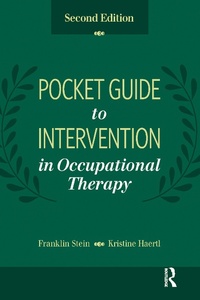
Pocket Guide to Intervention in Occupational Therapy
2nd Edition
Published on 1. June 2024
394 pages
978-1-040-13868-7 (ISBN)
Description

Pocket Guide to Intervention in Occupational Therapy, Second Edition builds upon the strengths of the first edition as a useful quick reference of occupational therapy terms and interventions regarding specific diagnoses and conditions.
Occupational therapy is an evidence-based health care profession that uses scientifically based research to justify clinical practice. Interventions in hospitals, clinics, and community and school settings continue to evolve based on scientific evidence. These interventions are intended to prevent injury and maintain or improve client function.
Pocket Guide to Intervention in Occupational Therapy, Second Edition by Dr. Franklin Stein and Dr. Kristine Haertl is organized around the major conditions that occupational therapists encounter in their everyday practice. These include physical, psychosocial, cognitive, geriatric, and pediatric diagnoses. Intervention guidelines are outlined for the major disabilities. In addition, there are brief descriptions of the intervention techniques that therapists use and definitions of terms that are relevant to interventions.
Intervention techniques encompass the following:
Non-medical techniques such as client health education or counseling
Instruction in activities of daily living, modifying of environment such as in ergonomics
Teaching and demonstrating arts and crafts as therapeutic activities
Providing sensory stimulating activities especially for children
The appendices include an outline of essential skills for occupational therapists, general developmental guidelines, an overview of muscles and movements, orthotic devices, tables of muscles, average range of motion measurements, prime movers for upper and selected lower extremity motions, and substitutions for muscle contractions.
Pocket Guide to Intervention in Occupational Therapy, Second Edition is based on the latest scientific evidence garnered from recent research studies, meta-analyses, scoping reviews, occupational therapy textbooks and their own wide experiences as a clinician, professor and researcher.
Occupational therapy is an evidence-based health care profession that uses scientifically based research to justify clinical practice. Interventions in hospitals, clinics, and community and school settings continue to evolve based on scientific evidence. These interventions are intended to prevent injury and maintain or improve client function.
Pocket Guide to Intervention in Occupational Therapy, Second Edition by Dr. Franklin Stein and Dr. Kristine Haertl is organized around the major conditions that occupational therapists encounter in their everyday practice. These include physical, psychosocial, cognitive, geriatric, and pediatric diagnoses. Intervention guidelines are outlined for the major disabilities. In addition, there are brief descriptions of the intervention techniques that therapists use and definitions of terms that are relevant to interventions.
Intervention techniques encompass the following:
Non-medical techniques such as client health education or counseling
Instruction in activities of daily living, modifying of environment such as in ergonomics
Teaching and demonstrating arts and crafts as therapeutic activities
Providing sensory stimulating activities especially for children
The appendices include an outline of essential skills for occupational therapists, general developmental guidelines, an overview of muscles and movements, orthotic devices, tables of muscles, average range of motion measurements, prime movers for upper and selected lower extremity motions, and substitutions for muscle contractions.
Pocket Guide to Intervention in Occupational Therapy, Second Edition is based on the latest scientific evidence garnered from recent research studies, meta-analyses, scoping reviews, occupational therapy textbooks and their own wide experiences as a clinician, professor and researcher.
More details
Edition
2nd edition
Language
English
Place of publication
London
United Kingdom
Publishing group
Taylor & Francis Ltd
Target group
College/higher education
Professional and scholarly
ISBN-13
978-1-040-13868-7 (9781040138687)
Copyright in bibliographic data and cover images is held by Nielsen Book Services Limited or by the publishers or by their respective licensors: all rights reserved.
Schweitzer Classification
Other editions
Additional editions
Franklin Stein | Kristine Haertl
Pocket Guide to Intervention in Occupational Therapy
Book
11/2024
2nd Edition
Routledge
€215.40
Shipment within 10-20 days
Franklin Stein | Kristine Haertl
Pocket Guide to Intervention in Occupational Therapy
Book
05/2019
2nd Edition
SLACK Incorporated
€91.60
Shipment within 3-4 weeks
Persons
Franklin Stein, PhD, OTR/L, FAOTA is currently Professor Emeritus of Occupational Therapy at the University of South Dakota in Vermillion, founding editor of Annals of International Occupational Therapy, and life member of the American Psychological Association. Previously, he was the Director of the School of Medical Rehabilitation at the University of Manitoba in Winnipeg, Canada, Director of the Occupational Therapy Program at the University of Wisconsin, Milwaukee, and Associate Professor, Graduate Division at Sargent College, Boston, Massachusetts. He is the first author of the textbook Clinical Research in Occupational Therapy, Fifth Edition (2013) with Martin Rice and Susan Cutler; Occupational Therapy and Ergonomics (2006) with Ingrid Soderback, Susan Cutler, and Barbara Larson; Psychosocial Occupational Therapy: A Holistic Approach, Second Edition (2002) with Susan Cutler; Pocket Guide to Treatment in Occupational Therapy (2000) with Becky Roose; and Stress Management Questionnaire (2003), plus over 50 publications in journals and books related to rehabilitation and psychosocial research. He has also presented more than 100 seminars, workshops, institutes, short courses, and research papers at national and international conferences.
Kristine Haertl, PhD, OTR/L, FAOTA is a professor in the Department of Occupational Therapy at St. Catherine University in St. Paul, Minnesota. She is an academician and practitioner in the areas of developmental disabilities, psychiatric practice, and occupational science. Dr. Haertl has been active in mental health research related to peer-supported mental health housing models and exploration of the nature and efficacy of services at a freestanding psychiatric occupational therapy clinic. Her research has led to legislative changes regarding evidenced-based mental health practice in Minnesota and has helped secure funding for the development of Fairweather housing units in Pennsylvania. In addition to full-time faculty work, Dr. Haertl has served as the chairperson of a large mental health board in Minnesota and maintains a private practice, serving persons with psychiatric disorders and developmental disabilities. She has over 50 academic publications including her book, Adults With Intellectual and Developmental Disabilities: Strategies for Occupational Therapy (2014), and over 100 presentations nationally and internationally. She has received a number of awards in areas related to fitness, occupational therapy, and mental health service.
Kristine Haertl, PhD, OTR/L, FAOTA is a professor in the Department of Occupational Therapy at St. Catherine University in St. Paul, Minnesota. She is an academician and practitioner in the areas of developmental disabilities, psychiatric practice, and occupational science. Dr. Haertl has been active in mental health research related to peer-supported mental health housing models and exploration of the nature and efficacy of services at a freestanding psychiatric occupational therapy clinic. Her research has led to legislative changes regarding evidenced-based mental health practice in Minnesota and has helped secure funding for the development of Fairweather housing units in Pennsylvania. In addition to full-time faculty work, Dr. Haertl has served as the chairperson of a large mental health board in Minnesota and maintains a private practice, serving persons with psychiatric disorders and developmental disabilities. She has over 50 academic publications including her book, Adults With Intellectual and Developmental Disabilities: Strategies for Occupational Therapy (2014), and over 100 presentations nationally and internationally. She has received a number of awards in areas related to fitness, occupational therapy, and mental health service.
Content
Dedication Acknowledgments About the AuthorsPrefaceMajor Terms and InterventionsAlzheimer's DiseaseAmputationAmyotrophic Lateral Sclerosis (ALS)Anorexia NervosaAntisocial Personality DisorderAnxiety DisordersAphasiaAttention Deficit Disorder (ADD)/Attention Deficit Hyperactivity Disorder (ADHD)AutismBipolar DisorderBlindnessBorderline Personality DisorderBurnsCancerCardiac Disease/Cardiac DysfunctionCarpal Tunnel SyndromeCerebral Palsy (CP)Cerebrovascular Accident (CVA)Chronic Obstructive Pulmonary Disease (COPD)Cognitive-Perceptual DeficitsConduct DisordersDepressionDown SyndromeDuchenne Muscular DystrophyEdemaGuillain-Barre SyndromeHand InjuriesLearning Disability/Specific Learning DisorderLow Back Pain (LBP)Motor Control Multiple Sclerosis (MS)Myasthenia GravisOsteoarthritisParkinson's DiseasePost-Polio SyndromeRheumatoid ArthritisSchizophreniaSensory DeficitsSpinal Cord InjuryTraumatic Brain InjuryWeakness?ReferencesAppendix A: Ten Essential Clinical Skills for Occupational TherapistsAppendix B: Commonly Used Medical AbbreviationsAppendix C: Developmental Milestones: Birth to 5 YearsAppendix D: Orthotics and Orthoses Exoskeletal or External Devices to Limit or Assist Motion in Joints of BodyAppendix E: Table of MusclesAppendix F: Average Range of Motion MeasurementsAppendix G: Prime Movers for Upper and Selected Lower Extremity MotionsAppendix H: Substitutions for Muscle ContractionAppendix I: Health Organization Web Resources
